
12 CITY CORPORATIONS OPERATE ON JUST TK 230B ANNUAL BUDGET: PRI STUDY
Cities host most BD economic activities, but run on poor funding
FE REPORT | Friday, 19 September 2025
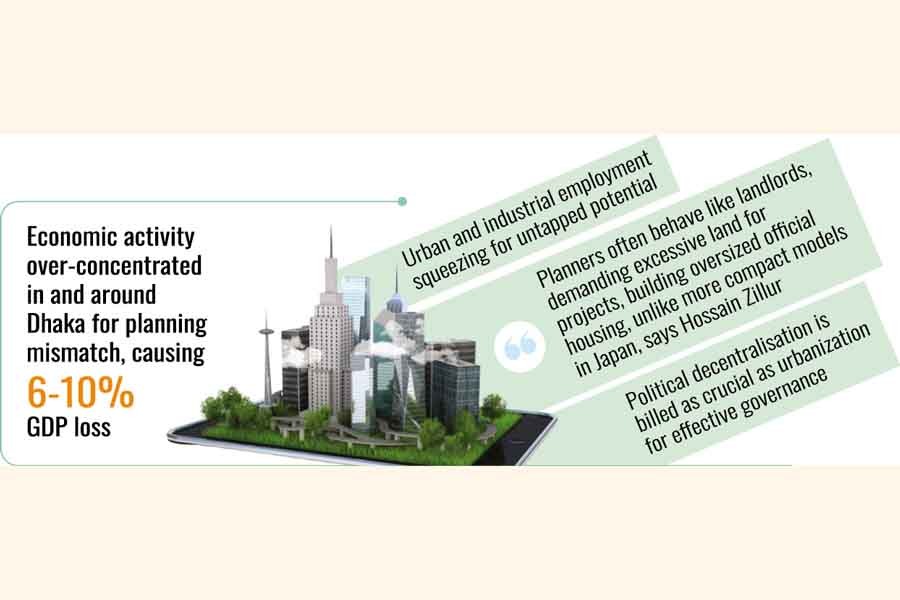
 Bangladesh's 12 city corporations operate on an aggregate annual budget of just Tk 230 billion despite hosting over half of the country's economic activities with overconcentration in and around Dhaka.
A study by the Policy Research Institute of Bangladesh (PRI) attributes such development flaws to inefficient urbanisation, driven by poor planning, coordination, and resource allocation, which makes the country count an estimated GDP loss of 6-10 per cent.
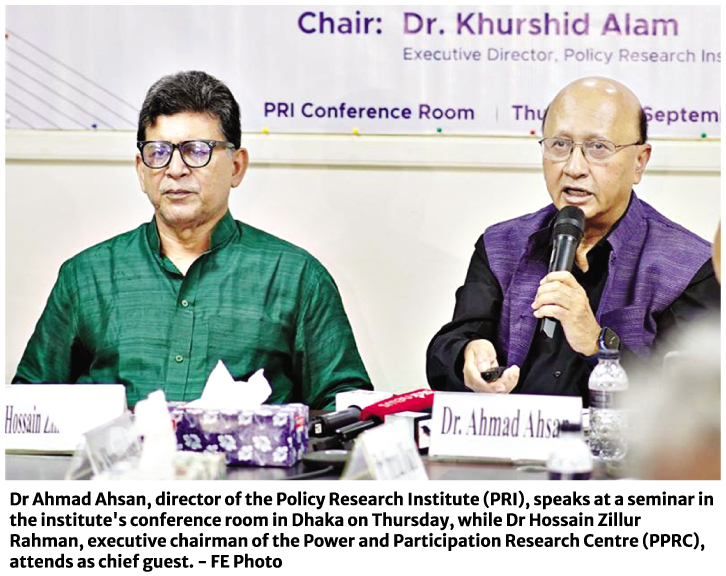
Dr Ahmad Ahsan, Director of PRI, presented the findings at a seminar on 'Urbanisation and Bangladesh's Development: Selected Findings from BIDS-PRI Research' Thursday in the institute's conference room.
Dr Hossain Zillur Rahman, Executive Chairman of the Power and Participation Research Centre (PPRC), attended as chief guest while experts and economists spoke at the event chaired by Dr Khurshid Alam, Executive Director of PRI.
The study has mentioned that weak revenue mobilisation by urban local- government bodies constrains their spending capacity. Property and transfer taxes from Dhaka and Chattogram account for just 0.13 per cent and 0.06 per cent respectively of GDP, underscoring severe fiscal shortfalls.
The study report also warns that Bangladesh is showing red flags in economic development amid rapid urbanisation, with urban employment growth falling from 4.0 per cent in 2010-2017 to just 0.8 per cent in the following period, while urban industrial employment slipped into negative territory.
Dr Hossain Zillur Rahman called for research on data quality, policy cycles, interest-group influence, meaningful decentralisation, district-town revival, and efficient urban land use as remedial measures.
"Effective city management demands specialised expertise and robust governance at all levels," the economist told the meet.
Pointing to Bangladesh's land scarcity, he notes planners "often behave like landlords", demanding excessive land for projects and building oversized official housing, unlike more compact models in Japan.
He stresses that political decentralisation is as crucial as urbanisation, but discussions on power devolution rarely reach policy tables.
"Dhaka remains the country's only functional city, while Chattogram is losing significance after the relocation of railway and naval headquarters," he said, adding that district schools used to anchor towns, but now even union chairmen do not live in their villages.
Dr Khurshid Alam said Dhaka's growth was unplanned and reactive, with policies constantly trying to catch up with realities.
The concentration of facilities in Dhaka has made both citizens and institutions reluctant to relocate, he added.
Dr Imran Matin, Executive Director of BRAC Institute of Governance and Development (BIGD), cited the costly 'missing middle' dynamics where resources bypass second-tier cities and flow directly to more rural areas.
He called for harnessing knowledge outside Dhaka and ensuring citizen participation in city governance.
Dr Ashikur Rahman, Principal Economist of PRI, argues that the city-development authorities in the country are designed to weaken city corporations and centralize power.
Presenting the keynote Dr Ahsan said while urbanization had long been a driver of growth, the current Dhaka-centric pattern was proving unsustainable.
"Excessive concentration of people and economic activity in the capital-together with congestion, pollution, and diversion of resources from other urban centres-was sharply hampering development, slowing job creation, reducing industrial employment, and causing economic losses."
Although some relocation of people and industries is occurring outside Dhaka, this largely bypasses secondary cities and instead shifts to smaller towns and rural areas, undermining the benefits of urbanization and weakening long-term growth prospects, the paper reveals.
"The poor state of urban services-water supply, sanitation, waste management, health, and education-was cited as a central constraint, with Gazipur highlighted as an example of industrial dynamism coexisting with poor welfare for workers," said Dr Ahsan.
The PRI study attributes these challenges to the absence of a National Policy on Urbanisation, the lack of a dedicated ministry, and fragmented governance between elected city leaders, central agencies, and line ministries, leaving plans ineffective or ignored.
The institute has emphasized the need for unified, decentralized city governments with authority and resources to operate transparently and accountably.
The study also points to strategic opportunities, including Chattogram's port and regional development and the Khulna bypass corridor, as priorities to restore urban dynamism and drive Bangladesh's next phase of growth.
Officials have said that the event was the first in PRI's two-part talk series. The next seminar will feature Dr Ahmad Ahsan speaking on 'Can Bangladesh Develop without Decentralizing?'
jahid.rn@gmail.com