
Climate pressures slow farm productivity
FE REPORT | Wednesday, 3 December 2025
Bangladesh's long-standing gains in agricultural productivity are beginning to lose momentum as climate stresses, rising input costs and shrinking arable land erode farmers' profitability.
A new study by the Bangladesh Institute of Development Studies (BIDS) warns that the country's agrifood system, employing nearly half of the labour force, is increasingly constrained by slowing yield improvements and diminishing returns from intensive input use.
Presented at a dissemination seminar on Tuesday, the study, Perspectives on the Agrifood System in Bangladesh, shows that total factor productivity (TFP) growth has levelled off after years of robust expansion.
Researchers argue that without stronger diversification, improved technologies and better risk management, the sector faces mounting sustainability challenges.
Senior officials and experts attending the event emphasised that climate variability, weak market structures and inconsistent agricultural data are exacerbating the slowdown, calling for urgent reforms to protect future food security.
The findings were presented by Dr Mohammad Yunus, Research Director at BIDS, at a dissemination seminar held at the institute's auditorium.
SM Shakil Akhter, Secretary of the Planning Division, attended as chief guest, with BIDS Director General Professor AK Enamul Haque presiding.
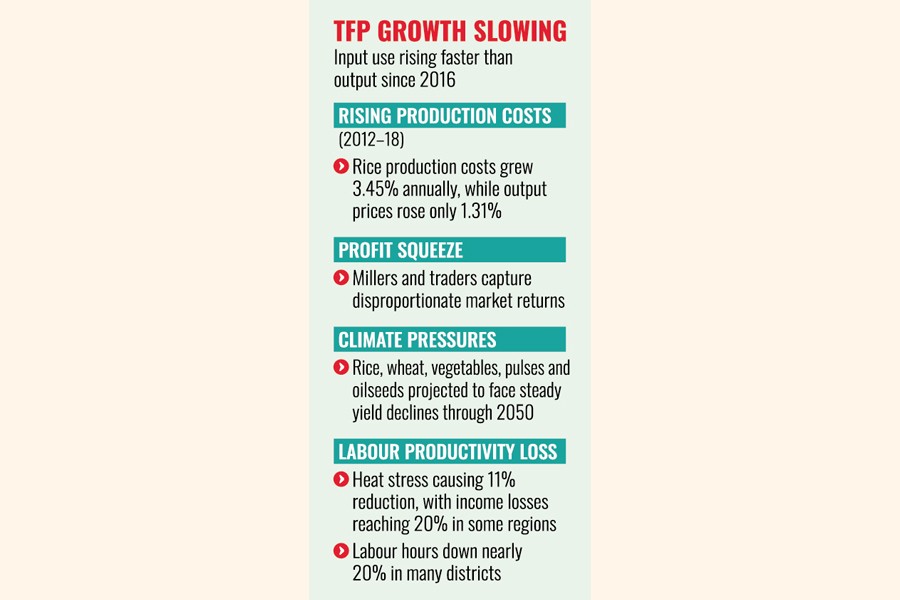
Dr Yunus said rice production costs rose by 3.45 per cent annually between 2012 and 2018, while output prices increased by only 1.31 per cent per year, squeezing farmers' profitability.
He attributed weak price realisation largely to the oligopolistic structure of the rice market, where millers and traders capture a disproportionate share of returns.
The study shows that TFP growth declined between 2016 and 2021 as input use grew faster than output, signalling diminishing returns to traditional intensification.
Although there was some recovery in 2019-21, the sector remains heavily dependent on input-intensive practices that raise sustainability concerns.
The paper notes that Bangladesh achieved rapid land and labour productivity gains during the 2000s, but the momentum has slowed due to weaker yield improvements, rising production costs and shrinking arable land.
Climate variability is becoming one of the strongest headwinds, it added.
Highlighting results from long-term modelling, Dr Yunus said rising temperatures and erratic rainfall are already affecting rice, wheat, vegetable, pulse and oilseed yields, which are projected to decline steadily through 2050.
Heat stress has emerged as a major constraint on agricultural labour, contributing to about an 11 per cent reduction in labour productivity and up to a 20 per cent income loss in some regions.
He said structural weaknesses continue to limit agricultural transformation, particularly the dominance of rice, which occupies more than 80 per cent of the gross cropped area.
This restricts diversification into higher-value crops. Inadequate technologies for non-rice crops, weak water management and limited post-harvest support further hinder diversification efforts.
Yet livestock, poultry and aquaculture have shown strong growth, with fish, meat, milk and egg production rising significantly in recent years. Total fish output reached 4.76 million tonnes in FY22, driven mainly by inland aquaculture, said Dr Yunus.
Despite these gains, Bangladesh remains highly dependent on imports of wheat, pulses, edible oil, dairy and several other foods, leaving it exposed to global price volatility.
Research cited at the seminar shows that in many districts, agricultural labour hours have fallen by nearly 20 per cent due to heatwaves, which delay land preparation and inflate labour costs.
Long-term projections indicate that Boro rice production may fall by up to 8 per cent between 2030 and 2050 unless climate-resilient, water-saving and salinity-tolerant varieties are widely adopted.
Excessive and imbalanced use of fertiliser and pesticide is degrading soil health and raising the risk of groundwater contamination, it added.
Planning Secretary SM Shakil Akhter said Bangladesh's agricultural data system suffers from significant inconsistencies. Production data from BBS and DAE often differ even when both institutions operate in the same areas, undermining reliability.
He added that although large agricultural projects are taken up every year, the number actually completed remains unclear.
Many projects experience unnecessary cost escalation and stall after one phase ends, he said.
Professor Enamul Haque noted that value addition in agriculture has doubled from 12 per cent to 24 per cent, contributing to poverty reduction across multiple crops.
However, in regulated markets such as rice, poverty-reduction effects remain limited because price controls keep farmer margins low, he added.
The BIDS Director General also said many farmers, facing low profitability, are increasingly shifting to contract farming.
Rising urea consumption has raised concerns about potential health and environmental impacts, though evidence remains inconclusive.
He added that adoption of water-saving technologies such as Alternate Wetting and Drying remains low because farmers perceive them as costlier.
jahid.rn@gmail.com