
Closer China-Taiwan ties: A US nightmare?
Tanbir Uddin Arman | Thursday, 27 February 2014
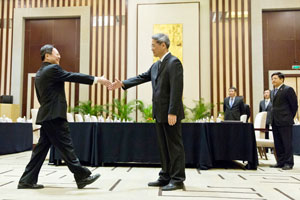
China and Taiwan held on February 11 their first-ever 'historic' talks since they split six decades ago. The talks are expected to produce some concrete results for easing the stand-off between the two sides since the end of the civil war in 1949. Chiang Kai-Shek and his nationalist Kuomintang party (KMT) fled to China's Taiwan, an island, upon being defeated by Mao's Communist surge in 1949. KMT ruled Taiwan from 1949 to 2000, and they believed that the island would eventually be reunited with the mainland.
But with the passage of time, an anti-reunification sentiment had eventually begun to take root in the predominantly ethnic Taiwanese, mainly because of the KMT's discriminatory behaviour towards them, and with the advent of their Taiwanese Democratic Progressive Party in 1986. During his presidency from 2000 to 2008, the Democratic Progressive Party leader Chen Shui Bian envisioned an independent Taiwan, which would be separated from the mainland China's dominance. He emphasised Taiwanese sovereignty as the most priority issue on the party's political agenda.
Taiwan's relations with mainland China have largely been eased with the KMT's return to power in Taiwan in 2008. The uninterrupted efforts by President Ma Ying-Jeou, who has long been backing Taiwan's unification with the mainland for a long time, have resulted in the February 11 China-Taiwan talks. The meeting is a landmark event in cross-strait relations between the two sides.
Taiwan is focused on securing economic benefits and security assurances rather than immediate unification with the mainland. Most of the Taiwanese want to improve their relations with China for improving business interest besides being assured of security.
In January-December, 2013, trade volume between mainland China and Taiwan reached US$ 197.28 billion from US$ 102 billion in 2007 as per the report of the Ministry of Commerce of the People's Republic of China. Taiwan is now China's seventh-largest trading partner and fifth-largest source of import. In 2009, Taiwan opened up one hundred of its industries to mainland investments.
China and Taiwan have agreed on allowing banks, insurances and other financial services on both sides' markets. President Ma Ying-Jeo of Taiwan has called for further development of cultural and educational exchanges with China through continuing the conciliatory approach to the mainland.
Moreover, Taiwan's geographical location plays a significant strategic role for China in undermining US maritime dominance and its naval base establishments in Southeast Asia and the Pacific region. China has now about 300-400 missiles, having the range of 120 nautical miles, facing Taiwan, in order to counter any potential threat posed by the US. Besides, it has 60 to 70 submarines in the area and strong air defence forces.
The geographical location of Taiwan entices the US to make it a strategic partner in order to defend its strategic interests vis-à-vis China. During the Cold War period, the US and Taiwan agreed on 'Taiwan Relations Act', mainly to serve two purposes: first, combating the rise of communism and expediting aid in the spread of globalisation and capitalism; secondly, the Act declared that if any outside nation attacked Taiwan, the US should come to its defence. Even though the Act had lost some of its relevance with the decline of Cold War in the 1990s, maintaining amicable ties with the Taiwanese island has hitherto been a strategic necessity for the US with a view to keeping its influence unharmed in Southeast Asia and the Pacific region and defending its allies - Japan, South Korea and the Philippines. America's Taiwan policy has long been emphasising Taiwanese independence as the US fears about the possibility that the unification of Taiwan would force American interests to fall into the hands of the Chinese Communists.
China, which has improved its relations with Taiwan over the past years and wants to keep the island under its jurisdiction, has already warned that it will react with its nuclear weapons if any intervention is made by the US in China-Taiwan internal affairs and if the US pursues further attempts at provoking Taiwanese independence.
One might say that the situation would make the US either lose, to a significant extent, its strategic interests in the region or take it to a military confrontation with China that would result in a major war.
The writer is a student of the Department of International Relations, University of Dhaka. tanbirarman30@gmail.com