
Clouds gather over Pahela Baishakh celebration
Shihab Sarkar | Friday, 24 April 2015
At long last, we appear to have driven another nail into the coffin of Pahela Baishakh celebration in Dhaka. A streak of self-destruction is perhaps at work within us. Only a nation gleefully oblivious of its many achievements can spoil its identity so brazenly. Sexual harassment of women has lately joined the many offences that go with mass-scale festivities these days. Given the organised form adopted to commit it, the villainy committed on last April 14 has assumed the proportions of a 'planned demonstration' of depravity. It had something highly sinister about it, with far-reaching implications.
On the Bangla New Year's Day (Pahela Baishakh) on April 14, over 20 women became victims of a seemingly well-orchestrated harassment that continued for one long hour. The spot comprised the crowded road between Dhaka University's TSC and the main entrance to Suhrawardy Udyan, and the areas near the Institute of Fine Arts. This place and the greater Nilkhet-Ramna neighbourhood have been the chief festival venue for the last 25 years.
From 2015, Pahela Baishakh may not be the same in the coming years -- for many women and girls. The orgiastic indecency on April 14 has instilled an eerie fear and worries into people who join the Pahela Baishakh festivities every year in the country's big cities. To add to our shame, the modern version of the festival is associated with Shantiniketan and the founder of the institution, Rabindranath Tagore. Moreover, since the celebration's formal, but humble, launch in Dhaka in 1961, songs and festivities on the day virtually have coalesced into the people's search for true nationhood.
This quest began formally in the Language Movement of 1952, and through a passage of just one decade it had interspersed with the East Pakistani Bengalees' fast emerging ethos, and the identity, cunningly suppressed by the Pakistani rulers. In fact, the Pahela Baishakh or Borshoboron musical event at Ramna Batamool in Dhaka charted out the people's future politico-cultural struggle uniquely fired by Bengalee nationalism. The ethno-cultural consciousness born of this struggle shaped our national identity. Besides, as years wore on in the quasi-theocratic Pakistan, it is the Ekushey and Pahela Baishakh spirit that had kept enhancing an unalloyed secularism in the land. All these developments have had politico-cultural dimensions. Keeping this perspective in view, the very thought of anything distantly linked to behavioural aberration vis-a-vis women is a hideous act.
Over the past decades, Pahela Baishakh has witnessed ever-increasing participation of people from all strata of society. It's now a national festival irrespective of social and community affiliations.
The occurrence of sexual assault on women on Pahela Baishakh this year in the capital is a traumatic experience. Besides, it is veritably a stain on the time-honoured edifice of our culture. Swooping down on some helpless young women in cahoots with each other borders on the behviour of psychopaths. The ugly incident on April 14 will perhaps stir the pessimists and doomsayers. They normally love to nurture a cynical view of things. Whatever strength that we commanded to brush off their gloomy prediction after the 2001 bomb blasts at the Pahela Baishakh function in the city, they have proved themselves to be correct -- uncannily though. From that year, the festival set out on a fresh journey through ensuring that a security blanket was in place at the venues. In black-and-white reality, the spontaneity innate with Noboborsho events received a jolt in 2001with the Ramna Botomool bombings. As the grimmer aspects of the recent harassment event keep unfolding, the festival may lose much of its appeal and lustre in the coming years. It will be a casualty at national level.
Since the independence of the country, we have not missed any opportunity to boast of our reinvigorated cultural landscape. Apparently, the independent status of the nation gave the people the freedom to invoke their rich cultural heritage. We proudly cast our look into the past; but a centuries-old culture does not comprise pageants and colourful performances only. Inner refinement is the most vital prerequisite for a rich and mature culture. The Bengalees of Bangladedsh may not have been quite successful in achieving this.
The cycle of value-decline reached a new low on April 14 this year. Painfully enough, it matters little whether the rowdy young men acted on their own volition or otherwise. The damage, nonetheless, has been done -- at least for some time.
The unabashed lewdness of frenzied youths in small groups has made the nation feel sullied. The general people present on the scene during the occurrence cannot also escape their share of blame. For they neither came forward to save the screaming girls and women, nor did they extend moral and physical backing to the few brave youths who reacted heroically, and stood by the harassed women. The impressive presence of law enforcers and the continued reminders of their numerous precautionary measures went pathetically futile on the day. Fingers are being pointed at their inaction and their inability to tackle the situation.
Crowds of jubilant people, including lots of women and children, were present at all the familiar spots on the day. The drawbacks in the whole arrangement of the event have troubled many. Close-circuit cameras were in place, but their fruitful use has been called into question. That a hazard like molestation could crop up in the crowded Pahela Baishakh festival may not have even fleetingly occurred to the authorities concerned, including the law enforcers and Dhaka University. How could the relevant agencies feel so confident that occurrences like assault on women will not take place at the festival venues?
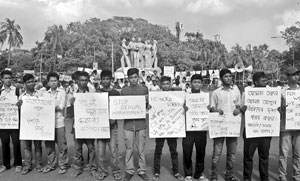
It is quite natural that lots of people, both female and male, have sharply reacted to the cowardly violence. Protests sparked off the very next day and have continued with increasing participation. Apart from expressing agonies and apprehensions, the protest programmes have demanded identification of the persons involved in the vile incident. Rights groups and other activists, student and cultural fronts have lamented the lackadaisical approach of the relevant authorities towards the repugnant act.
In the 21st century, Bangladesh rightfully takes pride in its women's empowerment. It could be proven by shining instances taken from many sectors. Women are given places of honour in many fields ranging from politics to academia, from administration to industry. The Pahela Baishakh persecution of women makes fun of this achievement. In fact, the broader area of our arts and culture has been made to bow down to the brute forces of negativism. This very force, though working invisibly but steadfastly, has for some time been out to destroy everything that we love to call linked to this soil.
There are precedents of sexual harassment on the Dhaka University campus. The memories of savagery let loose on a frolicking young woman on the New Year's night a few years ago are still fresh with many. Perhaps the most revolting incident of molestation took place at the Central Shaheed Minar on the campus on the night of 20th February in 1972. The sexual aggression on young women on this Pahela Baishakh only re-enacts the sordid spectacle of that year.
To speak bitterly, an ominous cloud has again started gathering on the Pahela Baishakh festival. With the occurrence of the hideous harassment, people may not be wrong if they start bracing for a fresh spell of dreadful occurrences centring on Pahela Baishakh. Yet there are brave souls aplenty who are prepared to face any threat to harmony posed by vested interests. That serves as a great boost to people's optimism.
shihabskr@ymail.com