
Combating transnational crimes
Muhammad Zamir | Monday, 9 March 2015
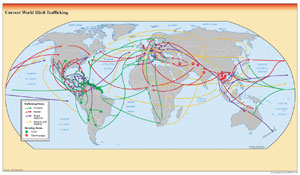
Louise I. Shelley of George Mason University has observed: "transnational crime will be a defining issue of the 21st century for policymakers - as defining as the Cold War was for the 20th century and colonialism was for the 19th. Terrorists and transnational crime groups will proliferate because these crime groups are major beneficiaries of globalisation. They take advantage of increased travel, trade, rapid money movements, telecommunications and computer links, and are well positioned for growth".
Transnational crime or transnational organised crime (TOC) is structured crime coordinated across national borders, involving groups or networks of individuals working in more than one country to plan and execute illegal business ventures. In order to achieve their goals, these criminal groups utilise systematic violence and corruption.
Transnational organised crime is widely opposed on the basis of a number of negative effects. It can undermine democracy, disrupt free market, drain national assets, and inhibit the development of stable societies. It has been argued that by doing so, national and international criminal groups threaten the security of all nations.
The victims of these transnational crime networks are governments that are unstable or not powerful enough to prevent them, with the networks conducting illegal activities that provide them with immeasurable profits. Transnational organised crimes interrupt peace and stability of nations worldwide, often using bribery, violence, or terror to meet their needs.
Transnational crimes are activities that have actual or potential effect across national borders. These crimes are inter-State in nature and may also offend fundamental values of the international community. The word "transnational" describes crimes that are not only international (that is, crimes that cross borders between countries), but crimes that by their nature involve cross-border transference as an essential part of the criminal activity.
Transnational crimes include crimes that may take place in one country, with their consequences significantly affecting another country with transit countries also being involved. Examples of transnational crimes in this context may include: human trafficking, smuggling of goods (such as arms and drugs) and illegal animal and plant products and other goods prohibited on environmental grounds (e.g. banned ozone depleting substances), sex slavery and terrorism offences.
Transnational organised crime (TOC) refers specifically to transnational crime carried out by organised crime organisations. In this regard it refers to those self-perpetuating associations of individuals who operate transnationally for the purpose of obtaining power, influence, monetary and/or commercial gains, wholly or in part by illegal means, while protecting their activities through a pattern of corruption and/or violence, or while protecting their illegal activities through a transnational organisational structure and the exploitation of transnational commerce or communication mechanisms.
It, however, needs to be understood that there is no single structure under which transnational organised criminals operate. They vary from hierarchies to clans, networks, and cells, and may evolve to other structures. The crimes they commit also differ. Transnational organised criminals act conspiratorially in their criminal activities and possess certain characteristics which, according to analysts, may include, but might not be limited to: (a) the violent activities that they commit or acts which are likely to intimidate, or make actual or implicit threats to do so; (b) exploiting differences between countries to further their objectives, enriching their organisation, expanding its power, and/or avoiding detection/apprehension; (c) attempting to gain influence in government, politics, and commerce through corrupt as well as legitimate means; (d) economic gain as their primary goal, not only from patently illegal activities but also from investment in legitimate businesses; and (e) attempting to insulate both their leadership and membership from detection, sanction, and/or prosecution through their organisational structure.
Transnational organised crime has been identified as one of the ten threats and challenges to international peace and security by the United Nations High Level Panel on Threats, Challenges and Change. The UN has accordingly attempted to take a stand against this threat with the adoption of the United Nations Convention against Transnational Organised Crime. It has been agreed upon not only to fight against this form of criminal activity but also because UN member states now recognise that this is a serious and growing problem that can only be solved through close international cooperation.
An Ad-Hoc Committee set up for this purpose is considering measures and regulatory arrangements aimed at identifying, defining and linking them to domestic criminal offences that can facilitate the adoption of new, sweeping frameworks for mutual legal assistance, extradition, law-enforcement cooperation, and technical assistance and training.
The international community in this context, both in the international as well as in the regional terms, have reiterated on the need to build international capacity, strengthen cooperation and existing partnerships. This is being done because all agree that sustainable progress against TOC requires both political commitment and effective law enforcement and criminal justice capacities on a worldwide basis.
TOC threatens the security and well-being of people around the world and jeopardises the functioning of the global economy - including socio-economic development in the South Asian region.
Over the past decade, important gains have been made in developing criminal justice capacities in key regions of the world. The goal of SAARC states should be to promote the expansion of such achievements on a regional basis, to the point where international law enforcement capabilities and cooperation among states are self-sustaining. Progress also needs to be made in developing a common normative framework for international cooperation against TOC threats.
The challenge for us in South Asia and other countries in the contiguous regions over the next decade is to bring the promise of this worldwide regime into practice. We have to be pro-active and encourage international partners to dedicate the necessary political capital and resources toward making the promise of these commitments a reality.
One important tool would be to pursue this not only through our renewed commitment to multilateral diplomacy but also by leveraging bilateral partnerships and elevating the importance of combating TOC as a key priority area of South Asian diplomacy through improved coordination of on-going programmes.
This will then enable them to obtain the assistance of international partners and to raise international criminal justice, border security, and law-enforcement standards and norms.
It may be added here that such a dynamics is being pursued by the United States and its partners in the European Union, the G-8, the G-20, and also in the new inter-regional platforms across the Pacific and Atlantic.
Given existing limits on the exercise of extraterritorial enforcement jurisdiction, states are now developing and fine-tuning mechanisms to cooperate in transnational criminal matters - extradition, lawful removal, and mutual legal assistance.
Extradition is the mechanism by which one sovereign state requests and obtains custody of a fugitive located within the jurisdiction and control of another sovereign country. If the fugitive is found within the territory of the requested state, then the requested state may arrest the fugitive and subject him or her to its extradition process. It needs to be mentioned, however, that the extradition procedures to which the fugitive will be subjected are dependent on the law and practice of the requested state.
Aside from mechanisms for the return of fugitives, states have also developed mechanisms for requesting and obtaining evidence for criminal investigations and prosecutions. When evidence or other forms of legal assistance, such as statements of witnesses or the service of documents, are needed from a foreign sovereign state, the requesting states may attempt to cooperate informally through their respective police agencies or, alternatively, resort to what is typically referred to as requests for "mutual legal assistance".
The practice of mutual legal assistance has developed from the comity-based system of letters rogatory, though it is now far more common for states to make mutual legal assistance requests directly to the designated "Central Authorities" within each state. In contemporary practice, such requests may still be made on the basis of reciprocity but may also be made pursuant to bilateral and multilateral treaties that obligate countries to provide assistance. Nevertheless, it also needs to be mentioned that many countries are able to provide a broad range of mutual legal assistance to other countries even in the absence of a treaty.
We, in South Asia, can benefit from the manner in which other states are slowly solving their challenges. This will then help SAARC (South Asian Association for Regional Cooperation) states to generate enhanced partnerships by building cooperative platforms and networks incrementally. It will also facilitate greater collective action, joint cases, and common strategic approaches with our international partners to combat transnational criminal threats in our region that is the home to nearly 1.6 billion people, about 22 per cent of the world's population.
To achieve this goal, South Asian States need to agree on the following:
(a) raising international awareness of TOC and building multilateral cooperation against it;
(b) partnering with countries able to contribute key law enforcement resources, other donors, and the United Nations to launch a new International Police Peace-keeping Operations Support Programme to enhance policing and law enforcement capacity in ungoverned spaces;
(c) leveraging assets to enhance foreign capabilities, including counterterrorism capacity building, foreign law enforcement cooperation, military cooperation, and the strengthening of justice and interior ministries;
(d) implementing a public diplomacy strategy to reduce the demand for illicit goods and services that fuels TOC in our region;
(e) strengthening courts, civil society groups, the media and the academia and institutions that help to uphold the rule of law in the region;
(f) initiating dialogue in the regional fora to stem the flow of dangerous counterfeit products;
(g) increasing international scientific research, data collection, and analysis to assess the scope and impact of TOC and the most effective means to combat it; and
(h) urging the United Nations to not only promote implementation of the United Nations Convention against Trans-national Organised Crime but also develop an appropriate review mechanism.
The writer, a former Ambassador, is an analyst specialised in foreign affairs, right to information and good governance.
mzamir@dhaka.net