
Complicated process keeps expats away from voting
Only 3.6pc of 13m Bangladeshis abroad cast postal votes
JAHIDUL ISLAM | Thursday, 12 February 2026
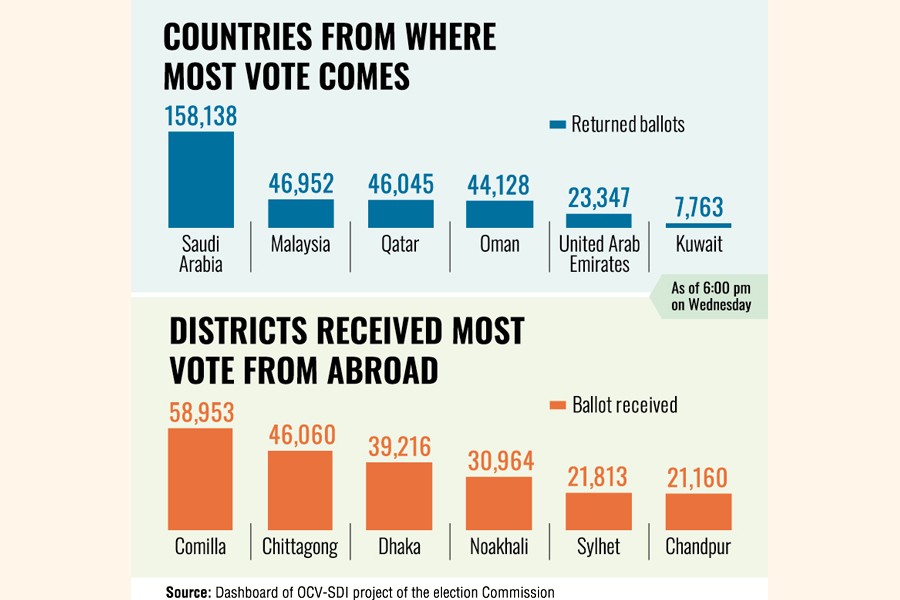
For the first time, the Bangladesh Election Commission allowed expatriates to vote in the Jatiya Sangsad election. Many cast their votes through an IT-supported postal system, but turnout remained low due to a complicated process and limited promotion.
As of 6:00 pm on Wednesday, returning officers in various parliamentary constituencies had received only 0.47 million voted ballots, although the Election Commission aims to ensure voting for at least 5.5 million expatriates.
The figure represented just 8.51 per cent of the target set under the Tk 494.36 million project titled "Out-of-Country Voting System Development and Implementation (OCV-SDI)" and only 3.60 per cent of the estimated 13 million Bangladeshis living abroad, according to senior officials at the Election Commission Secretariat.
Experts and officials attributed the low turnout to the complex voting process, limited voter literacy and inadequate promotion of the postal ballot system. Expatriate voters also voiced similar concerns.
Arifur Rahman, a Bangladeshi living in Rome, Italy, said getting a ballot was very complicated. Voters had to follow many verification steps, and even after receiving the ballot, they faced more checks before voting, which many expatriates found difficult.
A senior EC Secretariat official said that although expatriates had a one-month period to register for voting from abroad, the actual nationwide deadline was only five days, which limited overall participation.
Salim Ahmed Khan, team leader of the OCV-SDI project, said 0.77 million voters registered from abroad, and 0.51 million submitted their postal ballots. However, only 0.44 million ballots had reached the returning officers for counting, he added.
Officials said ballots reaching returning officers by 4:30pm on the voting day would be counted alongside votes cast at domestic polling centres.
Project documents show that more than 13 million Bangladeshis -- 10.51 per cent of the country's 123.7 million registered voters-currently live abroad and contribute significantly to the national economy.
The interim government pledged to ensure voting rights for expatriate citizens in the upcoming national election, according to the project document.
Jasmine Tuli, former additional secretary at the EC Secretariat, said lower literacy and lack of trust among expatriate voters contributed to the low turnout.
"Since this was the first time for this initiative, many voters may have doubted whether their votes would actually be counted," she added.
She also pointed out that promotion was a problem. "Because of time limits, it may not have been possible to reach all eligible expatriate voters effectively."
However, she added that the initiative was a positive step. "If this process continues, more expatriates are likely to take part in future elections."
To vote, expatriates were asked to download a mobile app from the Google Play Store or Apple App Store and fill out an electronic KYC (e-KYC) form.
After checking their details with the National ID database, a one-time password was sent to their mobile phone, followed by facial recognition and liveness verification to complete the registration.
In coordination with the Postal Department, the Election Commission sent ballots centrally to verified overseas voters, each containing a hologram security sticker and a prepaid return envelope.
Voters confirmed receipt by scanning a QR code and completing a second identity check. They then marked their ballots, sealed the envelopes and submitted them at nearby post offices. The Postal Department later sent the ballots to the designated returning officers in Bangladesh.
EC officials said that expatriates from 124 countries received ballot papers. Analysis of the returned ballots shows that most came from the Middle East, with Saudi Arabia leading at 1,58,138 ballots.
It was followed by Malaysia (46,952), Qatar (46,045), Oman (44,128), the United Arab Emirates (23,347) and Kuwait (7,763).
Among the districts, Comilla received the highest number of overseas ballots at 58,953, followed by Chittagong (46,060), Dhaka (39,216), Noakhali (30,964), Sylhet (21,813) and Chandpur (21,160).
jahid.rn@gmail.com