
INTERIM GOVT’S PRODIGAL REASSESSMENT OF PROJECTS
Cost of 65 dev projects ramped up by Tk 798.34b
JAHIDUL ISLAM | Wednesday, 25 February 2026
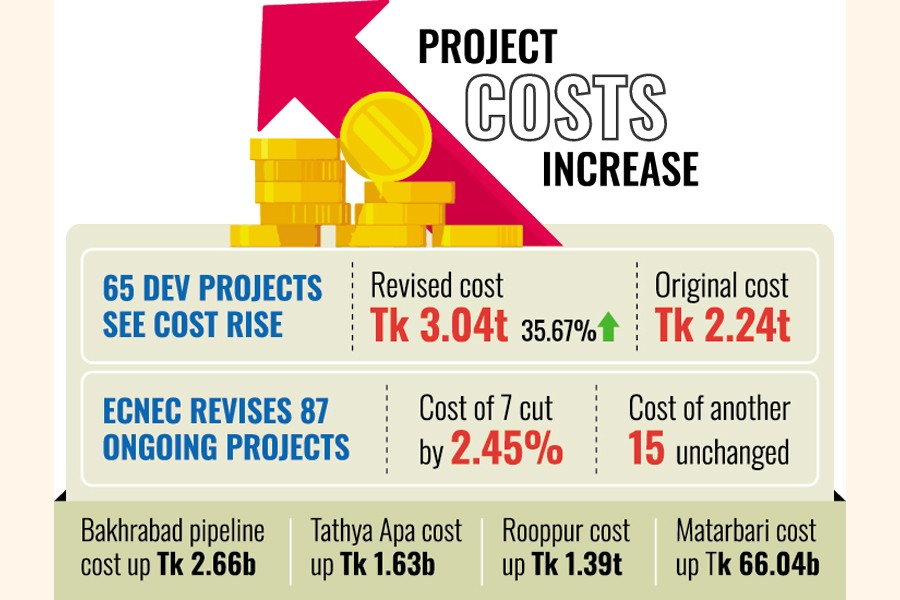
Costs of 65 projects have been ramped up by Tk 798.34 billion in apparent prodigal reappraisals of the development schemes by the just-gone interim government during its one-and-a-half-year tenure, sources say.
The projects, originally undertaken at a combined cost of Tk 2.24 trillion, were revised to Tk 3.04 trillion, marking an overall cost escalation of 35.67 per cent.
The information emerges from a review of the minutes of 19 meetings of the Executive Committee of the National Economic Council (Ecnec) during the tenure of the stopgap administration installed after the July-August 2024 uprising.
Further analysis by the FE shows that the Ecnec revised a total of 87 ongoing projects -- an average of 4.58 projects per meeting. Of the revised schemes, the cost of seven was reduced by Tk 9.50 billion, or 2.45 per cent of their original combined estimate of Tk 387.50 billion.
The cost of another 15 projects remained unchanged, although their implementation period was extended.
Economists have observed that despite high expectations that the interim government would enhance investment efficiency and ensure optimum use of public funds by rigorously scrutinising projects under the Annual Development Programme (ADP), the repeated upward revision of project costs fell short of that expectation.
A review shows that although the interim government assumed office on August 8, 2024 following the fall of the Awami League government, the first Ecnec meeting was held on September 18 that year after the reconstitution of the NEC and Ecnec.
At that meeting, four projects were approved, two of which were revised proposals. Among them, the ongoing "Bakhrabad-Meghnaghat-Haripur Gas Transmission Pipeline Construction" project saw its cost revised upward to Tk 15.71 billion from the original Tk 13.05 billion.
The cost of another project, titled "Tathya Apa: Empowering Women through ICT towards Building Digital Bangladesh (2nd Phase)", was also increased by Tk 1.63 billion.
In the final phase of its tenure, the interim government headed by Prof Muhammad Yunus approved the first revision by the Executive Committee of the National Economic Council (Ecnec) raising the cost of the Rooppur Nuclear Power Plant construction project to Tk 1.39 trillion.
The highly debated project was originally approved in 2016 with a cost of Tk 1.13 trillion, reflecting an increase of Tk 255.93 billion, or 22.63 per cent, following the revision.
The Ecnec also approved the third-phase revision of the Saidabad Water Treatment Plant Phase-III, aimed at increasing potable water supply to the capital city, Dhaka, from the Meghna River, with a revised project cost of Tk 160.15 billion.
The Dhaka Water Supply and Sewerage Authority initiated the project in 2015 with an initial cost of Tk 45.97 billion, which later increased by Tk 114.17 billion, or 248.35 per cent.
The cost of SASEC Road Connectivity Project-2: Elenga-Hatikamrul-Rangpur Highway Four-laning increased by Tk 71.55 billion, while the Matarbari Port Development Project saw a rise by Tk 66.04 billion.
The government also approved an additional allocation of Tk 14.10 billion for the Chattogram City Sewerage System Installation Project (Phase I) and Tk 13.24 billion for the Emergency Multi-Sector Rohingya Crisis Response Project.
The cost of the controversial Upazila Mini Stadium Construction Project (Phase II) also increased by 48 per cent, rising from Tk 16.49 billion to Tk 28.55 billion.
The Dhaka Mass Rapid Transit Development Project (Line-6) was the only megaproject whose cost was cut, declining by 2.53 per cent from Tk 334.72 billion to Tk 327.18 billion, generating savings of Tk 7.54 billion.
The savings were achieved by rationalising components worth over Tk 15 billion, mainly related to station-plaza development and land acquisition.
The major decisions of the first Ecnec meeting of the interim government focused on improving project efficiency and strengthening the monitoring of development schemes approved earlier.
The meeting also emphasised faster preliminary screening of projects, especially foreign-aided ones, prioritising small and high-impact projects, reducing dependence on land acquisition, and simplifying the project approval and implementation process to enhance public-investment efficiency.
jahid.rn@gmail.com