
Cox\\\'s Bazar: A potential economic hub
Our Chittagong Correspondent | Sunday, 30 November 2014
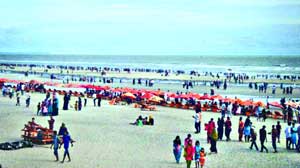
A main thrust of country's economy may be on Cox's Bazar tourism haven. It boasts the longest unbroken sea beach in the world and hosts an array of small and big islands. Some 3 million tourists from home and abroad visit this site during the tourist season alone. But unplanned development of the beach city poses nagging problems for the backpackers.
The number of foreign visitors has been on the decline in recent years. But local visitors are on the rise in number. Poor sanitation, absence of proper lighting facilities and evening activities are discouraging foreigners from taking a trip to this beach.
Mushrooming growth of hotels, motels, guesthouses and apartments over the recent years has changed the character of the once-quiet sea beach. There are over 14,000 rooms, including 1790 in 11 luxury hotels and 8750 in 175 guesthouses, in Cox's Bazar town. Another four to five thousand rooms will be added by next year.
The annual turnover in the beach city is over Tk 8.00 billion in terms of transportation and stay. Experts opine that the revenue earning from tourism in Cox's Bazar can contribute a lot more to the national economy if planned development schemes are taken for the tourism industry to flourish.
St Martin's Island: It is the most beautiful coral island where live corals are found. It is only30 kilometres off Teknaf and tourists can go there by local tourist boat, sea truck or motorboat. This small coral island, about 10 kilometre southeast of the southern tip of the mainland is a tropical clique, with beaches fringed with coconut palms and bountiful marine life.
Sonadia Island: It is about seven kilometres off Cox's Bazar and stretches over nine square kilometres. Western side of the island is sandy. Different kinds of shells are found on this panoramic patch of land in the bosom of the Bay of Bengal. During the winter season, fishermen set up temporary camps and dry sea fish after catching them from the sea.
Sea of Salt: Salt is one of the most valuable resources Cox's Bazar offers. The salt produced in Cox's Bazar and Banskhali upazila of south Chittagong meets country's entire demand for salt.
Salt is produced in nearly 70,000 acres of land at the islands of Kutubdia, Moheshkhali, Cox's Bazar Sadar and Teknaf. A bumper harvest of salt in this maritime area not only meets the national demand for 1.2 million metric tonnes, but also leaves a surplus of 0.3 million MT annually.
Although a huge quantity of salt is produced in Cox's Bazar alone, the country imports a good quantity of salt at the behest of corrupt officials in the government. And this unnecessary import trade leaves the Cox's Bazar salt neglected. Syndicates of dishonest traders import salt under back-to-back L/C (letter of credit), which causes huge financial loss to the farmers as they do not get due price of the produce. A good quantity of salt is also being smuggled out of the country, farmers alleged.
The owner of a Salt Crushing Industry and leader of Cox's Bazar Salt Mill Owners Association said import of salt is a major threat to the existence of the salt farmers and also to the industry. Due to low price of the product the salt farmers are set to lose their capital and are feeling discouraged.
Shrimp: It is one of the major foreign-currency earners of the country. Shrimp cultivation is another major national resource in Cox's Bazar. Due to excessive greed of a section of traders this major foreign-exchange earner is facing problems on the world market. Shrimps worth billions of Taka are returned from the importing European countries as the quality is not properly maintained.
A major portion of the shrimps is supplied from the coastal shrimp-culture areas of Cox's Bazar every year, apart from the coastal areas in Khulna, Bagerhat and other regions.
Dry fish: Cox's Bazar is the prime source of dry fish of Bangladesh. Rupchanda, Poa, Churi and Lotiya and other varieties of dry fish of this area are exported to different countries.
Sources concerned said that dry-fish export has, however, been on the decline in recent years as there is little arrangement for processing for lack of care and patronage from the government. Export of dry fish of Cox's Bazar can earn Tk 1.00 billion a year, traders said.
Thousands of people of Cox's Bazar, including women, maintain their livelihood by processing and selling dry fish to the local traders who again sell them to traders from Chittagong and other parts of the country.
There is a processing unit of dry fish in Nazirar Tek area near Cox's Bazar township, but the Shutki Mohal has lost its importance for lack of communications and other facilities. Sea fishes are dried there under the open sky.
A section of tourists also procure a good quantity of dry fish and take them home for consumption in the family throughout the year. High-quality dry fishes are also available in the Burmese shops scattered in the marketplaces.
It is alleged that the quality of dry fish degrades as a section of local traders use chemicals to keep them germ-free. Physicians say the chemicals and medicine mixed with the dry fish are harmful for health. Such practice has earned a bad name for dry fish on the international market.
Teknaf Land Port: The land port was set up in 2003 mainly with a view to checking smuggling of goods from Bangladesh to Myanmar and vice versa. But desired result is yet to be achieved as the smuggling across in the Bangladesh-Myanmar border still continues.
Proposed Bakkhali River Port: The government planned to set up a river port at Bakkhali of Cox's Bazar in 2010. The port will be constructed on an area of 700 acres from Kasturighat to Moheshkhali Channel on both banks of the River Bakkhali. Joint survey by the BIWTA Chittagong chapter and district administration of Cox'sBazar was also conducted in February 2012. But land acquisition is yet to be accomplished. Border trade with Myanmar will be further augmented once the river port gets operational.