
Cox's Bazar's Nazirartek operates Tk 4b dried fish trade per year
OUR CORRESPONDENT | Sunday, 4 January 2026
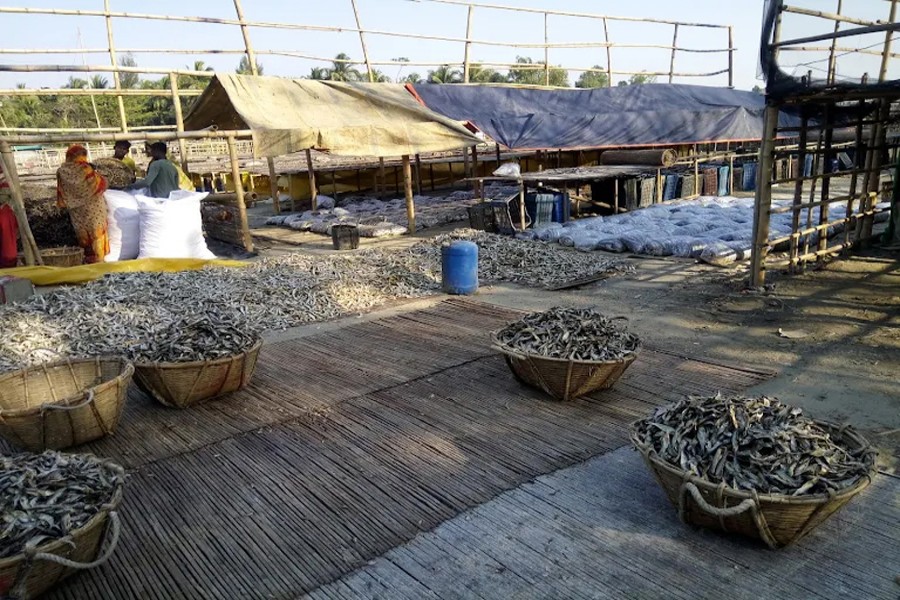
COX'S BAZAR, Jan 04: Cox's Bazar's Nazirartek dried fish market - spread over an area of about 100 acres along the seashore - have now become the country's busiest and largest dried fish production area, with a trade potential of at least Tk 4 billion per year.
About 20,000 workers work here, most of whom are women. Fresh fish caught from the sea are brought in every day, washed and dried in the sun for three- four days on bamboo platforms. Although the dry season is the busiest from November to April, some production continues throughout the year if there is no rain.
Traders said that every season Nazirartek produces 50,000-60,000 metric tonnes of dried fish, which has a market value of over Tk 4 billion. The dried fish is then supplied to the domestic market and exported to Hong Kong, Malaysia, Indonesia, Sri Lanka and some Middle Eastern countries.
OVER 300 DRIED FISH MARKET
In addition to Nazirartek, at least 300 smaller markets - or colloquially known as fish mahals- are producing and selling dried fish in Nuniarachara, Khurushkul, Maheshkhali, Chaufaldandi, Sonadia, Ukhia, Kutubdia, Teknaf and St. Martin. Cox's Bazar district accounts for a large part of the country's total production of dried fish, thanks to these markets.
OVER 25 SPECIES OF
DRIED FISH PRODUCED
Around 25-30 species of marine fish, including rupchanda (pomfret), chhuri (hairtail), koral (barramundi), surma (queen fish), laitya (bombay duck), popa, tekchanda (orna
te ponyfish), shark, faisya (Indian pellona) and naila fish are dried every day in the 50-60 shops of the Nazirartek market.
Businessman Aziz Uddin said, "Dried fish is mainly produced here from high-quality marine fish. That is why the demand for Nazirartek's dried fish is very high abroad."
WORKERS BUILT DRIED FISH INDUSTRY
Female worker Rashida Khatun said, "I come home early in the morning and wash the fish all day and put them in the market. The work is hard, but I earn good income during the season. This income supports my family."
Worker Mizanur Rahman said, "Going to the deep sea is risky. Still, when the fish is good, we earn the most during the season."
Worker Maryam Khatun said, "We have to stand in the sun and work every day. But this is our livelihood. Women have more opportunities here-this is a big achievement."
The price of dried fish per kilogram in the local market is as follows: Laitya: Tk 1,000-1,400; chhuri: Tk 800-1,800; shrimp: Tk 1,000-1,500; maitya (Indian mackerel): Tk 800-1,600; koral: Tk 1,500-1,900; rupchanda: Tk 1,800-2,500.
Traders say that production is expected to increase further this year.
Cox's Bazar Fisheries Traders' Unity Council President Osman Gani Tulu said, "Last year, the export of dried poa (pama croaker) was worth Tk 1.45 crore (Tk 14.5 million approx). If the production is good this year, the export revenue could reach Tk 4 billion."
INITIATIVES FOR SAFE DRIED POA
Referring to safe dried poa production without harmful chemicals, Cox's Bazar District Fisheries Officer Md. Nazmul Huda said, "We are increasing training and technical support to make dried poa production completely poison-free. Very soon, 100 per cent poison-free dried poa production will be possible."
Deputy Commissioner M. A. Mannan said, "Dried poa is very popular with tourists. Therefore, supervision has been increased in Nazirartek. Regular monitoring is being done to ensure the production environment, hygiene and quality."
tahjibulanam18@gmail.com