
Cronyism, kleptocratic legacy stalling Bangladesh's reforms
Experts warn, urge citizens to hold politicians accountable
FE Report | Monday, 20 April 2026
Speakers at a programme on Sunday stressed that entrenched cronyism, weak political accountability, and a longstanding "kleptocratic legacy" were continuing to stall Bangladesh's reform agenda, despite repeated policy commitments over the decades.
Speaking at a plenary session of the ninth SANEM Annual Economists' Conference 2026 at BRAC Centre Inn in the capital, they emphasised that meaningful reforms were inseparable from political accountability.
They urged the people to keep track of reforms and hold politicians accountable for those.
Delivering the keynote, Dr Debapriya Bhattacharya, a distinguished fellow at the Centre for Policy Dialogue (CPD), said Bangladesh's recent political economy had been shaped by "unchecked corruption, abuse of public resources", and authoritarian tendencies, which had allowed crony capitalism to evolve into an oligarchic system.
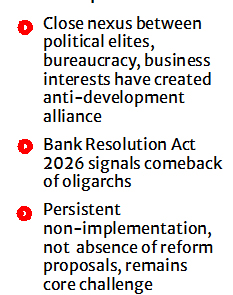
He warned that a close nexus between political elites, bureaucracy, and business interests had created what he described as an "anti-development alliance", undermining transparency and weakening institutions.
Focusing on the financial sector, Dr Bhattacharya criticised the Bank Resolution Act 2026, calling it a "parliamentary coup" that would enable former owners of failing banks to regain control with minimal capital.
Such developments, he said, signalled the "comeback of oligarchs" under continued political patronage.
He also pointed to rising non-performing loans (NPLs) as a major drag on the economy, noting that efforts to ensure central bank independence had yet to produce meaningful results.
The noted economist said reforms had become a "fashionable" term in Bangladesh, but meaningful transformation required strong political commitment and institutional capacity.
"Take it from me and from others that designing a reform is much easier than delivering it. Delivering is the real challenge," he said.
Dr Bhattacharya warned that if an elected government failed to honour its reform promises, "those who are not citizens of this country" would inevitably impose their own agendas. He specifically highlighted the role of the International Monetary Fund (IMF), noting that when internal signals for reforms were weak, such organisations would redesign programmes on which the government would be "forced to deliver".
Dr Bhattacharya described the necessity of external imposition as "disheartening if not insulting," arguing that the nation should be capable of generating its own reforms through a unified consensus between politicians, professionals, and bureaucrats.
To prevent this loss of agency, he urged citizens to remain "always very vigilant" and to use real-time data and tools like a "reform tracker" to keep their "political masters" accountable to their manifesto pledges.
He said unless the government took the lead on these initiatives, it risked becoming a "weak government" dictated by international partners.
Speaking as a special guest, Rehman Sobhan, chairman of CPD, argued that Bangladesh's core challenge lay not in the absence of reform proposals but in their persistent non-implementation.
"The reform agendas we see today are not new; they have been recycled for decades," he said, adding that there existed a "mutual interest" between governments and international lenders, such as the IMF and the World Bank, in maintaining the appearance of reforms while ensuring continued fund disbursements.
The session, titled "Romancing the Reform: The Bangladesh Story", was moderated by Dr Selim Raihan, executive director of the South Asian Network on Economic Modeling (SANEM), and brought together leading economists and policymakers to examine the structural and political barriers to reform.
bdsmile@gmail.com