
Cut delivery time to tap global leather goods market
Say speakers at BLLISS seminar
FE REPORT | Sunday, 15 October 2023
Bangladesh should pay a special attention to the issue of quickening the delivery time to tap the potential of its leather goods and footwear manufacturing sector in international market, experts said at a seminar on Saturday.
They called for faster customs clearance, easier port services, a bolstered backward linkage industry and skill development of the human resources.
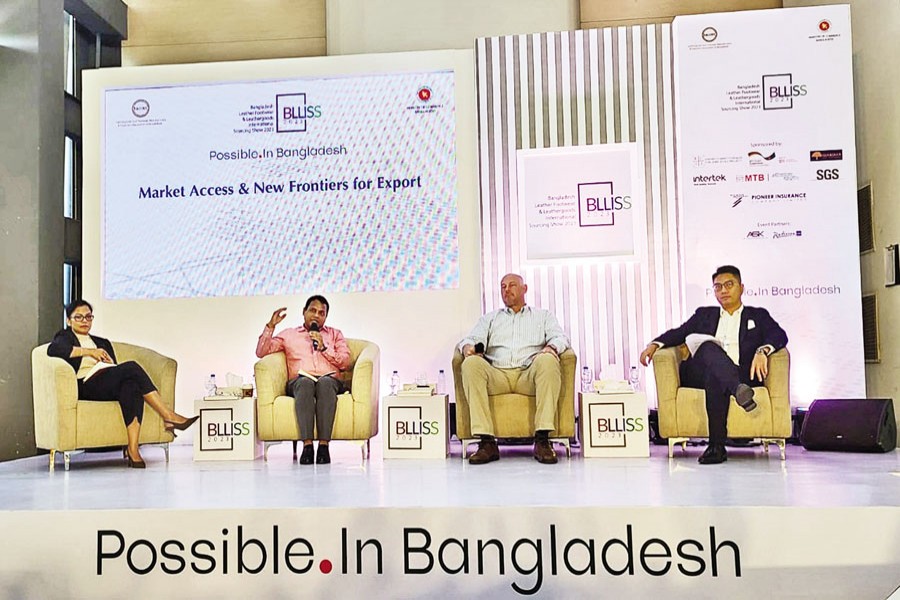
The seminar on 'Market Access: New Frontiers for Export' was held on the concluding day of three-day 4th Bangladesh Leather Footwear & Leathergoods International Sourcing Show (BLLISS-2023).
The Leathergoods and Footwear Manufacturers & Exporters Association of Bangladesh (LFMEAB) in collaboration with the commerce ministry organised the event at the International Convention City Bashundhara (ICCB) in the city's Kuril area.

Additional Secretary to Ministry of Commerce Abdur Rahim Khan, President of Manufacturing and Operations of Advanced Manufacturing Group (AMG) Michael Roy, and Managing Director of Blue Ocean Footwear Limited Lien Chun Yao (Jim) were the three panellists of the seminar moderated by LFMEAB Director Amrita Makin Islam.
LFMEAB President and Apex Footwear Ltd Managing Director Syed Nasim Manzur and the Metropolitan Chamber of Commerce and Industry, Dhaka (MCCI) Md Saiful Islam were also present.
Speaking on the occasion, Nasim Manzur said Bangladesh should not be viewed as a cheaper destination for footwear manufacturing as it was maintaining international standards and different expenses were going up.
"We need to meet the basic needs of our workforce," he said. The government was also paying attention to the living standard of the human resources.
"Even Prime Minister Sheikh Hasina, during her speech at the opening ceremony of the event, instructed to take care of the people," he said.
Responding to comments of other participants, he said that with Bangladesh being a land-scarce country, the local companies should get preference.
He also urged the foreign businesses to introduce modern technologies also in Bangladesh as they did in other manufacturing countries like China.
During the panel discussion, Abdur Rahim Khan said the government had been implementing different programmes to enhance competitiveness of the sector and looking for signing bilateral trade agreements to widen the access to export destinations.
"Beyond general approaches like holding trade fairs and promotions, the government is looking for different sorts of bilateral trade deals," he said. The trade agreements were also important to cope with the challenges that might arise from Bangladesh's graduation to a middle income country.
"We identified around 14 countries for trade agreements in the forms of CEPA, FTA and others," he said.
He also laid emphasis on bringing in more foreign direct investment, product diversification and technologies.
The business climate issue was not an issue for Bangladesh only, while reform was a continuous process, said the bureaucrat.
Michael Roy said Bangladesh had advantage like geopolitical stability, motivated workforce, product quality and tremendous sense of collaboration among stakeholders.
In order to ensure global market access, Bangladeshi manufacturers needed to deliver fast, he said.
"You see calendar, we see watches," he said underscoring the need for reducing lead time. He also said opportunities were sitting on the lap of Bangladeshi manufacturers, who should take actions accordingly to utilise it.
Mr Lien Chun Yao saw Bangladesh itself as a huge market for footwear as demand for different types of footwear by one individual was growing.
He underscored the need for supply chain localisation, training the local workforce and technology transfer.
saif.febd@gmail.com