
Cut in income inequality is main challenge now
FE Report | Friday, 3 July 2015
Economists said now Bangladesh's main challenge is reducing income inequality, which has been rising fast in the country, especially between the rural and the urban areas.
The income inequality also persists between the northern regions and the eastern or southern regions.
They said the country also needs to improve the civic amenities, like - transportation, education and healthcare.
The economists' comments came after the World Bank's (WB) latest per capita Gross National Income (GNI) estimate. On the basis of the estimate Bangladesh has graduated as a lower-middle income country from a low-income one.
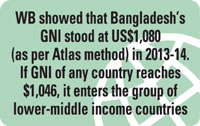
The WB showed that Bangladesh's GNI now stands at US$1,080 (as per Atlas method) in 2013-14. If GNI of any country reaches $1,046 dollar, it enters into the group of lower-middle income countries. But the threshold varies on the average income of the advanced nations.
Three more countries - Kenya, Myanmar and Tajikistan - also emerged as lower-middle income countries, according to the WB's latest report released on July 01.
However, Bangladesh Institute of Development Studies (BIDS) research director Dr. Binayak Sen said income inequality has been rising in the society amid the rise in per capita income.
There are three types of inequality - income, asset and consumption. Among these, income inequality and asset inequality are being prominent in the recent years, the BIDS economist commented.
Gini co-efficient of income increased from 0.393 in 2000 to 0.430 in 2010 in rural areas whereas it decreased from 0.497 to 0.452 during the period in urban areas. It increased from 0.451 to 0.458 at the national level.
The Gini co-efficient is a gauge of measuring inequality. Gini co-efficient can vary between '0' and '1'. The '1' is the most unequal state and the '0' is the most equal state.
Dr Sen said Bangladesh needs quality improvement in areas like education, healthcare and nutrition etc.
He said there are many countries with the similar status, but they are beset with various types of social unrest.
"India and Pakistan are the examples of such type of social instability," Dr Sen added.
Dr Hossain Zillur, founder of Power and Participation Research Centre (PPRC), said Bangladesh's latest status, awarded by WB, is just a statistical estimation. It hardly reflects the country's real socio-economic scenario.
"We need improvement in quality of governance and key social indicators on a sustainable basis."
He said there are many countries that are enjoying higher income status, but facing extreme income inequality.
"I don't find any self satisfaction with the new status, as we've to go forward and achieve more," he commented.
Dr Zahid Hussain, lead economist at WB Dhaka office, said the new status is a formal recognition for Bangladesh in its journey towards further advancement.
He, however, said Bangladesh's challenge is to retain the status.
The country should concentrate more on infrastructure development and attracting investment to retain the status and reach the next step - upper-middle income country, he concluded.
Policy Research Institute of Bangladesh (PRI) executive director Dr Ahsan H Mansur said the new status is recognition of continuous improvement of Bangladesh's economy. It might help improve the country's sovereign rating.
"If our sovereign rating improves, we might get funds at cheaper rates from external sources."
Solvency is the main criterion for getting loans, and it will help to promote the country's trade, he also added.
jasimharoon@yahoo.com