
Cyclone risks: Their management in Bangladesh
Farid Hasan Ahmed | Thursday, 5 June 2014
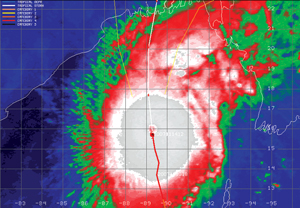
Bangladesh is prone to different types of natural disasters. Tropical cyclones brewing up in the Bay of Bengal, accompanied by storm surges, are one of the major hazards in the country. They occur mainly in April/May and October/November. Cyclones and storm surges are a continuous threat to the coastal population. Most of these cyclones hit the land on the Bangladesh coast or the coastal areas of Myanmar and India. In 1970, a super cyclone caused deaths of about 500,000 people in Bangladesh's coast belt.
On April 29, 1991, a powerful cyclone struck the coastal area of Bangladesh with wind speed of around 250 km/h. The storm killed at least 138,000 people, leaving as many as 10 million homeless.
On November 15, 2007, Sidr, another cyclone, hit the coastal areas of the country, affecting approximately 8.5 million women, men and children and killing about 4,000 persons. One and a half million homes were partially or completely destroyed, and around 1.2 million livestock were killed and 2.4 million acres of crops were ruined. The overall economic losses stood at US$ 1.7 billion.
On May 25, 2009, the cyclonic storm Aila hit the south-western part of Khulna Division, killing approximately 190 persons. Several hundred thousand homes were washed away when the wind-whipped tidal surges up to three metres destroyed the coastal belt. Cyclone Aila hit 14 districts in the south, affecting a population of around 3.7 million people. The cultivated land damaged in the area was around 96,617 hectares (ha); the loss in production was around 482,144 MT that was worth Taka 6,776 million.
Over the last three decades, particularly under the democratic governments, the country has invested a considerable amount of money in disaster management. As a result, it gained some ability to manage cyclones. However, people in the hazard-prone coastal areas, particularly the poor, still live with extreme uncertainties, risks and multifarious vulnerabilities. In view of the history, current capacity, the risks and vulnerability of Bangladesh to the cyclones, the following recommendations are placed for consideration of relevant organisations, actors and the authorities in their task of forming appropriate strategies and actions to further improve the emergency and cyclone risk-reduction functions.
CYCLONE EMERGENCY MANAGEMENT: An effective emergency management encompasses the measures taken before the assault of a disaster event which are aimed at minimising the loss of lives, and harms. Prior to any cyclone situation, a contingency a contingency plan provides the basis for identifying and further developing response capacity. It is important to prepare the contingency plan at all the administrative layers of the coastal area with the provision of necessary resources and their effective management. Strengthening emergency medical facilities across the vulnerable locations of the coastal belt to treat fatalities on time is an area of intervention.
MANAGEMENT OF CYCLONE RISKS: Nobody can prevent cyclones. But the negative consequences could be reduced. Some points are mentioned below as key areas of intervention for reducing cyclone risks:
The respective authorities at different levels should strengthen capacity-building initiatives of the local government and the communities at risk. A well-organised and coordinated effort is needed to further strengthen local-level planning, implement decision making process and for allocation of resources to the local government for cyclone-proof programmes in vulnerable locations. Proper resources from the central government and other sources should be ensured by the authorities and policymakers.
Mainstreaming "disaster risk reduction and climate change adaptation" in the existing development works and future initiatives of different government ministries or departments and non-governmental organisations (NGOs) of the country is very much important. The authorities concerned should develop a cyclone database, which is important for carrying out detailed studies and planning. The government and the NGOs need to redesign their development programmes with the active participation of the most vulnerable communities to ensure that they maximise the cyclone mitigation potential and incorporate traditional community coping practices which are fit technically, environmentally and economically.
The existing embankments, dams, dykes and other infrastructural set-ups have to be critically reviewed. An effective and strong green belt should be developed with trees and embankments considering the present and future vulnerabilities and risks. Some targeted but tested cyclone risk-reduction activities both structural (embankments, polders, river protection, cyclone shelters, housing schemes, roads, water and sanitation facilities) and non-structural (improving awareness and networks, early warning dissemination, coordination mechanism etc.) could be undertaken or renovated in consultation with communities at risk and relevant experts and organisations. The private sector could be involved in structural measures with appropriate facilitation and accountability mechanism on the part of the government. But limitations, such as difficulty in executing physical workings and weak management set-up for operation, maintenance and protection jobs, environmental consequences and lack of engagement of people in the interventions need to be addressed effectively by the authorities.
Prompt actions are expected from respective authorities and responsible quarters to launch new protection measures and to complete the ongoing repair work of embankments/dykes at vulnerable spots of the coastal region in conjunction with community and local government bodies as soon as possible. Any sort of irregularities and foot-dragging might cause further loss of lives, damages to crops and increase the sufferings of the people due to cyclones and tidal surges.
Appropriate allocation, rapid flow of funds and effective monitoring and supervision of these kinds of urgent activities should be ensured by the authorities at different tiers of the administration. Role of local government bodies and communities at different stages of work needs to be emphasised, supported and ensured by the authorities concerned.
Any livelihood-related initiative in the cyclone-prone areas has to take into account the disaster and the relevant aspects, so that the initiative does not go awry, rather yield some amount of benefits to the target people. Involvement of the community and enlisting their inputs in any kind of programme design and relevant issues affecting their lives and livelihood will make the intervention process easier and impact-bearing.
Impact minimising strategies such as the use of cropping patterns, which minimise exposure to losses, and the setting-up of cyclone-smart income-generating activities need to be undertaken. Crop types and patterns should be selected according to the susceptibility to cyclones and salinity. Urgent efforts should be put in by agencies concerned to find new varieties of crop species, which have cyclone and salt resistance.
The writer is a Disaster Risk Reduction and Climate Change Adaptation practitioner. He is also a Fellow of EPFL, Switzerland. The views expressed in the article are the writer's own. They have no link with his office. E-mail: farid.hasan2008@gmail.com