
Davos this year: Genie let out of the bottle cannot be put back
Hasnat Abdul Hye | Thursday, 26 January 2017
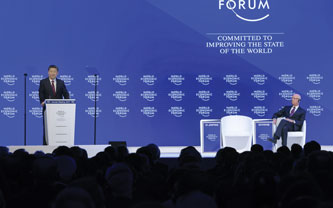
The annual assembly of elites from the politics, economics, business worlds and academia at Davos this year was held under the shadow of doubt and uncertainty. Britain's exit from the European Union (EU) last year followed by Donald Trump's election as the president of America and continuing battle cry from nativists and populist parties in several EU countries cast a pall of gloom on the usually ebullient mood of participants in the World Economic Forum (WEF) meeting at Davos that has just concluded. The otherwise glitzy conclave that had become globalization's signature event in recent years looked routine and even lacklustre. For the first time since its inception existential threat, rather than inexorable march towards an integrated and stronger world in future seemed to haunt the proceedings of the various sessions of the WEF meeting. It was accompanied by much hand-wringing, too, from the titan of finance and industry and the otherwise complacent policymakers who shaped the economic world order since the end of the cold war, ushering in the second golden age of globalization.
Globalization that began with renewed vigour in the early 90s collapsed precipitously in 2007 as if struck by an earthquake of fatal magnitude. The greatest shock was that the movers and shakers of the new world order were oblivious of the juddering under the feet. The elevation of muted grumble into angry protests from the victims of the disastrous march of events that led to the financial meltdown in 2007 took many experts in finance and industry and policymakers by surprise. The backlash of those disgruntled by the process of globalization manifested through angry protests, demonstrations and ballot in elections put the leaders in the defensive. After the watershed event of 2007 the annual talk-fest in Davos continued following the annual schedule but it was not business as usual. The awareness about what went wrong and a new sense of urgency to salvage the damage crept into the proceedings of the meetings following 2007. Sombre thoughts and perplexed introspection replaced euphoria.
GRIPPED BY A CRISIS OF CONFIDENCE: Unlike other meetings at Davos held before the explosion of nativist and populist outbursts during Brexit and the American presidential election, news that came from the proceedings of the just-concluded WEF meeting at Davos was patchy, subdued and desultory in nature. It was as if the participants from the developed countries were gripped by a crisis of confidence. The only silver lining in the darkening clouds hovering over the meeting was the presence of the Chinese president and his optimistic stance and determination to carry forward globalization through greater connectivity among countries and free trade. He seemed to send out the message that the abdication of global leadership by America and its retreat into isolationism will not leave a void. The process of globalization through free trade and movement of capital that have been vilified by the newly-elected American president for alleged 'carnage' in America will be promoted, it was assured by the Chinese president. Distraught participants took heart from the conviction about globalizations' rationale conveyed by the Chinese president and his commitment to the process. It also helped to raise the morale that the German Chancellor, Angela Merkel, though not in attendance at Davos, had earlier reiterated her country's positive stand regarding globalization, particularly free trade. Though relatively subdued in its statement and exhortation, the overall message that emerged from Davos at the end of the meeting was one of hope and commitment for a globalized world.
GROWING TIDE OF RIGHT-WING POPULISM: The theme of this year's WEF meeting was 'Responsive and Responsible Leadership'. This referred to the ability and willingness of the leaders in politics, business and finance to respond to the problems of growing income inequality, climate change, unequal benefits from free trade and migration across borders. These issues assumed critical importance in view of the growing tide of right-wing populism that threatens to sweep away the achievements made through international co-operation for global economic growth. It was natural, that every session and panel in the meeting of Davos was pre-occupied with thoughts about rolling back the loss of trust by people aggrieved over the globalized economic order to work in their interests. With a view to addressing the problems alleged to have been caused by globalization the WEF meeting this year focused on five priorities: (i) promoting global collaboration (ii) restoring a sense of shared identity (iii) revitalizing economic growth (iv) reforming capitalism and (v) preparing for the Fourth Industrial Revolution characterized by robotics and other high-tech methods used in business and industries.
GLOBAL COLLABORATION: Participants in the concerned panel on the first priority were optimistic that China will be able to take leadership in addressing the area covered by the first priority i.e. strengthening global co-operation even if America becomes isolationist as revealed in the policy declarations by the new incumbent of White House. China's recent moves in forging bilateral and multilateral trade agreements in Asia, Africa and Latin America underscore this willingness on its part.
A SENSE OF SHARED IDENTITY: This will avoid or at least mitigate a protectionist war that America is threatening to unleash and will also take care of the second priority included in the WEF agenda mentioned above.
REVITALIZING ECONOMIC GROWTH: It will be again China that will come forward to take care of the third priority viz. revitalizing world economic growth. Despite the stock market hiccup and currency fluctuation in early 2016, China was able to restore stability and keep the Chinese economy growing steadily at 6.7 per cent throughout last year. This has been accompanied by a shift in the structure of growth in the Chinese economy. Consumption accounted for over 70 per cent of the country's gross domestic product (GDP) last year. This and other economic reforms can be expected to ensure that China, the world's second largest economy, will be engine of growth for the global economy. China, together with like-minded Germany, leading EU, should be able to steer clear of recessionary trends in the global economy that may be prompted by America's protectionist policy. The possibility is there that even America will be ultimately compelled to forsake its beggar-thy-neighbour policy when it realises that the antediluvian policy of protectionism hurts national interests more than it benefits.
EQUITABLE DISTRIBUTION OF INCOME: The fourth priority area of reforming capitalism to ensure equitable distribution of income lies in the bailiwick of advanced capitalist countries like America, Britain, Germany and France. These are the countries that were the greatest beneficiaries of globalization but their financial institutions and other corporate bodies did not share the benefits accrued to them with the middle and the working class. This could be done through payment of taxes that were due under the law and sharing profits through rise in wages and incomes of low income groups. Acting selfishly these corporate bodies stashed their profits in off-shore tax havens to avoid or evade tax payments. On the other hand, they benefited from taxpayer's money in bailout payments after the financial crisis in 2007. It is these greedy corporate bodies and the inept or corrupt regulators who gave bad name to globalization. Though this was recognized by the participants from the developed countries in the meeting at Davos no frank criticism and analysis were made this year or in previous years following the 2007 crisis because Davos is controlled by capitalist interests. Though the issue of inequality featured in the discussion of panels this year recommendations for drastic restructuring of the capitalist system were made. This has been the greatest shortcoming of the WEF meeting at Davos, year after year, since the 2007 financial meltdown. That it has not changed its attitude towards capitalist system even after the political upheaval caused by right-wing populism (it is an irony because backlash against globalization under capitalism should have come from left-wing populists) shows how firmly entrenched are the capitalist sponsors of the WEF event at Davos.
FOURTH INDUSTRIAL REVOLUTION: The fifth and the last priority subject in this year's WEF agenda under the overarching heading of 'Responsive and Responsible Leadership', preparing for the Fourth Industrial Revolution, is again the responsibility of the industrially developed countries where automation is progressing almost by leaps and bounds, creating an army of unemployed. Here again, greed of capitalist enterprises to make enormous profit by reducing the cost of production is at work. For this particular priority solutions are not easy because the progress of technology promoted by profit seeking entrepreneurs has become almost unstoppable. The genie that has been let out of the bottle cannot be put back and neither is there any willingness in this regard among the capitalist owners and share holders. The WEF meeting at Davos identified this as one of the causes of unemployment, poverty and inequality but failed to come up with an answer. There is a great dilemma involved here. Capitalism thrives on replacing labour with machinery which reduces costs and increases profit. But automation also causes unemployment and income inequality. Though this has been recognized by the champions of capitalist system its extreme manifestation has not been visualized or taken seriously. Support of capitalism does not brook any restriction on technological innovations. Nor do the present apologists of the system or its critics like Thomas Pickety recommend any major overhaul. Even the risk of the capitalist production system coming apart as a result of fall in consumer expenditure following technology-driven unemployment has not made the practitioners and policymakers anxious beyond thinking about 'Preparing for the Fourth Industrial Revolution'. Framers of the WEF agenda this year did not realize that 'preparation' may mean mass suicide as was exhorted by some arcane cult gurus in the past. In fact, Angus Deaton, the Nobel Laurite for economics, has already mentioned about growing cases of suicides by unemployed American workers.
To conclude, China alone will not be able to sustain the future world economic order with whatever degree of globalization. The existential crisis facing the globalized economic order stems from capitalist production system that promotes unequal distribution of income and builds up the army of unemployed through technological change. Rationalizing the latter part of the problem (technology change) by the hyperbolic nomenclature of 'Fourth Industrial Revolution' does not hide the fact that the seeds of destruction of capitalism are being sown by the system itself. This can be the stuff of a Hollywood 'super hero' blockbuster with the twist that unlike the comic book universe the super heroes will prove to be mortal when pitted against high-tech adversaries.
hasnat.hye5@gmail.com