
DCs asked to mobilise mobile courts to ensure jute bag use
Saturday, 10 June 2023
REZAUL KARIM
The government has called upon deputy commissioners (DCs) to initiate legal measures against the rampant breaches of the 'Mandatory Jute Packaging Act-2010' in order to ensure the use of eco-friendly jute sacks and bags, according to sources.
In line with the objective, the commerce ministry recently issued instructions to district administrations to conduct mobile courts, thereby ensuring strict adherence to the existing legislation.
This decision was made during a meeting chaired by Senior Commerce Secretary Tapan Kanti Ghosh, focusing on enhancing the capacity of jute product exports.
During the meeting, officials complained that traders continue to disregard the use of jute sacks and bags for packaging purposes, opting instead for artificial and cheap alternatives like polythene bags. Regrettably, no legal action has been taken against these violators.
Private jute millers in the country have repeatedly urged the government to enforce the 'Mandatory Jute Packaging Act' nationwide, according to sector insiders. They argue that instead of using jute-made sacks and bags as required by law, artificial alternatives are being used for selling, transporting, importing and exporting commodities.
Currently, the use of jute sacks is limited to government rice procurement campaigns, while jute bags are utilised for packaging jute seeds. Sources said that authorities responsible for ensuring the use of jute sacks have failed to curb violations at various levels.
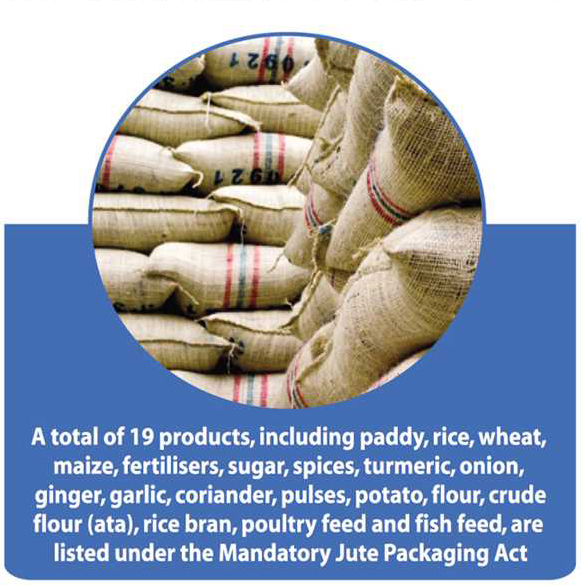
A total of 19 products, including paddy, rice, wheat, maize, fertilizers, sugar, spices, turmeric, onion, ginger, garlic, coriander, pulses, potato, flour, crude flour (ata), rice bran, poultry feed and fish feed, are listed under the Mandatory Jute Packaging Act. This list aims to protect the environment by prohibiting the use of artificial packaging.
To effectively enforce the mandatory jute packaging act and promote the use of jute bags, the Ministry of Textiles and Jute decided to implement strict measures through mobile courts during a meeting held on March 23, 2023.
However, according to a document, the instruction to operate such courts for the mandatory use of eco-friendly bags has yet to be implemented by the Department of Jute.
Following the anti-dumping duty imposed by India on Bangladeshi jute goods, the government introduced the 'Mandatory Jute Packaging Act-2010' and subsequent 'Jute Packaging Rules-2013'.
The legal framework also aims at reviving the struggling jute sector in the country and combatting environmental pollution caused by the widespread use of synthetic bags in packaging goods.
Jute serves as a vital cash crop for over 3 million small farm households, accounting for nearly one-third of manufacturing output and standing as Bangladesh's largest agricultural export commodity.
The livelihoods of an estimated 50 million individuals depend on jute-related activities encompassing agriculture, domestic marketing, manufacturing and trade.
According to the Bangladesh Jute Mills Association (BJMA), the jute industry has long been the lifeblood of the economy and continues to be a key pillar of the rural economy in Bangladesh today.
Around 15 million farmers engage in cultivating this cash crop, with millions more involved in its processing, transportation and associated services. In contrast, the use of polythene diminishes soil fertility, harms marine animals and disrupts drainage systems.
On the other hand, during its 120-day cultivation period, one hectare of jute plants absorbs over 15 tonnes of carbon dioxide. Jute bags are renowned for their strength, durability and reusability.
The BJMA attributes the decline of jute industries to the proliferation of polythene bags.
According to a BJMA document, despite its designation as the 'Mandatory Jute Packaging Act', law enforcement agencies have shown a lack of initiative in implementing this crucial law nationwide.
According to a private jute miller, the mandatory use of jute bags has the potential to revive the jute sector's golden days and eliminate the illicit trade of plastic shopping bags.
However, the miller notes that traders have become complacent in adhering to the law, emphasising the need for strict measures by authorities to ensure its effective implementation.
In the previous fiscal year 2021-2022, the export volume of raw jute and jute products amounted to $1.12 billion, according to the Export Promotion Bureau.
Data from the bureau shows that Bangladesh generated $1.16148 billion through the export of raw jute and jute goods in fiscal year 2020-21, compared to $882.35 million in fiscal year 2019-20.
The country currently produces around 8-9 million bales of raw jute. Out of this volume, around 5-5.5 million bales are utilised in the manufacturing of various jute goods, while the remaining portion is exported as raw jute.
Contacted, a senior commerce official said, "We have asked the DCs to ensure the implementation of the Mandatory Jute Packaging Act."
rezamumu@gmail.com