
Dealing with dowry
Md. Abdur Rashid | Saturday, 29 November 2014
Dowry is common in countries with patriarchal societies which expect women to live with their husbands' families. It has been a socio-economic custom for a long time since Babylonian, Roman, Greek, Chinese and Indus Valley civilisations up to the 21st century. Dowry is a curse for women and their empowerment as they undergo social exploitation, subjugation, subordination and oppression physically and psychologically.
Parents of brides save money in banks; sometimes the bride herself collects resources from parents so that she would be highly prized in her husband's family and her husband is made happy in the name of social tradition. From upper to lower classes, brides and her parents cannot escape from it and they are harassed by husband, his family members and wives of own brothers. Tortures of girls failing to procure dowry lead to their severe physical injuries and even at times cause their deaths.
Despite the UN Convention on the Elimination of all Forms of Discrimination against Women (CEDAW), the Beijing Declaration and Platform for Action and the Cairo Programme of Action and the Dowry Prohibition Act 1980 (Bangladesh), the dowry system still exists in different countries including Bangladesh.
Anthropologist Jack Goody demonstrates that dowry is a form of inheritance found in the broad swathe of Eurasian societies from Japan to Ireland. It is also prevalent in the Sub-Saharan African region. It is basically developed in the intensive plough agriculture, where farming is largely men's work. This is why dowry is given to men (Goody, J.1976).
Even in the oldest available records such as the Hammurabi in ancient Babylon civilisation (Thomson: 2009), in ancient Greece in the 5th century B.C., in the Roman Empire (Demos: 2007), dowry was pervasive in different forms. The ancient code of Manu sanctioned dowry but it was the most prestigious form associated with the Brahmin caste and was restricted for the lower caste (Tambiah & Goody: 1973).The same practice was in China, India, America and Europe.
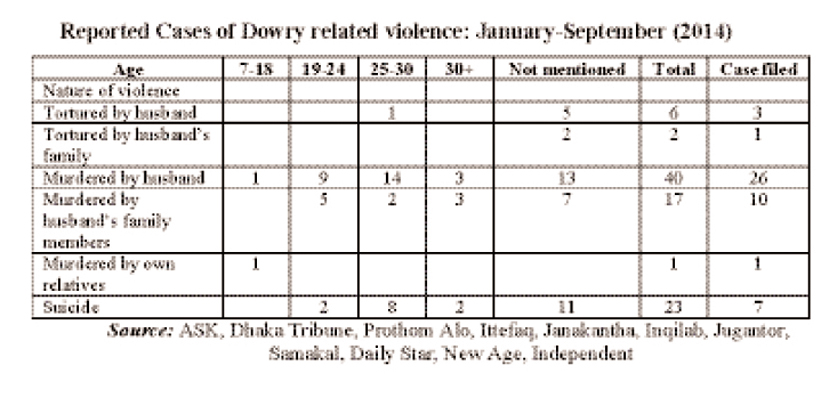
In Bangladesh, the dowry system is pervasive due to the patriarchal nature of society. The following chart indicates the severity of violence of dowry system and its bad impacts on society:
From January to September in 2013, the incidents of dowry-related violence stood at 265. There were 149 deaths and 111 cases were filed for dowry-related violence.
Dowry has a lot of grievous consequences for both the bride and her family members resulting in injuries and even deaths. Severe physical abuses due to non-payment of dowry include beating, burning with cigarettes, withholding food, social segregation or exclusion, stigmatisation and denial of medical treatment. The abuses are usually meted out by her husband and mother-in-law. Verbal abuse may include starting rumours about the character of the wife who does not want to disclose it to her parents. If the physical abuse continues and worsens, this may lead the wife to commit suicide. It is common that as a result of not meeting the demands for dowry, husbands send their wives to their parents' houses.
Bangladesh needs to adopt some strong measures to stop dowry system. Firstly, there is a need for a social movement against dowry to establish human dignity of women and a situation of cooperation in society in this regard. The guardians should not give in marriage their girls to those who demand dowry. Girls also should not marry men who want dowry. Bridegrooms must pay their alimony to the brides especially of Muslim families. Enactment of law in parliament is not enough until its implementation is assured.
The government must ensure that women enjoy all human and fundamental rights including education (key to empowerment), health, and decision-making power at all levels along with men in a state of cooperation, equality and equity. An environment of cooperation has to be established in place of gender discrimination in all organisations and institutions. Both man and woman should think that they are inextricably linked to each other.
Instant punishment must be meted out by the law enforcers. Here the government can establish community police in every locality so that the victims can get supports they need instantly when they are tortured for dowry.
The writer is Assistant Manager, Social Advocacy & Knowledge Dissemination Unit, Palli Karma-Sahayak Foundation. dumarashid@gmail.com