
Macroeconomic situation
Debt buildup, capital flight, inflation stoke instability
A step in time could forestall volatility, Prof Dr Wahiududdin Mahmud tells economic reporters
FE REPORT | Sunday, 3 September 2023
Inflation, debt buildup, capital flight and reserves depletion are among factors fueling macroeconomic instability in Bangladesh that could be averted with prudent measures in time, says a noted economist.
The present macroeconomic instability could be avoided had there been proper interventions by authorities concerned in the past, Prof Dr Wahiududdin Mahmud told economic journalists in Dhaka on Saturday.
Bangladesh's economy has been facing macroeconomic challenges like fast-depleting foreign-exchange reserves, volatility on the foreign- exchange market, and persisting higher inflation.
"If we did gradual adjustment with dollars, then we could avoid the current problems, but we kept it static," Dr Mahmud said.
The noted economist was speaking with financial journalists at the Economic Reporters' Forum or ERF at its office. Forum president Refayet Ullah Mirdha chaired the programme while its general secretary Abul Kasem and other members attended the programme.
Dr Mahmud said economists do have some weaknesses in their analytical views of the country's economic health but there is no political culture to accommodate those who speak unpopular truths.
In his critical appreciation of the economic situation Prof Mahmud said: "We were in a good position as we had a current-account surplus and the reserves were ballooning. And such a position in the economy forced us to take on projects."
He said good foreign reserves are used to signal others that their economy is good and such fund is used during crisis period.
Dr Wahiduddin Mahmud is a member of the United Nations Committee for Development Policy. He was in charge of the Ministry of Finance and Planning in the Caretaker Government of Bangladesh in 1996.
Focusing on the country's infrastructure development, the economist observed that all projects are now being implemented on credit. "We have to repay it," he says and reminds about the debt liabilities.
He mentions that over the next three years Bangladesh will have to pay US$5.0 billion each in debt servicing.
"If we take infrastructure projects one after another by taking loans, what will happen in future? Is development so easy?" He posed the question.
"If we fail to coordinate them properly, we have to face problems," he told the economic journalists on a note of caution about debt buildup.
He mentioned that Bangladesh's external debts surged to $100 billion, from a $50-billion level, in recent years.
He said this is okay in terms of GDP or it is around 30 per cent of GDP
Dr Mahmud thinks infrastructure development does not mean development. Rather he stressed the need for human-resource development.
"Without human-resource development the infrastructure development is nothing but a skeleton," the economist opined-at a time when the government has been undertaking and executing a slew of megaprojects in infrastructure sector.
He said after the Padma Bridge, many people enjoyed traveling. Terming such projects prestigious, he said transport can now easily move. But, he asked, "Is it enough? Cost-benefit analysis justified?"
Investment must attract private investment and foreign direct investment. "Are we getting economic benefit?"
In this context, he cited the infrastructure development in Vietnam for an analogy. "They have attracted $10 billion in FDI a year, but we are in $1.0 billion."
He feels that FDI remained lower on grounds of lack of power, gas and land, and for bureaucracy.
He said Bangladesh has a high density of population in cities. So metro rail is expensive here.
He was critical of the private- sector borrowing from the international market. "Many now have windfall defaults in the country, then how can we dare to allow them to borrow from the international market?"
He said many had already been on the default list. Such default helps lower the country's rankings.
On monetary policy, Dr Mahmud said the 6.0-percent deposit and 9.0- percent lending rate were there. "It gave the benefit to the business people."
On capital flight he said now many new mechanisms have been invented. Dual citizenship is one of them. Under-invoicing and over-invoicing are old mechanisms.
"They behave like a shell company which is a dummy company," the economist said as regards reports on offshore investment by some.
As one reason he said uncertainty in the economy pushes up capital flight.
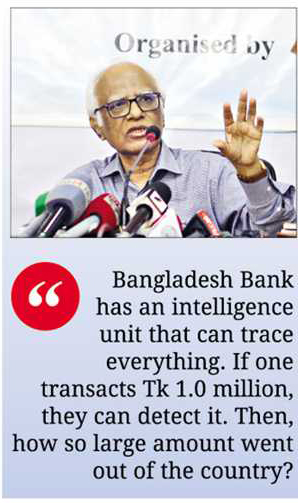
Dr. Mahmud said the Bangladesh Bank has an intelligence unit that can trace everything. "If one transacts Tk 1.0 million, they can detect it. "Then, how so large amount went out of the country?"
He said they did not take it by using the bag. "Banks must have footprints."
He regrets that Bangladesh has no free- trade agreements, but Vietnam has 25/30 FTAs. They have FTAs with the European Union.
He thinks China and India are good sources for imports-they never can be export destinations.
"Our export destination will be always Western economies as we are based on labour-intensive manufacturing.
"Not China and India, even the emerging economies will not be our good export destinations."
He said the China block is not favorable.
"We have to take position neutrally-who favors us or not should not be considered."
On higher inflation, Dr Mahmud said inflation is a neo-nominal equilibrium. "When inflation persists high, the inequality rises," Dr Mahmud said about the domino effect of consumer price rises.
jasimharoon@yahoo.com