
ADEQUATE FUEL STOCK IN BD
Decision on fuel price hike from May likely
Minister tells parliament about supply, price adjustment
FE REPORT | Wednesday, 8 April 2026
A decision to increase fuel prices from next month may be made following discussions at a cabinet meeting, the energy minister told parliament Tuesday, reassuring that Bangladesh holds adequate stock of fuels despite global crisis.
Minister for Power, Energy and Mineral Resources Iqbal Hasan Mahmud Tuku made the statement in the House during question hour on the tenth day of the first session of the 13th National Parliament.
The session was chaired by Speaker Hafiz Uddin Ahmad.
The minister explains that there is a structured mechanism for adjusting fuel prices, which is reviewed on a monthly basis. "The final decision for the coming month will be determined at the cabinet level."
Economists and energy experts are of the view that a hike in fuel prices would have domino effect on people's living and the economy at large.
Highlighting global challenges, Tuku pointed to geopolitical instability over the Middle East and restrictions imposed by Iran on shipping through the Strait of Hormuz, which have disrupted global energy-supply chains.
"Despite these challenges," he emphasizes, "the government has ensured a steady supply of fuel from multiple sources."
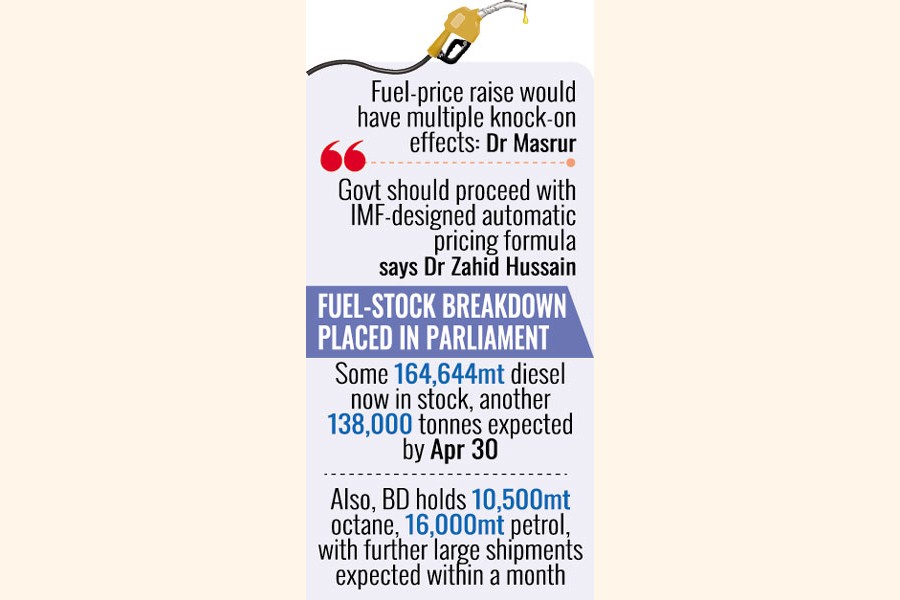
Providing an update on current reserves, the minister said Bangladesh has 164,644 metric tonnes of diesel in stock, with an additional 138,000 tonnes expected to arrive by April 30. The country also holds 10,500 tons of octane and 16,000 tons of petrol, with further large shipments expected within this month.
Comparing regional trends, he notes that Pakistan has increased fuel prices by 50 percent, while Sri Lanka has introduced fuel rationing. India, Afghanistan and Nepal have also raised fuel prices. "In contrast, Bangladesh has so far kept prices stable to reduce the burden on citizens."
To support farmers during the irrigation season, the government has instructed district administrators to issue "agriculture cards" to ensure uninterrupted diesel supply.
On enforcement, the minister reaffirms government's 'zero-tolerance' policy against illegal hoarding and smuggling of fuels.
Between March 3 and April 4, authorities had conducted 342 operations nationwide, filing 2,456 cases. These drives resulted in 31 jail sentences, fines totaling Tk 12.539 million, and the recovery of approximately 4.048 million litres of fuels.
The minister also assures parliament that monitoring has been strengthened through the appointment of "tag officers" at filling stations and regular virtual meetings with district administrations.
Economists are, however, divided over the government plan to raise fuel prices from next month, arguing about a difficult tradeoff between fiscal constraints and the cost of living.
One group says the increase will disproportionately hit low- and lower-middle-income households, as higher fuel costs are likely to feed through into the prices of essential goods and services.
Rising transport and production costs could amplify inflationary pressures already felt by consumers, they alert.
Dr M. Masrur Reaz, chairman and chief executive Officer of Policy Exchange Bangladesh, says the impact would be broad-based.
Higher fuel prices would raise labour and freight costs, feeding into the wider economy.
"Power and electricity costs will increase as a result of the adjustment, with multiple knock-on effects," he told The Financial Express.
He adds that irrigation and transport costs would rise sharply, placing an additional pressure on lower-income groups. Others argue that an adjustment is unavoidable, as such.
mirmostafiz@yahoo.com
jasimharoon@yahoo.com