
Deep Space Exploration poised to make a comeback
Zeenat Khan and Ferdous Khan from Maryland, USA | Wednesday, 21 December 2016
November 08, 2016 was a watershed day in US history. Contrary to all expectations, Donald J Trump won the US presidential election by winning the majority in the Electoral College count, although he was trailing the Democratic nominee, Hillary R Clinton by 2.7 million votes in the popular vote count. This is a monumental shift in US politics, as it portends a sharp break from the policies of the previous eight years under Barack H Obama. One such area where a sharp break is expected is in the arena of space policy, where the Trump transitional team wants to go back to 20-years-old policy of Deep Space Exploration, championed by George HW Bush, and then abandoned by William J Clinton. This reversal is not without consequences though, since the money for exploration is slated to come from existing programmes on Climate Change, Earth Science including Earth Observations as well as the Asteroid Redirect Mission favoured by Obama. This is in line with Trump's policy of de-emphasising the threat of Climate Change, as well as many of the salient features of the Obama administration such as the Affordable Care Act, Medicare expansion and a generous Immigration policy.
On the exploration front, the initial salvo came from two prominent Trump senior advisers, Robert S. Walker and Peter Navarro. Writing an Op-Ed in the SpaceNews, they argued that "NASA should be focused primarily on deep-space activities rather than Earth-centric work that are better handled by other agencies." Furthermore, "Human exploration of our entire solar system by the end of this century should be NASA's focus and goal." Trump's running mate, Indiana Governor Mike Pence in late October had promised to revive the National Space Policy Council, headed by a sitting Vice President (Mike Pence in the forthcoming Trump presidency) and representatives from the Industry, Military and Civilian space agencies, and Academia.
The focus will be, Pence tweeted, on reviving the space policy goals, presumably including deep-space exploration. Obama had promised to revive the Council, but never got to doing so for lack of enthusiasm. Obama actually increased the NASA Earth Science Budget by 63 per cent while slashing its exploration budget. President Obama repeatedly cut the budget for the Constellation programme, designed to take humans to Mars, threatening to veto it once it reached his desk. NASA Human Mars Mission was delayed until 2030 under his watch.
All that is poised to come back under Trump watch. In fact, Trump already met a group of Silicon Valley entrepreneurs, including Elon Musk, the CEO of SpaceX. SpaceX designs, manufactures and launches advanced rockets and spacecrafts. Trump may reduce the $2.0 billion plus budget on NASA Earth Sciences, and increase the funding for Space Technology and Astrophysics substantially. SpaceX, Orbital ATK and similar companies like Boeing will be possible benefactors. "Vibrant companies like Orbital ATK and SpaceX are already re-supplying the International Space Station (ISS). SpaceX and Boeing/ULA are developing systems to carry astronauts to ISS and beyond. Virgin Galactic and Blue Origin are leading the way on space tourism. Other firms like Paragon, Sierra Nevada, and Xcor are developing spacecraft and spacecraft components."
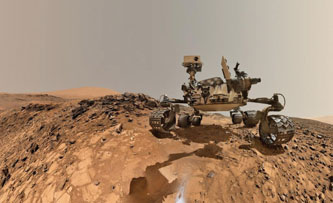
"The US space agency is already developing a capsule called Orion and a huge rocket known as the Space Launch System (SLS) to get astronauts to distant destinations such as Mars." Currently, NASA uses Russian Soyuz rockets to transport to ISS and the cost is $81 million dollars per astronaut. According to Dr. FirouzNaderi, a former NASA scientist who was in charge to re-plan the Mars programme since 2000, "We have been successfully exploring Mars, with different spacecraft, trying to better understand the potential of Mars." In an interview with Kayhn (an Iranian digital website) in London, Naderi added that NASA has contracted with SpaceX and Boeing to build commercial transports for ferrying astronauts. He predicted that the earliest these companies can provide spacecraft is 2018. The hope is to land man on Mars by 2030.
Deep Space Exploration has a cherished history in NASA chronicles. Ronald Reagan had signed the 1984 Commercial Space Launch Act. The 41st President of the US, George HW Bush was all set for sending man to Mars by the end of the century, assuming he would be re-elected in 1992 (Bill Clinton won), and another with similar enthusiasm will move in the White House in 1996. One of the authors of this article (ZK) clearly remembers those heady days of early 90's, when the spouse (FK) who used to work in Deep Space Radiation Protection programme at NASA Langley (in Virginia) would talk excitedly about human exploration of Mars as many exciting things were happening at NASA Langley Mars exploration research in terms of space radiation protection. The Radiation Environment on a Long Duration Mars Mission posed some of the most difficult challenges where radiation from all over the universe could impact the astronauts, their instruments in their spacecraft. The source of the radiation, Galactic Cosmic Rays (GCR) and Solar Energetic Particles (SEP) consisted of high energy protons, Helium nuclei, and heavier ions from the Cosmic Rays, which may travel at very high speed. With a spacecraft that is in transit for a good two years from the Earth to Mars then back, it made sense to think of the radiation danger posed by these potentially lethal particles to astronauts (manned mission) and/or spacecraft and its electronics. The key part of the understanding the danger meant figuring out what happens when nuclei at very high energy break up within the human body, and the associated biological radiation dose that it posed. The goal was to devise appropriate shielding for the astronauts and spacecraft to minimise immediate and long term damage to both. On impact with the body tissues (and computer electronics), the rays break up into smaller fragments which can be highly ionising, and thus detrimental to human health. As a result, NASA scientists today understand the nature of the hazard much better. In any case, all that activity came to a halt (not completely stopped) after Bill Clinton won. Bill Clinton and the US Congress did not share Ronald Reagan or George H W Bush's American pioneering spirit in exploring the unknown. Clinton saw little value in pursuing the 'next frontier,' and his liberal arts background most likely didn't help to follow a goal that emphasised scientific exploration of the Red Planet that we know so little about. The priority became, in the now famous words of one of his advisers, "it's the economy, stupid!"
Is exploring Deep Space worth the investment? Americans are justified in asking, as did the Clinton and the Obama administrations, whether billions of dollars are worth spending in exploring the Solar System, including Mars, where there is an endless list of issues that need attention than space exploration. Walker and Navarro answer this as follows. Every dollar that is invested wisely on the US space programme will deliver robust returns in terms of inventions, innovations, and economic growth. The second reason for an ambitious space programme is existential. Advanced industrial nations such as "China and Russia continue to move briskly forward with military-focused initiatives." Each continues to develop weapons explicitly designed, in the strategic parlance, to "deny, degrade, deceive, disrupt, or destroy" US capability in space. US strategic advantage in space requires that the space programme be reinvigorated. "Space represents a challenge of infinite proportions. There is no environment more hostile. There are no distances to travel that are greater."
NASA scientists never gave up on making it to Mars one day. In the 1890s astronomer Percival Lowell thought he saw "an intricate system of canals that must have been built by intelligent beings." He never found them but even on a shoestring budget his predecessors have kept up their unyielding research to answer the ultimate question: "Are we alone in the universe?" After about 40 years of experimenting with robots, they kept on hoping that one day another president will provide them inspiration and allocate more money for NASA to begin an exhilarating journey for the human exploration of Mars. Perhaps with President-elect Donald Trump their prayers have been answered. Only time will tell.
Ferdous Khan is a theoretical nuclear physicist who did his post-doctoral research at NASA Langley's space radiation programme in the early 1990s.
zeenat.khan1983@gmail.com