
Democracy at work in Delhi: Lessons to learn
Muhammad Zamir | Monday, 23 February 2015
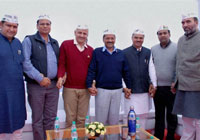
Kejriwal and Modi have proven that it is possible for an ordinary man to come into politics in India and win. It has been a departure from what had been happening over the last 67 years, when politics had become an exclusive club of the top one per cent of that country. We have a lot to learn from this exercise.
The swearing-in ceremony is over and India's unwieldy capital has a new Chief Minister - Arvind Kejriwal - leader of the Aam Admi Party (AAP) and a cabinet of six members. Kejriwal has however not kept any portfolio for himself. His victory has been particularly embarrassing for Prime Minister Modi, as he on behalf of the Bharatiya Janata Party (BJP), had thrown his personal weight to highlight his party's election campaign and also to enhance the chances of victory for former police official Kiran Bedi, BJP's chief ministerial candidate. This was done to assert his growing national importance also in the domestic context in the capital. The exercise has, however, for the first time since the start of his prime ministership, provided, as observed by Monobina Gupta with "a credible political opposition party" and "an imaginative balance" to the BJP juggernaut within India.
This time round the increased support for the AAP appears to have come from the youth, lower middle class and sections of people caught in the poverty trap. Kejriwal was perceived as one who could deliver their minimum needs - clean drinking water and electricity - thereby improving their social security. S.S. Pattanaik, a political analyst, has pointed out that of the total electorate, young voters constituted 1.31 per cent and that AAP was able to mobilise this section. Many of them apparently volunteered themselves as political workers and campaigned for this party in educational institutions - whose multiplier effect was not foreseen by the BJP or the Congress. This significantly contributed to greater awareness among the lower and middle income class whose family members attend such institutions. Many now suggest that this and the 67 per cent turnout helped to turn the table towards AAP and it winning 67 of the 70 seats in this election. This was a considerable change from the 2013 election where the AAP won 28 seats. The BJP, which had been relatively apathetic about local elections in Delhi after their massive victory in the national elections last year, appears to have been caught unawares with the local developments. Their number of seats in the 2013 Delhi elections was 32; it fell this time to 3. The Congress party also continued with their pathetic performance, by failing to win even one seat out of 70.
Analysts have pointed out that this miserable result on the part of BJP and Congress was partially because of the AAP catching the imagination of the Muslim voters in Delhi. Last time in 2013, a majority of them had voted for the BJP and some for the Congress. It is understood that part of the swing towards AAP also resulted out of appeals to voters on behalf of the AAP by left-political parties from outside Delhi, including the Trinamool Congress led by the Chief Minister of the State of West Bengal.
Polls leading up to the election had suggested the possibility of a narrow victory for the AAP, but no one foresaw such a drubbing of all the other Parties. Modi also failed to realise the latent popularity that existed among the poorer classes in Delhi for Kejriwal and unfortunately. He ended up terming Kejriwal as a "backstabber" who had betrayed voters last time round by quitting his post and responsibilities only a few weeks after taking office as Chief Minister of Delhi. Critics generally agree that the result has been a personal setback for Modi and the BJP. This defeat may eventually end up being a crucial challenge for Modi. He needs to win State elections in the coming years to gain control of both Houses of the national parliament, where he is attempting to push through certain agenda reforms on land acquisition (a sensitive issue for upper class rural landowners), tax and certain issues related to the economy. His efforts are presently being frustrated in the Upper House (where the BJP lacks the necessary majority) where States are allocated seats.
Kejriwal and his AAP have played their cards very cautiously in the days leading up to the election and also since then. He has continued to demonstrate his eagerness to be identified with the common man by transcending political borders. He has interpreted his commitment as a task that is aimed at restoring a level playing field for the common man. In this context he has emphasised on the need for greater security for ordinary citizens rather than any emphasis on himself and his senior colleagues within the AAP. Accordingly, he has refused to permit Z-Plus security facilities for himself, because according to him, this will disconnect him and his party leadership from the masses. Instead, he has supported the idea of installation of more CCTV cameras in Delhi, soonest possible. He has also asked that steps be taken to ensure women empowerment and emphasised that all the 67 MLAs from AAP should lead by example. This has however led some gender activists to ask the question as to why Kejriwal' selection of his Cabinet does not include any lady member. That will probably happen sooner than later.
In the same vein, to reduce the suffering of the poorer section, he has asked the relevant authorities to ensure that the poorer communities living in city ghettos receive free 20 liters of water per person per month. He has encouraged the installation of water metres so that there is no wastage and greater conservation. He has promised to adopt measures that would not permit soaring of power tariffs which harm the socio-economic prospects of the lower income groups in a city of over 15 million. On his personal initiative, different administrative heads of government departments in Delhi have also been asked to prepare presentation of the challenges being faced by them in the form of manifestos that can then be discussed for resolution by the new Chief Minister and his newly-appointed Cabinet. He is hoping that if he cannot resolve the existing issues, then he will seek inter-active engagement with the relevant central Ministries in Delhi. It may be added here that last time round, he faced difficulties with regard to financial support structures, due to absence of devolution in certain sectors.
This election has highlighted another red card for Modi - one that has also drawn the attention of US President Obama - religious freedom in India. The Delhi election result has, according to many, underlined the uneasiness of the upwardly mobile urban population in Delhi with (as pointed out by the Hindustan Times) "the persistent toxic vilification of minorities by BJP figures and ideological affiliates, saffronisation of education instead of preparing the young for a globalised workplace and loony rhetoric about ancient science and reproductive obligations of women". These have been turn-offs for the urban clientele of Delhi with their entrepreneurial instincts. Understanding the sentiment Modi has already called in the Police Commissioner in Delhi and instructed him to provide additional security to the minority communities of different faiths living in Delhi - a bit late according to some.
Kejriwal after his victory, landed on the ground running even before he was sworn in on February 14. He knew that he required a miracle to deliver on his promises. This was achieved through his meetings with Modi and other important central leaders of the BJP in charge of important Ministerial portfolios that would be significant for achieving what he had promised in the AAP manifesto. One amongst them was the Union Home Minister Rajnath Singh, whose support will be essential with regard to the sensitive issue of Delhi being granted complete statehood rights. The second crucial step has been requesting Venkaiah Naidu, the Union Minister for Urban Development, to take steps to identify necessary land in and around Delhi for arranging proper housing for the poorer class and also for helping to set up more schools, colleges, hospitals and parking facilities. These areas of interest can only boost AAP's popularity.
As mentioned by Amy Kazmin and Victor Mallet in the Financial Times, Kejriwal has emerged "as a lightning rod for dissent, especially over controversial policies" initiated earlier by the Congress party and subsequently by the BJP "favouring big business at the expense of ordinary people". They have noted that this victory appears to have expanded the horizon for the AAP and they are now talking openly of "a fundamental transformation of India's money-driven political system" with its existing process of "opaque campaign financing".
BJP's slip in terms of representation and the inability of Congress to win even a single seat in the Delhi state election show that democracy is functioning in India and that its citizens rely on themselves to bring forth change without relying on external actors for this purpose - something we need to follow in Bangladesh.
The writer, a former Ambassador, is an analyst
specialised in foreign affairs, right to information
and good governance.
mzamir@dhaka.net