
Demographic transition: Challenges and opportunities
Andrew Mason reviewing the book | Friday, 29 August 2014
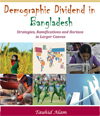
The demographic transition in Bangladesh is leading to slower population growth and changes in population age structure that will pose challenges and create opportunities. Fe rtility is continuing its decline to low levels, but population growth continues under the influence of population momentum.
Demographic change is creating a "window of opportunity" as the child dependency burden declines and the share of the population in the working-age increases. Many countries in East and Southeast Asia have succeeded in reaping a demographic dividend that has boosted economic growth. As Asian countries move further along in their demographic transition, they will continue to experience important social and economic implications for decades to come.
First, in all countries, the percentage of children in the population is declining or has already reached low levels, largely because of rapid decline in birth rates. Second, and more significantly, the proportion of the elderly and working age population is increasing throughout Asia. The acceleration has been particularly pronounced in high-income countries, mainly because of their very low fertility rates. But lower-income countries in the region will experience significant increases in the relative size of their working-age populations in the next few decades.
The demographic dividend is not, however, an automatic consequence of favourable demographic changes. Rather, it depends on the ability of an economy to productively use its additional workers. The "East Asian Miracle" is a case in point. The key to reap the dividend offered by favourable demographic transition is to make adequate investment in the next generation of youth.
This book illustrates the most updated account of population and demographic trends and prognosis of Bangladesh with a detailed analysis of the prospects and challenges for augmenting a demographic dividend accruing from the steady demographic transition of the country along with the entailing social and economic transformation.
Understanding demographic change and its implications for Asia has been at the centre of my own work throughout my career. Each decade is bringing new opportunities and challenges to be analysed by a new generation of scholars. I congratulate Tauhid Alam who worked in the United Nations Population Fund (UNFPA) Bangladesh for taking up this endeavour and making such an important contribution to our understanding of the linkages between population and development.
Dr. Andrew Mason is Professor of Economics, University of Hawaii and Senior Fellow, East
West Center Hawaii. mason@hawaii.edutouhidalam@
hotmail.com
..........................
Demographic Dividend
in Bangladesh: Strategies, Ramifications and Horizon in larger Canvas
by Tauhid Alam
Academic Press and Publishers Library
ISBN 978 984 90880
On line book shop: www.rokomari.com
Price: BDT 2000, No of Pages 208