
Denim makers altering Keraniganj landscape
Jubair Hasan | Sunday, 1 March 2015
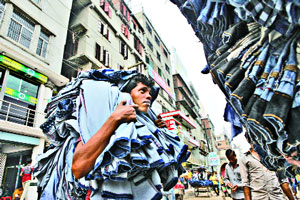
Thousands of denim products manufacturers across the Buriganga river have made their mark and are now exploring export potentials after meeting a major portion of domestic demand, owners said.
The jeans product producers have created jobs for more than 0.3 million people and are capable of supplying over 70 per cent of the country's total demand for denim wears.
Albeit informally, the manufacturers have also forayed into the export markets by exporting small volume of the products to countries such as India, Nepal, Bhutan and Myanmar in recent years.
Considering the growing number of factories and sound production atmosphere, insiders liken it to China's Shaoxing city.
Located on the bank of the Buriganga, Keraniganj is home to an estimated 5,500 small and medium-sized factories, mostly denim making units that make various types of clothing for local customers.
Wholesalers and retailers from all over the country come to purchase the good quality products from a cluster of 200 markets in the textile hub.
According to the factory owners, the area was known for supplying re-modified used cloths in the 1980s. Since then the area has rebuilt itself as an apparel manufacturing belt for the local market.
Talking about the shift and prospect, Jahangir Hossain, owner of Grameen Pant House, said he started manufacturing business with two sewing machines with an investment of nearly Tk 10,000 in 1992.
"At present, I've 100 machines which produce nearly 0.1 million piece of denim products a year and more than 100 people are employed here," he said.
He said like him, there are a good number of factory owners, who once worked there and now owns manufacturing units. "We're now competing with the Chinese jeans because of the quality of our local products," he added.
Md. Saiful Islam, owner of Sadiya Garments that makes jeans and gabardine items, said he initially invested nearly Tk 0.2 million one and half years ago, leaving his rent-a-car business.
"Now I can supply more than 250 items a week and I have a plan invest further if the ongoing political chaos comes to an end," he said.
He said manufacturing units in the densely-populated industrial zone also created the space for other businesses like housing, shops, furniture, accessories and allowed them to grow.
Alamgir Hossain, owner of New Dipu Pant House, said a few 'luggage party' men from outside the country visit the area and take 100 to 200 items in their luggage during the travel.
"The manufacturers are very innovative in terms of design keeping new market trend in mind and that's the speciality of the hub," he said.
He said wholesalers all over the country purchase various types of jeans and gabardine item at Tk 150 to Tk 500 and then sell those to Tk 250 to Tk 900 to local customers.
Owners said the daily sales at the cluster, which houses around 200 markets spread over an area of two kilometres are nearly Tk 300 million.
General Secretary of Keraniganj Garment Manufacturers and Merchant Association Mizanur Rahman said this is a unique apparel industrial area, which saw no labour protest in the past because of good relations between owners and workers.
He said the owners well understand pulse of the workers as a good number of them were working at the units.
"Manufacturing units are dominating economic and development activities. So, it's making a silent revolution by improving the livelihood of the growing population in the suburb," he said.
He identified high bank rate, political instability, deteriorating law and order situation, shortage of utilities services as major barriers to developing businesses in the area in a more robust way.
Jeans trader Aminul Islam, who has a shop at Bangabazar in Gulistan, said the traders in many cases sell those denim products of Keraniganj in the name of products made in Thailand, Hong Kong and China.
He admitted that the manufacturers use the foreign tags to satisfy local consumers who like overseas clothing.
The manufacturers said they are now focusing more on quality and design of the relatively low-cost products, which have good demand in neighbouring countries.
They also said the Keraniganj manufacturers can earn a good amount of foreign currencies through exports.
jubairfe1980@gmail.com