
Denmark and Bangladesh -- a strong partnership
Thursday, 5 June 2014
Denmark was among the first countries to officially recognise Bangladesh following Independence in 1971. Bangladesh was then one of the poorest nations in the world and on the verge of humanitarian disaster. Today, a little more than 40 years later, Bangladesh has emerged as a country that enjoys impressive economic growth and remarkable social progress.
Bangladesh has been a chief recipient of Danish development assistance since Independence. Together Denmark and Bangladesh have come a long way over those years, moving from a more traditional donor-recipient relationship to a strong partnership based on mutual interests. Poverty reduction and promotion of human rights and democracy have always been - and will remain - the overriding principles of our long-standing cooperation.
The partnership between Denmark and Bangladesh has expanded over the years to include a strong focus on commercial cooperation. Denmark has for many years been active in promoting growth and development in Bangladesh through trade and business. Denmark has a number of business instruments at hand in Bangladesh - one of the oldest and most successful is the Danida Business Partnership Programme (DBP) that brings together Bangladeshi and Danish private companies. More than 100 different partnerships have been established since the programme was initiated, creating jobs and prosperity in Bangladesh through transfer of knowledge and technology from Danish to local companies. Denmark is also putting more and more emphasis on integrating private sector into development programmes, using the know-how of Danish companies to address key challenges in Bangladesh in areas as renewable energy and water resource management.
The span of Denmark's cooperation with Bangladesh is extensive, ranging from innovative business partnerships that bring new solutions to farmer field schools that benefit millions of people in rural Bangladesh.
Make the problem a solution - an innovative business approach to wastewater
Danidais currently supporting Pure H2O, a Danish company that collaborates with several Bangladeshi partners. Pure H2O together with Navana Group, OEKO-TEX and BSR (HER Project) works on cleaning wastewater from the garment industry. With a strong CSR approach the partners are setting up a water filtration unit within OEKO-TEX (a garment factory) that will make it possible to reuse the wastewater from the garments production to provide clean drinking water to the workers. With this project Bangladesh is leading the way in addressing the global problem of a pollution arising from the textile production. The project at the same time addresses one of Bangladesh' major challenges: clean drinking water.
Pure H2O provides the technology and know-how to clean the wastewater from the garment production. No chemicals are required in the purification process which makes it a sustainable and green project. Navana Group is the local counterpart of Pure H2O that provides technical and maintenance support for the equipment piloted at the factory premises. They also contribute by powering the unit with solar energy which further mitigate the energy challenges in Bangladesh. To make sure that the access to clean drinking water improves the living standards, the HER project educates the workers on how to clean the water canisters and related hygiene issues.
Since this project is built around wastewater treatment, renewable energy and clean drinking water, it subsequently helps mitigate the water and energy problems in Bangladesh while at the same time improving the living conditions for garment workers and the local community.
Farmer Field Schools help feed 3 million Bangladeshis
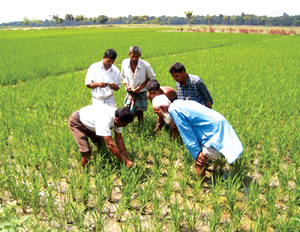
Danida has also supported Farmer Field Schools since 2006. The schools - established in rural areas all over Bangladesh - help poor and landless farmers increase the total profit of their crop. Farmers attending the schools have learned about more effective methods of cultivation, production and marketing, and they have been taught about nutrition and hygiene. To this day, more than 800.000 farmers have gone through training at Farmer Field Schools. Overall, more than 3 million people - the farmers and their immediate families - have benefitted from the project. They make more money on their crops, eat better and are in better health than before. The project has reached even further as some of the participating farmers shared their experiences and knowledge with other farmers outside of the Farmer Field Schools.
Not only did most farmers increase their total yield, they were also able to sell more fish and chicken as well as earn more on their products. Overall, the annual income of families rose by 38 percent. This increase also affected other parts of society as the farmers were able to expand their business and hire more people. Food shortages dropped from 20% to 11% and the cost of fighting diseases has also gone down due to better nutrition and hygiene.
In the years to come, 1 million men and women are expected to participate in the Farmer Field School programme to become self-reliant and gain a broader knowledge on crops, livestock and fisheries.