
Capital Shortage, Factory closures
Deshbandhu Group pleads for govt intervention
REZAUL KARIM | Sunday, 14 September 2025
Deshbandhu Group, one of Bangladesh's leading industrial conglomerates, has sought urgent government intervention to continue operations and prevent possible labour unrest as it struggles with an acute capital shortage, sources said.
Managing Director (MD) Golam Rahman has formally appealed to the Ministry of Labour and Employment for taking necessary measures to safeguard the group's businesses and employment base. Following the request, the ministry forwarded the matter to the Ministry of Finance for action under existing rules and regulations.
"We have received a letter from Deshbandhu Group and are scrutinising the issue," said an official of the ministry.
The group says its operations have suffered severely since 2020 due to the combined fallout of the Covid-19 pandemic and the Russia-Ukraine war.
According to the MD, depreciation of the taka, surging raw material prices, and rising operating costs have all contributed to a prolonged capital shortage.
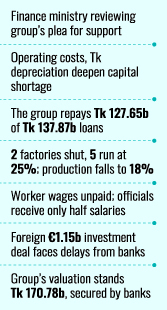
Since 2005, the conglomerate has borrowed Tk 137.87 billion from 19 banks and financial institutions, repaying Tk 127.65 billion up to July 2025. Despite these repayments, Deshbandhu claims banks have not extended new loans or facilitated restructuring of existing ones, leaving the group starved of working capital.
The shortage of funds has already forced the closure of two factories, including its sugar mill. Five more factories are running at no more than 25 per cent of capacity.
Overall, the group says its production has fallen to just 18 per cent of total capacity, as it struggles to source raw materials without access to import LCs.
"Since January 2024, especially from August last year, we have been unable to obtain LCs from banks. As a result, we are forced to collect raw materials domestically at inflated prices, reducing output to one-fifth of our actual capacity," the MD said.
The cash crunch has also hit the livelihoods of Deshbandhu's 25,000 workers and employees.
For the last six months, the company has managed to pay wages by borrowing from alternative sources. However, it has only been able to pay 50 per cent of salaries and allowances to engineers, chemists, and other officials.
Last month's wages for workers remain unpaid, raising fears of labour dissatisfaction and unrest. "We are deeply concerned that worker grievances could escalate at any time if the situation continues," Mr Rahman warned.
Although the management has not yet announced layoffs, the MD cautioned that the option may become unavoidable if the crisis persists.
In letters to Bangladesh Bank, the Finance Division, and the Financial Institutions Division (FID), the group requested urgent instructions to banks to provide fresh working capital, open back-to-back LCs for raw materials, and reschedule loans under BB guidelines.
Instead, the company alleges, some banks classified its accounts rather than rescheduling them. This has further restricted credit lines, leaving factories unable to procure raw materials or sustain production.
To ease its financial troubles, Deshbandhu signed a foreign investment agreement worth €1.15 billion. The Bangladesh Investment Development Board (BIDA) even issued an appreciation letter to Bangladesh Bank in support of the group.
However, the company claims that banks have yet to provide the required documentation to the foreign investor, delaying the deal and putting the investment at risk of cancellation.
"If the process drags on, Bangladesh could lose out on a major inflow of foreign capital," the MD cautioned.
An evaluation by Ernst & Young valued Deshbandhu Group at Tk 170.78 billion, mortgaged and secured by seven banks. Despite this significant asset base, the group says that for the past year these banks have declined to provide working capital or open LCs, leaving its factories paralysed.
With businesses across sugar, textiles, cement, food, and real estate, Deshbandhu Group plays a notable role in Bangladesh's industrial landscape. But unless urgent steps are taken, the conglomerate warns that production shutdowns and unpaid wages could spark widespread labour unrest.
"The survival of 19 factories and the livelihoods of 25,000 workers are now at stake. Without immediate support, the consequences could be severe for both the company and the economy," Mr Rahman said.
rezamumu@gmail.com