
Despite strong profits, Biman's total assets decline for third straight year
GULAM RABBANI | Tuesday, 24 February 2026
Despite repeated claims by Biman Bangladesh Airlines that it has remained profitable over the five consecutive years, the national carrier's total assets have continued to decline.
According to the airline's latest audited financial statements, total assets stood at Tk 168.72 billion at the end of fiscal year 2024-25 (FY'25). This marked a drop of Tk 4.18 billion from Tk 172.90 billion in FY'24, while the figure was Tk 173.76 billion in FY'23, indicating a downward trend over the past three years.
The asset breakdown for FY'25 is as follows -- Tk 94.58 billion in aircraft equipment, Tk 17.71 billion in other non-current assets, Tk 30.79 billion in current assets, and Tk 25.64 billion in cash and bank balances.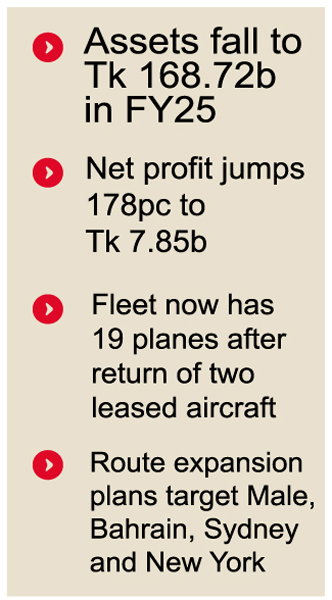 The asset decline occurred even as Biman reported strong earnings.
In a statement last month, the airline said it posted a net profit of Tk 7.85 billion for FY'25, a 178 per cent surge from the previous fiscal year. Its operating profit was Tk 16.02 billion, while total revenue rose 9.46 per cent year-on-year to Tk 115.59 billion -- the highest in its history.
These figures were disclosed in the airline's annual financial statements presented at its Annual General Meeting (AGM) on December 30, 2025, chaired by then board chairman Sk Bashir Uddin.
According to the statement, the state-owned airline has sustained profitability for five consecutive years and recorded net profits in nine of the past ten fiscal years, suggesting a period of sustained financial success.
However, the ongoing asset erosion contrasts sharply with the absence of significant capital expenditures, particularly in fleet expansion. No new aircraft have been acquired in recent years, with the last additions being two Dash-8 aircraft in early 2021, sources said.
The fleet has now just 19 aircraft after two leased planes were returned last year upon contract expiry. The current fleet composition includes four Boeing 777-300ERs, four Boeing 787-8s, two Boeing 787-9s, four Boeing 737s and five Dash-8-400s.
A company official, who declined to be named, told The FE that the decline in assets was primarily due to depreciation charges and reduced cash balances.
The financial statements noted that the company purchased stores and spare parts during the period under review. Such acquisitions would ordinarily be reflected in total assets, but their apparent absence from reported figures has raised questions about whether the purchases were properly recorded and accounted for.
Kazi Wahidul Alam, a former Biman board member and aviation expert, said that while assets naturally lose value over time due to depreciation, this should not occur in a profitable commercial organisation.
He stressed the need to improve operational efficiency and ensure management by experienced aviation professionals, arguing that excessive bureaucratic control hampers performance and that a commercial airline should be run on business principles rather than administrative dominance.
When asked, newly appointed Managing Director and CEO Dr Humayra Sultana declined to comment on the matter.
Biman currently operates flights to 22 international destinations and plans to expand its network to Male, Bahrain, Sydney and New York -- routes considered potentially profitable.
Amid rising international travel demand and growing competition from foreign carriers, Biman unveiled an ambitious decade-long plan in March 2024 to acquire at least 26 new aircraft and expand its route network.
Despite adopting such ambitious plan, the authorities couldn't make any firm decision or place orders with any manufacturer for a long time, even as two aviation giants -- Europe's Airbus and the US-based Boeing -- repeatedly submitted their proposals.
However, at its latest AGM, the Biman took an "in-principle" decision to purchase 14 aircraft from Boeing.
bikashju@gmail.com