
DGHS to set up 170 city health centres in Dhaka, Chattogram
JAHIDUL ISLAM | Friday, 10 April 2026
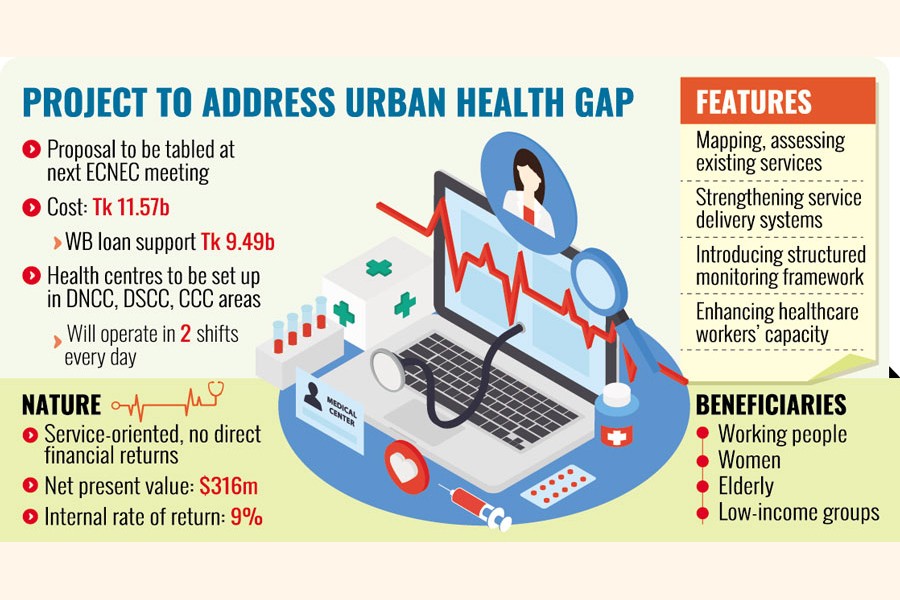
The Directorate General of Health Services (DGHS) is going to establish 170 city health centres in the metropolitan areas of Dhaka and Chattogram within the next three years to address serious health-service deficiency in urban areas.
The Health Services Division under the Ministry of Health and Family Welfare proposed a project with an estimated cost of Tk 11.57 billion in this regard.
The project will have loan support of Tk 9.49 billion from the World Bank.
Officials say the project proposal was initially considered for placement at the latest meeting of the Executive Committee of the National Economic Council (ECNEC), although it was not included in the formal agenda.
It was later decided to place the proposal as a tabled item, but the meeting ended ahead of schedule.
The proposal is now expected to be presented at the next ECNEC meeting.
The proposal says the project titled "Expanding Access to Integrated Health Care for the Urban Population" aims at strengthening primary healthcare services in cities.
Urban public primary healthcare coverage remains limited, despite nearly 40 per cent of the country's population living in city regions.
Out of the 35 government outdoor dispensaries under the health ministry in urban areas, 17 are in the capital and nine are in Chattogram City Corporation (CCC) areas.
Services are typically available only in the morning, restricting access for a large segment of urban residents.
Under the project, 170 city health centres will be established in the areas of Dhaka north, Dhaka south, and Chattogram city corporations.
They will provide primary healthcare services in two shifts, aiming to improve access for working people, women, the elderly, and low-income urban populations.
The project also seeks to establish a "hub-and-spoke" network, linking urban primary healthcare and nutrition centres with referral facilities to ensure integrated service delivery.
At least one functional primary healthcare centre is planned for each ward in the selected city corporations.
The initiative comes amid rapid urbanisation, with city population rising from 27 per cent in 2011 to over 40 per cent in 2023 and projected to reach 86.5 million by 2030.
Dhaka alone is expected to host around 28 million people by then, intensifying pressure on healthcare infrastructure.
Officials note that urban primary healthcare remains fragmented, with responsibilities divided across multiple ministries and institutions, resulting in weak coordination.
As a result, many urban residents rely heavily on private healthcare services, increasing out-of-pocket expenditure.
The project includes mapping and assessment of the existing services, strengthening service delivery systems, introducing a structured monitoring framework, and enhancing the capacity of healthcare workers through training.
It will also ensure the supply of medicines, equipment and climate-resilient infrastructure, along with improved water, sanitation and hygiene (WASH) and medical waste management systems.
Although the project is service-oriented and does not generate direct financial returns, an economic analysis found it viable, with an estimated net present value (NPV) of $316 million and an internal rate of return (IRR) of 9 per cent.
The Planning Commission has recommended the project for approval, subject to signing a memorandum of understanding with the Local Government Division (LGD) to ensure coordination and sustainability.
jahid.rn@gmail.com