
Dhaka bourse hits two-month low, as investors absorb money tightening shock
FE REPORT | Monday, 9 October 2023
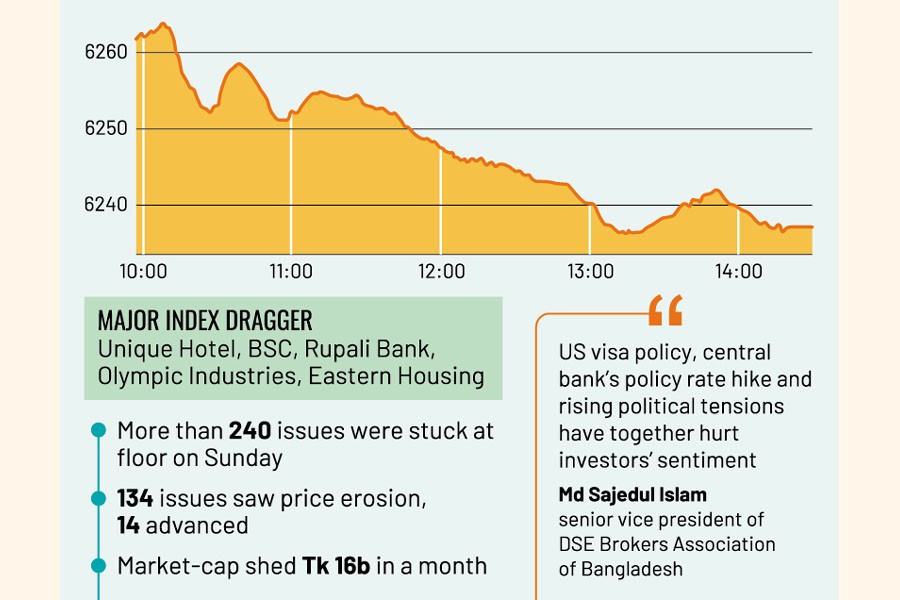
The key index of the Dhaka bourse hit two-month low on Sunday as jittery investors continued to dump holdings to exit the market.
As the market absorbed the impact of US visa restrictions, it received another blow from the policy rate hike by the central bank, intended to tame inflation.
The Bangladesh Bank last week raised its key policy rate, also known as the repo rate, by 75 basis points to 7.25 per cent, the highest in a decade.
Repo rate is the rate at which the central bank lends money to commercial banks in the event of any shortfall of funds.
With the increase in the repo rate, borrowing costs of commercial banks from the Bangladesh Bank will go up, leading to a spike in the banks' lending rates.
The central bank has already raised the lending rate for banks to 10.7 per cent as part of a belt-tightening measure for reining in the runaway inflation.
The latest moves make funds costlier, which is expected to drive money flow from the stock market to banks. Many investors are likely to invest in fixed-income deposits rather than in the stock market, market analysts said.
Multiple factors, such as US visa policy, policy rate hike, and rising political tensions, have together hurt investors' sentiment, said Md Sajedul Islam, senior vice president of the DSE Brokers Association of Bangladesh.
"The prevailing floor price discourages investors from putting fresh bets on stocks, while one issue after another emerges eroding their confidence," said Mr Islam, also managing director of Shyamol Equity Management.
The new policy rate will gradually slow down the money flow to the stock market, he added.
The market fell from the start of the Sunday's session as investors, particularly the retail ones, went for panic sales. It plunged below 6,250-mark at the opening.
The DSEX, the benchmark index of the Dhaka Stock Exchange (DSE), finally slid 24.48 points to settle at 6,237, lowest in nearly two months.
Top negative index contributors were Unique Hotel, Bangladesh Shipping Corporation, Rupali Bank, Olympic Industries, and Eastern Housing. These securities jointly contributed one-fourth index fall, according to amarstock.com, a market data analyst.
Two other indices also ended lower. The DS30 Index, which consists of blue-chip companies, fell nearly 7 points to 2,130 and the DSES index, which represents Shariah-based companies, dropped 4.55 points to 1,351.
Turnover, a crucial indicator of the market, also fell 6 per cent to Tk 3.68 billion, the lowest since August 20.
The market capitalisation, which refers to the total market value of companies' outstanding shares, shed around Tk 16 billion in a month to Tk 7,769 billion by the end of Sunday.
Stocks plummeted as investors went for heavy sell-offs for they became unnerved by the central bank's money tightening policies, said EBL Securities.
All the sectors faced selling pressure, leading to price erosion of 55 per cent traded stocks. Out of 297 issues traded, 134 declined, 14 advanced and 149 remained unchanged.
General insurance sector took the biggest hit, losing more than 4 per cent, followed by IT, services & real estate, paper & printing and tannery.
Sea Pearl Beach Resorts was the most-traded stock with shares worth Tk 177 million changing hands, closely followed by Gemini Sea Food, LafargeHolcim, Fu-Wang Food and Bangladesh Shipping Corporation.
Loss-making Central Pharmaceuticals was the top gainer, soaring 9.91 per cent while Miracle Industries the worst loser, losing 8.90 per cent.
The Chittagong Stock Exchange (CSE) also saw a massive decline with the CSE All Share Price Index (CASPI) shedding 54 points to settle at 18,477 and its Selective Categories Index (CSCX) losing 32 points to 11,046.
Of the issues traded, 79 declined, only 8 advanced and 37 issues remained unchanged on the CSE trading floor.
The port-city bourse traded 2.65 million shares and mutual fund units with a turnover volume of Tk 162 million.
babulfexpress@gmail.com