
Dhaka stocks drive index up in H1 on high hopes of reforms, economic revival
BABUL BARMAN | Wednesday, 1 July 2026
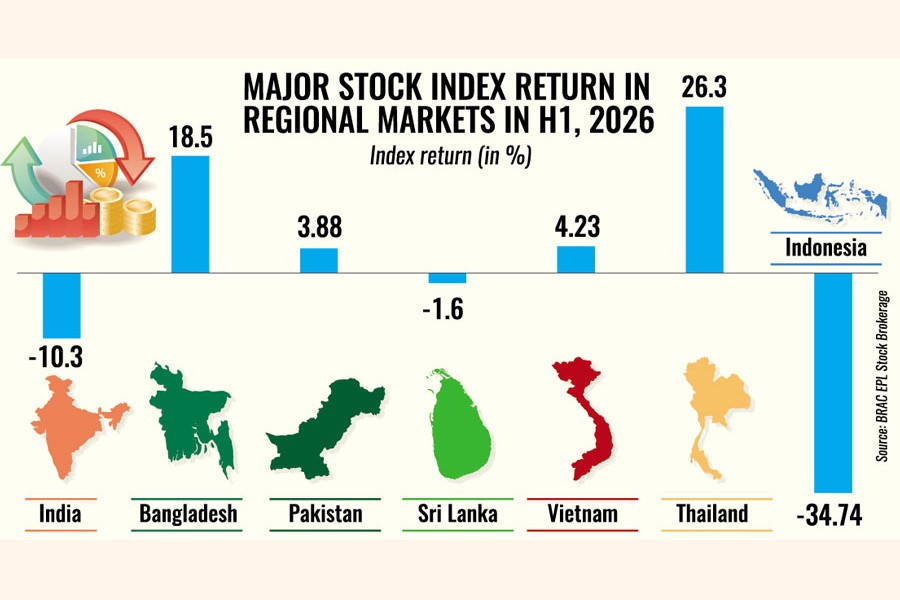
Bangladesh's stock market staged a strong recovery in the first half of 2026, with the benchmark index of the Dhaka Stock Exchange (DSE) surging more than 18 per cent, buoyed by signs of macroeconomic rebound and growing optimism over sweeping regulatory reforms.
The surge in the index after years of depression reflected a gradual return of investor confidence as the newly elected government stepped up efforts to restore market discipline and revive the broader economy.
The benchmark index, DSEX, climbed nearly 900 points to 5,763 in the six months through Tuesday, the final trading day of the first half of 2026. Market capitalisation rose 3 per cent to Tk 6.98 trillion during the period.
In the same period, India experienced a negative index return of 10.3 per cent, while Pakistan witnessed a marginal index rise of 3.88 per cent and Thailand's market grew by 26.3 per cent, according to BRAC EPL Stockbrokerage.
The DS30 index, comprising Bangladesh's blue-chip companies, surged 325 points, while the DSES index, which tracks Shariah-compliant stocks, advanced 168 points, indicating broad-based gains across different market segments.
The recovery was driven by a combination of political and economic factors, including easing domestic uncertainty, stronger foreign exchange reserves, a more stable exchange rate, moderating inflation and renewed policy attention to the capital market, said Md Sajedul Islam, a director of the DSE.
"Improved domestic cues and repeated political commitments of the government toward capital market development boosted investor confidence," he said.
Investor sentiment received another major boost following the appointment of renowned chartered accountant Masud Khan as chairman of the Bangladesh Securities and Exchange Commission (BSEC) in early June. Three new commissioners were also appointed for four-year terms, signalling a comprehensive overhaul of the country's capital market regulator.
The new leadership has raised expectations of stronger regulation, greater transparency and long-awaited structural reforms, encouraging investors to increase their exposure to equities, said Salim Afzal Shawon, head of research at BRAC EPL Stock Brokerage, while talking to the Financial Express over the phone.
"Investors had been expecting regulatory changes for quite some time. When the government finally introduced a major reshuffle at the regulator, it helped restore confidence among market participants, as seen in similar situations before," Mr Shawon said.
Investors poured fresh funds into fundamentally strong stocks, particularly in the second quarter of 2026, amid growing optimism over sweeping changes in the securities regulator.
Large-cap and fundamentally strong stocks led the rally. Blue-chip companies generated price returns ranging from 2 per cent to 37 per cent during the six-month period, with share prices of 27 of the 30 DS30 constituent companies posting gains.
Market momentum was also visible in daily trade turnover. Average daily turnover jumped 53 per cent year-on-year to Tk 8 billion during the January-June period this year.
"The rise in turnover suggests that confidence is gradually returning to the market," Mr Shawon said, adding that investors are increasingly positioning themselves ahead of anticipated reforms.
After assuming office, the new BSEC chief pledged to restore investor confidence, attract quality companies to the stock market and transform Bangladesh from a retail-driven frontier market into a transparent, institution-led emerging market.
The newly formed BSEC commission recently lifted the floor prices on shares of Beximco and Islami Bank, bringing an end to the floor price regime after four years.
Although the stock price of Beximco suffered a steep fall, the impact on the benchmark index remained limited due to Beximco's prior exclusion from the index, while more than 80 per cent of Islami Bank shares remained locked.
Mr Khan announced plans to conduct a comprehensive review of existing securities regulations, IPO approval procedures and reporting requirements to make the regulatory framework more efficient and business-friendly.
He noted that many large local corporations, multinational companies and state-owned enterprises remain outside the stock market despite being suitable for listing. "The commission plans to engage with these companies and introduce a direct listing framework to bring quality issuers to the market," he added after taking charge in early June.
Although there has been no new listing in the past two years, simplified listing procedures and the continuation of tax advantages for listed companies are expected to encourage more companies to go public, improving market depth and diversification in the coming months, according to Mr Shawon.
The government also introduced a number of market-friendly measures in the final budget for FY27, including tax relief, market reforms and sector-specific incentives that are expected to support corporate profitability, improve cash flows and encourage investment.
Alongside improving political stability, several key macroeconomic indicators have also strengthened, including foreign exchange reserves and remittance inflows.
Bangladesh's gross foreign exchange reserves crossed the $37 billion mark on Monday for the first time in nearly four years, as the country received around $700 million in loans from development partners.
The improving reserve position has eased concerns over external vulnerabilities and strengthened expectations of greater macroeconomic stability, said Akramul Alam, head of research at Royal Capital.
Meanwhile, crude oil traded at about $70.7 a barrel on Tuesday, returning to its pre-Iran-war level and marking its steepest quarterly fall since 2020.
The sharp decline followed an increase in supply as shipping traffic through the Strait of Hormuz accelerated after progress towards a ceasefire eased concerns over disruptions, according to international media reports.
Positive outlook for H2
Analysts remain optimistic about the market's outlook in the second half of 2026. They expect the ongoing economic recovery, improving macroeconomic indicators and continued regulatory reforms to provide further support to equities.
Valuations remain attractive, with many blue-chip stocks trading at substantial discounts to their historical averages, offering compelling opportunities for long-term investors, Mr Alam said.
He believes sustained political stability and more consistent policymaking could provide a significant boost to the country's economy, strengthen corporate earnings prospects and further improve investor sentiment, helping the market extend its recovery in the months ahead.
However, Mr Alam noted that new listings and a more accommodating market structure will be needed to strengthen the capital market and the broader economy.
The country's banking sector remains under strain, creating an opportunity for the capital market to play a larger role in financing businesses.
The FY27 budget also emphasises the need for reducing excessive reliance on bank financing and promoting equity-based financing through the development of the capital market. babulfexpress@gmail.com