
Dhakis struggle to keep tradition alive
Except puja season drummers find it hard to earn during rest of the year
Tuesday, 25 October 2022
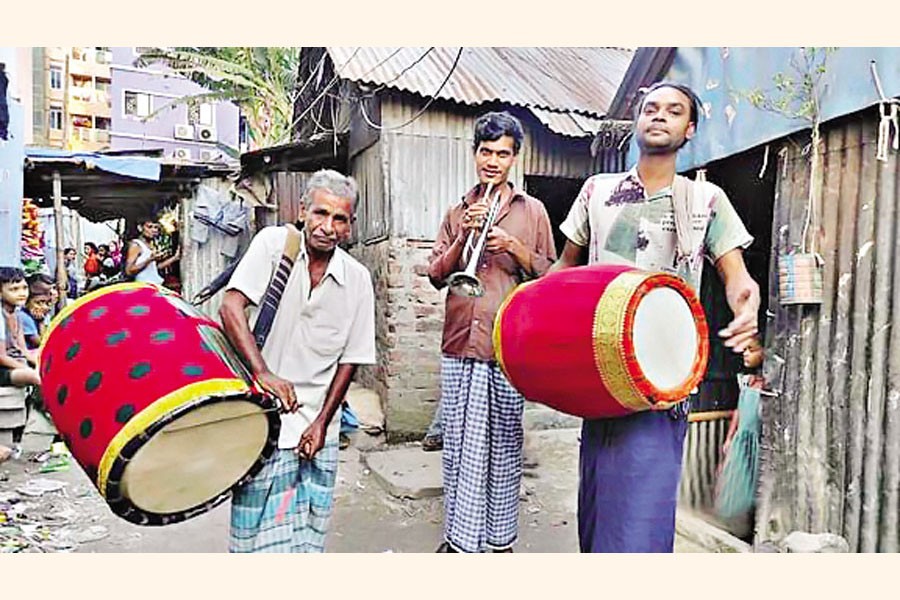
Sushil Das learnt to play the Dhak, a traditional Bengali drum usually played with wooden sticks, from his father when he was a child. For five decades, the sexagenarian has played the instrument for audiences both at home and abroad. He has performed in Kolkata as well as the Indian capital of New Delhi.
But Sushil now finds it hard to make ends meet as a drummer, amid rising costs of living. The increasing reliance on technology for music at social events also threatens to render the profession obsolete, reports bdnews24.com.
Heeding the lessons from the struggles of their fathers, the children of drummers in Dhaka tend to leave the family profession and opt for other careers after completing their studies.
Dhakis typically belonging to the Rishi sect of Hindus use the surname Das.
A narrow alleyway leads to more than 500 small houses crammed together in the neighbourhood of Nitaiganj in Narayanganj, also known as Rishi Para. The area is home to at least 20 drummers, while a few others live in Deobhog and Tribeni.
The Rishi sect is spread across the country. Members of a marginalised group, they are also known as Monidas and Robidas. In some parts of the country, Muslims also play the Dhak along with Hindus going by the surname Malakar. Those living in Brahmanbaria use Rishi as their family name.
The Rishis in Brahmanbaria inhabit two villages - Kashinagar and Sitanagar - near the Titas River. Kunjabihari Rishi, a resident of Sitanagar, said there were still seven bands of musicians in the village of 2,000 residents. Some villagers form temporary bands during Durga Puja, the biggest festival for Hindus in Bangladesh, when drummers are in high demand.
The Monidas sect of the Hindu community is predominantly engaged in playing the dhak. Aside from pujas and weddings, bands are invited to play Muslim shrines as well. Every traditional band has a Dhaki in it. For drummers, the Bengali months of Agrahayon, Poush, Magh and Falgun, comprising the Hindu wedding season, are rife with opportunities to perform.
Usually, a band consists of five members -- one plays the dhak, two play the flute, one plays a pair of hand cymbals and another plays the dhol, a smaller drum. But larger bands are hired for events of the more affluent members of society. These groups earn around Tk 25,000 to Tk 30,000 in an event. Dhakis say they pocket around Tk 500 to Tk 3,000 from these events.
The advancement of technology has had a profound impact on the profession, according to Bishnu Chandra Das, chief of Ma Lakshmi Band Party.
"It was a fruitful profession before and we could run our families with the earnings. We used to be invited to play the dhak at folk concerts throughout the year. Nowadays, most cultural events bring DJs to play music." The rhythmic beats from the drums, hanging from the players' shoulders or strapped to their waists, have given way to the flashier sounds booming out of sound systems at most events.