
Difficult-to-treat drug-resistant bacteria spreading in BD ICUs
Find two icddr,b studies
FE REPORT | Sunday, 26 July 2026
Difficult-to-treat drug-resistant bacteria are spreading within the country's ICUs with alarmingly high mortality among patients who developed these infections, found two new researches conducted by icddr,b.
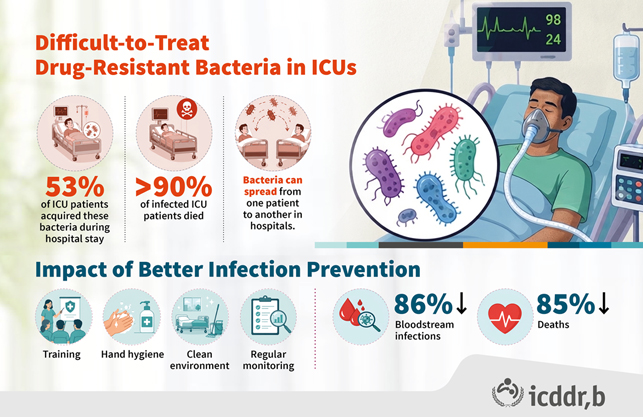
With more than half of ICU patients who were initially free from these drug-resistant bacteria, acquiring them while receiving hospital care, said the studies published recently in Microbiology Spectrum and Antimicrobial Resistance & Infection Control journals.
The studies, however, showed that strengthening infection prevention and control practices can dramatically reduce severe infections and deaths.
The studies analysed data from 373 critically ill adult patients admitted to ICUs between July 2023 and February 2024 and 363 neonates admitted to NICUs between December 2023 and September 2024 of a tertiary care government hospital in Dhaka.
Dr Gazi Md. Salahuddin Mamun, assistant scientist at icddr,b and the lead author of difficult-to-treat resistant burden paper, stated in an icddr,b statement on Saturday, "We followed ICU patients throughout their stay and used laboratory testing and whole-genome sequencing to understand how resistant bacteria spread within the hospital and how colonidation later progressed to infection."
The study was funded by US Centers for Disease Control and Prevention (CDC) and focused on difficult-to-treat resistant gram-negative bacteria, a group of bacteria that are resistant to commonly used antibiotics, making infections extremely difficult to treat.
An earlier icddr,b study documented widespread colonisation with drug-resistant bacteria in hospitals and communities, including among newborns.
The current studies add new evidence on how these bacteria spread within ICUs and how improved infection prevention can reduce infections and deaths.
Importantly, 105 out of 198 patients (53 per cent), who were initially free from these resistant bacteria, acquired colonization with them during their ICU stay, suggesting substantial in-hospital transmission.
Among patients who developed culture-confirmed infections with these difficult-to-treat bacteria, mortality was alarmingly high. More than 90 per cent of patients with these infections died in ICU.
However, after seven months of continued intervention, bloodstream infections fell from 28 to 4 per 100 admissions, representing an 86 per cent reduction, while mortality decreased from 26 to 4 deaths per 100 admissions.
Dr Fahmida Chowdhury, Lead, AMR Research Unit at icddr,b, and the principal investigator of this study, said, "A hospital should be a place of healing, not a place where patients acquire another potentially life-threatening infection while seeking treatment”.
nsrafsanju@gmail.com