
Digital courses that professionals need to learn
MUSTAFIZUR RAHMAN RONNIE | Thursday, 2 November 2023
In a time of swift technological development, the acquisition of digital skills has become indispensable for both students and professionals seeking to thrive in the modern workforce. Proficiency in online skills is paramount for success in the private sector and entrepreneurship. Digital courses offer vital knowledge in segments like social media marketing, SEO (search engine optimisation), and data analytics, enabling professionals to reach wider audiences and make informed business decisions. They empower professionals to harness the full potential of internet for business growth and innovation. This article explores the critical courses poised to unlock new opportunities and propel individuals toward success in an increasingly digital-centric world.
For non-business background marketers looking to enter the field, it is essential to start with the fundamentals and gradually progress toward more advanced concepts. Here is a breakdown of beginner steps and advanced levels.
Beginner steps: Firstly, one should familiarise oneself with marketing fundamentals like the 4Ps (product, price, place, promotion) and target audience segmentation. Then they should start studying digital marketing fundamentals with the basics of online marketing channels, such as social media, email marketing, content marketing, and SEO. Then comes learning how to write content creation and copywriting. Furthermore, gaining proficiency in data analysis and interpretation to understand customer behaviour and campaign performance. Finally, comes, learning social media management by familiarising oneself with popular social media platforms, and learning how to create, schedule, and analyse posts.
Intermediate steps: Email Marketing Automation, segmentation, and A/B testing is essential for marketers. Then comes learning search engine optimisation (SEO) to understand on-page and off-page SEO techniques to improve website visibility. Learning how to create Pay-Per-Click (PPC) Advertising and optimising paid advertising campaigns on platforms like Google Ads and social media will be essential for almost any business. Moreover, building an understanding of customer relationship management (CRM) systems will help one manage customer data and improve customer interactions. By compiling all of that, professionals can further master advanced analytics tools and techniques to gain deeper insights and make data-driven decisions.
Advanced steps: For advanced-stage learners, learning how to use comprehensive campaign management and marketing automation platforms is important. Conversion Rate Optimisation (CRO) is another area that will help one to optimise websites and landing pages for higher conversion rates through A/B testing and user experience improvements. Exploring predictive analytics and machine learning applications for marketing is a unique area for advanced stage learners. Most importantly, they need to learn strategic planning and market research that will help them do competitive analysis, and build informed marketing strategies as well as acquire soft skills in team management, project planning, and budgeting for marketing departments.
Learners need to keep in mind that the progression from beginner to advanced levels requires dedication, continuous learning, and practical application of skills. 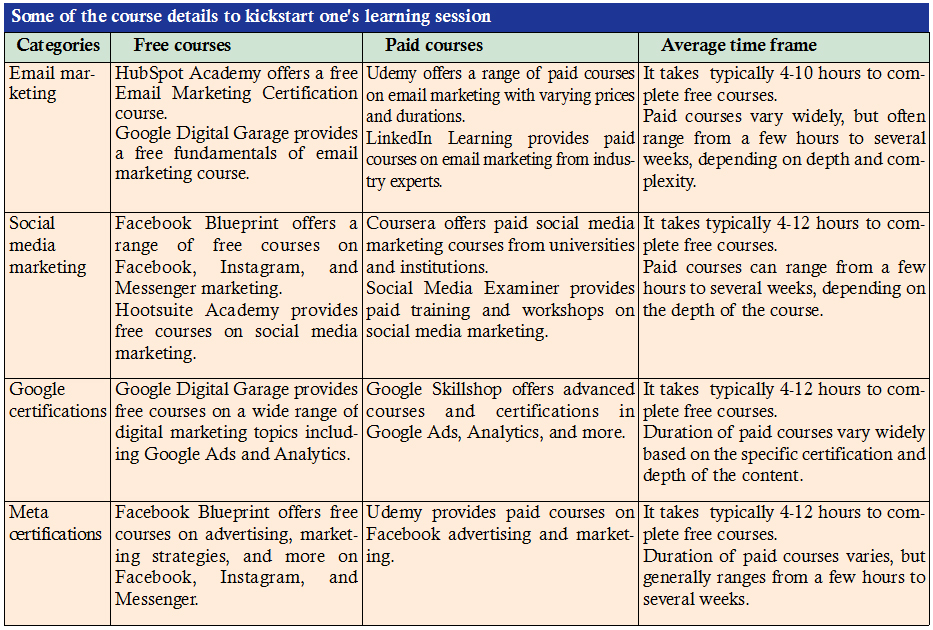 Online resources: Online resources include Google Digital Garage, Meta Blueprint (formerly Facebook), Hubspot Academy,Alison, Oxford Home Study, and others. Both paid and free courses are available. Some of them also provide free certifications.
The timeframes mentioned are approximate and can vary based on individual learning speed and the depth of the course content. One needs to always check the specific course details for accurate information. Additionally, it is beneficial to supplement online learning with hands-on practice and real-world application of the skills learned.
After completing training in digital courses, individuals unlock a myriad of opportunities across diverse industries. They can find their niche in digital marketing agencies, assuming roles like digital marketing specialist or social media manager, where they orchestrate effective online campaigns for clients. E-commerce companies eagerly seek talent in positions such as e-commerce marketing manager and email marketing manager, relying on these professionals to drive sales and customer engagement. In the dynamic realm of startups, these skills are invaluable, positioning individuals as growth hackers or content marketers, propelling fledgling businesses to success. In-house marketing departments of established companies also welcome their expertise, be it in roles as marketing managers or social media strategists. Freelancing and consulting are thriving avenues, enabling individuals to offer their expertise on a project basis. These skills have high demands in freelancing marketplaces like UpWork, Fiverr,Freelancer.com, etc.
Additionally, they can leverage their skills to forge a personal brand or venture into influencer marketing. For those inclined towards data-driven insights, positions in analytics and reporting, such as marketing analyst or SEO analyst, await in companies hungry for strategic decision-making. The applications of these skills extend far beyond the digital realm, finding a place in sales, education, government, and even the technology sector. In essence, the completion of these courses opens doors to a dynamic array of opportunities in today's digitally-charged professional landscape.
Challenges to learning: One significant hurdle is often the presence of mental barriers, including self-doubt or fear of the unknown. Venturing into a new field can be intimidating, particularly without a background in business or marketing. Understanding the intricacies of how businesses operate, from market research to customer segmentation, can feel overwhelming at first. Additionally, the evolving nature of digital marketing technologies and platforms can be daunting, especially for those unfamiliar with the digital landscape.
Another challenge lies in the potential need for a supportive peer or mentor. Having a peer or mentor can provide invaluable guidance, offer insights, troubleshoot difficulties, and offer a fresh perspective on complex concepts. They can help demystify digital marketing strategies, making them more accessible and practical for beginners. Without this support system, individuals may find it harder to navigate the complexities of the field.
Moreover, keeping up with the rapidly changing digital marketing landscape poses a continuous challenge. Staying updated with the latest trends, tools, and best practices requires ongoing dedication and learning. This can be particularly demanding for those balancing learning with other commitments like work or studies.
Overcoming these challenges often requires persistence, a growth mindset, and a willingness to seek out resources and communities that can offer support and guidance. Joining online forums, participating in workshops, and seeking out mentorship opportunities are all effective strategies to surmount these hurdles and pave the way toward becoming a proficient digital marketer.
As technology continues to shape industries and consumer behaviour, the significance of digital skills cannot be overstated. Embracing these courses is an investment in personal and professional growth, allowing individuals to not only keep pace with industry trends but also lead with confidence. In a time when digital change is the norm, the knowledge gained from these courses becomes a competitive edge, opening doors to new possibilities and ventures.
The writer is working as the head of Learning & Development at Intellier Limited, a subsidiary of Team Group.
mustafizurrahmanronnie@gmail.com