
Digital payments gain momentum as Eid spending surges in Bangladesh
Sunday, 24 May 2026
Eid-ul-Adha in Bangladesh has long been more than a religious celebration; it is a powerful economic moment that sets the rhythm of consumption, trade, and financial activity across the country. This year, that rhythm is shifting in a way that is both subtle and transformative. What is emerging is not merely a surge in spending, but a deeper structural change in how people pay, how businesses operate, and how banks are redefining their role in everyday commerce.
Describing Eid as an "economic heartbeat that energizes families, businesses, and markets across the country," industry observers note that this heartbeat is growing stronger -- yet also smarter. Consumer spending this Eid is expected to rise across nearly every category, from groceries and travel to electronics, dining, and Qurbani-related purchases. However, the more important story is not the scale of spending itself, but the way transactions are increasingly being conducted in a rapidly digitizing economy.
Across Bangladesh, consumers are steadily moving away from cash as their default choice. Cards, mobile financial services, QR payments, and digital wallets are becoming increasingly central to everyday transactions. What was once considered a convenience is now becoming an expectation. According to Rashid, the defining feature of modern spending is no longer just purchasing power, but the ability to transact "smartly, safely, and seamlessly." Eid, in this sense, is becoming the clearest annual reflection of Bangladesh's accelerating digital transformation.
This shift is visible in the rapid expansion of digital transactions during the festive season. Payments are no longer limited to utilities or transfers. Today, consumers are using digital channels for nearly everything -- air tickets, food delivery, e-commerce shopping, gifts, and even livestock purchases for Qurbani. Card payments, QR-based systems, mobile banking, and instant transfers are all experiencing strong growth. Importantly, this change is no longer confined to urban areas. Digital payments are steadily becoming mainstream across the country, reshaping consumer behavior in both cities and smaller towns.
Still, the transition is not purely technological. It is behavioral. Consumers are increasingly comparing offers, rewards, and benefits before choosing payment methods. Banks are no longer passive facilitators of transactions; they are active participants in shaping consumer decisions. Yet despite this momentum, awareness and adoption gaps remain, particularly in less digitally mature segments of the population.
Behind this surge in activity lies significant preparation from the banking sector. Eid is one of the most operationally demanding periods of the year, requiring banks to function at peak capacity while maintaining security and reliability. Institutions such as United Commercial Bank PLC prepare months in advance by ensuring adequate cash supply in ATM networks, strengthening digital infrastructure, and maintaining round-the-clock monitoring of systems and customer support channels. This preparation is not limited to urban banking centers. It extends to ensuring stability across digital platforms that now carry a growing share of financial activity.
It is important to note that increased digital adoption also brings heightened cybersecurity responsibilities. Higher transaction volumes during Eid naturally attract increased fraud attempts. As Rashid emphasized, banks are strengthening fraud monitoring systems and reinforcing customer awareness campaigns. The message is clear: convenience without security is incomplete. Trust, he suggested, is the true foundation of digital finance, especially during high-activity periods like Eid.
At a macro level, Bangladesh is steadily moving toward what many describe as a cashless economy, and Eid is acting as an accelerant. Several structural forces are driving this shift: widespread smartphone adoption, affordable internet access, expanding e-commerce platforms, and the growing acceptance of QR payments among merchants. Yet perhaps the most important driver is generational change. Younger consumers are far more comfortable with digital financial ecosystems, valuing speed, flexibility, and transparency over traditional cash-based transactions.
This transformation also offers a broader economic signal. Eid-related financial flows -- ranging from card transactions and mobile banking activity to remittances and deposits -- serve as a real-time indicator of consumer confidence. For many families, remittances from overseas workers arrive just in time for Eid spending, reinforcing the festival's role as both a cultural and financial anchor. For businesses, it is often the peak sales period of the year. For banks, it becomes a synchronized surge across every channel of financial activity.
The role of banks in this ecosystem is also evolving. Beyond facilitating payments, they are increasingly responsible for ensuring safety, accessibility, and confidence in financial behavior. Digital tools such as chip-enabled cards, contactless payments, 3D Secure authentication, virtual cards, QR systems, and instant alerts are reducing reliance on cash while improving transaction security. As Rashid put it, "The safest wallet during Eid may no longer be the one in your pocket -- it may be the one on your phone."
Small and medium enterprises are another critical part of this transformation. Eid generates significant demand spikes for retailers, restaurants, transport operators, and livestock traders. Banks are supporting these businesses with working capital financing, merchant payment solutions, QR systems, and digital collection tools. The impact is structural: when SMEs digitize, efficiency improves, financial visibility increases, and local economies become more resilient.
E-commerce, too, has become an integral part of Eid consumption patterns. What began as a convenience-driven channel has now become a lifestyle choice. Consumers routinely purchase fashion, electronics, groceries, travel services, vouchers, and even Qurbani livestock online. Banks enable this ecosystem through secure payment gateways, installment facilities, cashback campaigns, loyalty programs, and merchant integration. The result is a more interconnected retail economy, where physical and digital commerce increasingly blend into a single experience.
Yet amid this rapid transformation, one message remains consistent: financial discipline and cybersecurity awareness are essential. Consumers are urged to avoid sharing sensitive banking information and to remain cautious of fraudulent links and platforms. As digital finance expands, awareness becomes as important as access.
Looking ahead, the changes underway appear irreversible. Consumers are becoming more digitally confident, more selective in their spending, and more expectant of personalized financial experiences. Banking itself is shifting from a transactional service to an experiential ecosystem. The future customer, as Rashid noted, will not simply choose a bank -- they will choose an experience.
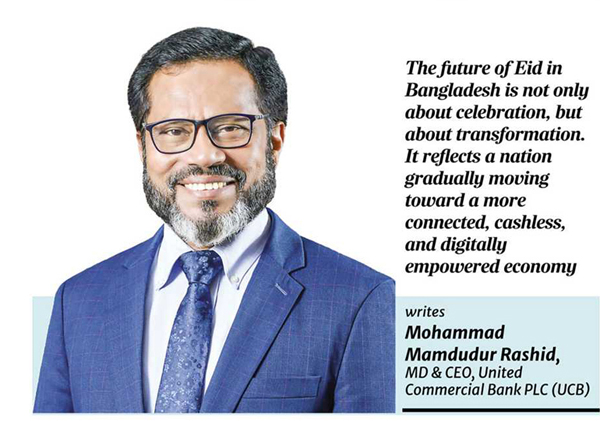
In that sense, the future of Eid in Bangladesh is not only about celebration, but about transformation. It reflects a nation gradually moving toward a more connected, cashless, and digitally empowered economy. At the center of that shift, institutions like United Commercial Bank PLC are positioning themselves not just as financial service providers, but as architects of a safer, smarter, and more inclusive financial future.
Mohammad Mamdudur Rashid, Managing Director & CEO of United Commercial Bank PLC (UCB)