
Discrimination in dengue prevention efforts
Disadvantaged communities disproportionately exposed
FE REPORT | Monday, 2 December 2024
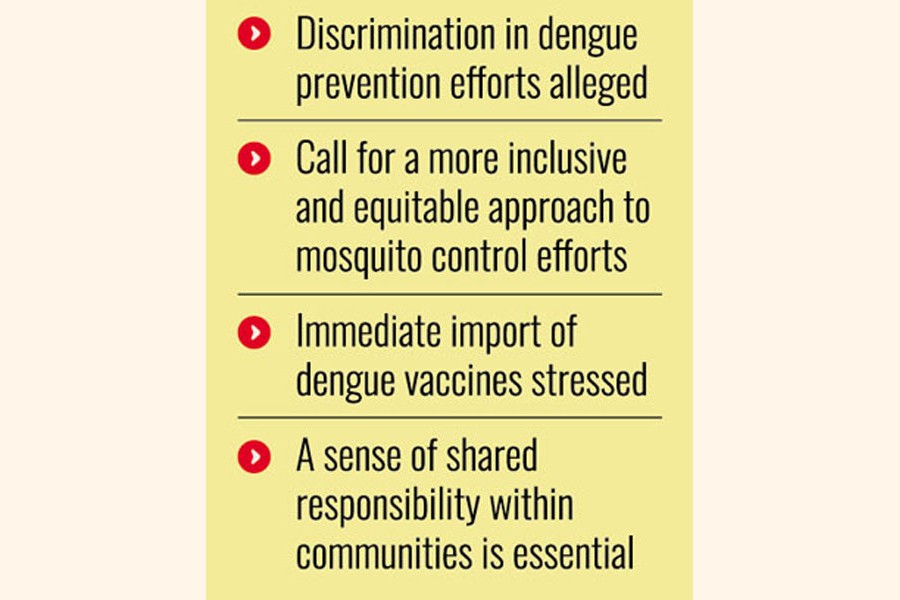
Discrimination in dengue prevention efforts has left underprivileged communities disproportionately exposed to the deadly disease, speakers at a roundtable discussion said on Sunday.
They pointed out that anti-mosquito measures, including the application of insecticides, are heavily focused on wealthy neighborhoods while slums and low-income areas are routinely neglected.
This systemic bias, they argued, not only exacerbates existing inequalities but also undermines efforts to effectively control the spread of dengue, which has become a significant public health crisis in Bangladesh.
The speakers called for stringent action, urging city authorities, healthcare providers, and policymakers to address the inequities in dengue prevention and treatment.
They insisted that a comprehensive, inclusive strategy is essential to combat dengue effectively and ensure that no community is left behind in the fight against this devastating disease.
The roundtable, titled "Dangers of Dengue and Ways to Prevent It," was held at the CIRDAP auditorium in Dhaka.
Organised by the Bangladesh Private Medical College Association (BPMCA), the event aimed to raise public awareness about the ongoing outbreak and propose comprehensive strategies to curb the disease.
Speakers lambasted the city corporation authorities for prioritizing mosquito control efforts in affluent neighborhoods inhabited by influential individuals, leaving marginalized areas to fend for themselves against the deadly Aedes mosquitoes.
This inequitable distribution of resources, according to experts at the event, reflects a troubling trend in public health governance, where the most vulnerable segments of the population are systematically neglected.
They called for a more inclusive and equitable approach to mosquito control efforts, ensuring that no community is left behind, regardless of socio-economic status.
Additionally, the speakers emphasised the need to immediately import dengue vaccines as part of a broader strategy to address the crisis.
Vice-President of Bangladesh Medical and Dental Council (BMDC) Professor Dr. Md. Zafarullah Chowdhury, who was present as the chief guest, shed light on the severity of dengue.
He explained that while some cases manifest as mild flu-like symptoms, severe forms such as dengue hemorrhagic fever and dengue shock syndrome can be fatal without timely intervention.
Highlighting the gravity of the situation, he shared alarming statistics from the Health Services Department, noting that as of November 2024, the country recorded 465 deaths and 90,798 reported cases of dengue.
Dr. Chowdhury stressed the importance of accurate and timely diagnosis to combat the disease effectively.
He laid stress on the role of clinical observation and laboratory testing in differentiating dengue from other illnesses with similar symptoms, urging healthcare professionals to remain vigilant.
Registrar of the Bangladesh Health Education Accreditation Council Professor Dr. Md. Humayun Kabir Talukder highlighted that simple measures such as regular cleaning of water containers, proper waste disposal, and maintaining effective drainage systems can reduce the risk of dengue by up to 50 per cent.
He also advised families to use mosquito nets and repellents, particularly for children, to minimize the risk of infection.
He emphasised that prevention remains the most effective tool in the fight against dengue, calling for reducing mosquito breeding grounds by eliminating stagnant water and improving waste management practices.
BPMCA General Secretary Professor Dr. Md. Moazzem Hossen reiterated that public awareness and community participation are keys to controlling the spread of dengue.
He advocated for large-scale educational campaigns to inform the public about preventive measures, including the importance of eliminating stagnant water and adopting protective habits.
According to him, fostering a sense of shared responsibility within communities is essential for the success of any anti-dengue initiative.
In addition to focusing on the gaps in current mosquito control efforts, BPMCA President MA Mubin Khan announced a week-long awareness programme to address the crisis.
The programme includes seminars, discussions, distribution of leaflets, free medical camps, and clean-up drive in schools, colleges, and markets.
He expressed BPMCA's commitment to collaborating with the government to sustain these efforts throughout the year.
He also emphasised the need for a coordinated and unified approach to tackling dengue, urging all stakeholders to work together to protect public health and prioritize the needs of underprivileged communities.
bdsmile@gmail.com