
Bus Route Rationalisation in Dhaka City
DMP's alleged non-coop hindering plan execution
MUNIMA SULTANA | Sunday, 10 August 2025
The implementation of the Bus Route Rationalisation (BRR) plan, designed to introduce single-route bus services in Dhaka, has faced major hurdles, allegedly due to non-cooperation from the Dhaka Metropolitan Police (DMP).
Insiders involved in the initiative claim the DMP is firmly opposed to the move, fearing it would reduce its authority over route permits. They alleged that during the previous Awami League government, the DMP actively created obstacles to introducing the company-operated bus route system, also known as the Bus Route Franchise (BRF).
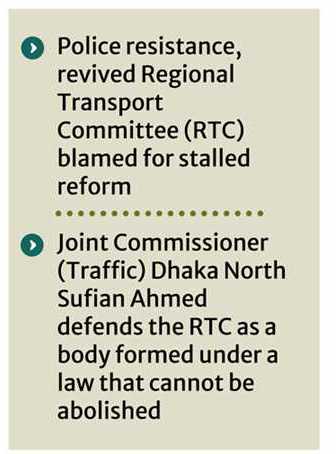
Following the government's fall, they say, the DMP has continued to resist the initiative, instead reviving a Regional Transport Committee (RTC) largely made up of non-technical members, mainly leaders of various transport owners' and workers' associations.
The RTC, established under the Bangladesh Road Transport Authority Act, is chaired by the DMP commissioner and comprises around 30 members representing transport owners' and workers' bodies. A representative from the Bangladesh Road Transport Authority (BRTA) serves as the member secretary.
Joint Commissioner (Traffic), Dhaka North, Sufian Ahmed defended the RTC, saying it was formed under a law passed by Parliament and therefore cannot be abolished.
"There are hardly any experts other than us (traffic police)," he told the FE by phone, responding to concerns about the lack of technical expertise in the RTC.
Sources said the DMP had previously warned it would not comply with the BRR unless the RTC remained in place. This stance was formally recorded in a letter dated 23 November 2022, responding to the draft 'Bus Route Operation and Route Franchise Act 2022' and criticising the proposal for bypassing RTC authority.
During the interim government, both the DMP and transport associations lobbied for the RTC's revival, claiming Dhaka's worsening traffic chaos was partly due to its inactivity in recent years.
The DMP also devised its own route plan and launched a pink-coloured bus service from Gazipur to various destinations in the city, reportedly with the backing of prominent bus owners keen on new route approvals.
The DMP further objected to granting unilateral powers to the Dhaka Transport Coordination Authority (DTCA) to implement the BRR and BRF.
However, transport experts and analysts have long blamed the RTC for the capital's unplanned and chaotic bus routes, arguing it authorised hundreds of buses without assessing passenger demand or traffic flow.
This, they say, has resulted in buses from the same company competing against each other, while multiple operators crowd the same routes.
The BRR and BRF concepts were based on extensive studies, international best practices, and insights from the Strategic Transport Plan (STP), developed in 2005 with a 25-year vision.
But due to politically controlled transport associations and resistance from traffic police, the STP's central aim of regularising city bus services remains unfulfilled.
The STP, now undergoing its third revision, still recommends creating 'BusNet', a company to operate the BRF.
Despite this, the DMP recently proposed introducing 23 new routes through the RTC, a plan later rejected by the Rail and Road Transport Adviser following an FE report.
Bus operators said that both police and transport owners had already collected payments from companies seeking to operate on these proposed routes, confident the RTC would regain full authority from the government.
Under RTC practice, new routes are considered following member proposals, with the committee determining the permissible number of buses. Experts oppose this method, calling it arbitrary and unscientific.
The DTCA's BRR blueprint proposed rationalising the city's 385 existing routes into 44, grouped into nine clusters, each identified by a distinct colour and operated by one or two companies.
Officials say the 44 routes were chosen after preliminary studies, with scope for revision following further research.
In contrast, in January this year, the DMP's Traffic Department proposed 54 routes, including 25 circular ones, disregarding the DTCA's rationalisation plan.
They launched the pink-coloured bus service from Gazipur, claiming operations under 22 companies with a counter-based ticketing system.
However, in practice, most operators do not use counters, and buses frequently compete head-to-head due to the fragmented ownership of individual vehicles.
A DMP study also revealed that while 388 routes had permits for 18,358 buses, only 110 routes are currently in operation, with 4,546 buses, a situation experts attribute to flawed, non-scientific route planning.
smunima@yahoo.com