
Down syndrome and occupational therapy
Rabeya Ferdous | Friday, 7 February 2014
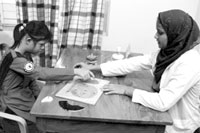
Down syndrome is a common disorder in Bangladesh. In every cell in the human body there is a nucleus, where genetic material is stored in genes. Genes carry the codes responsible for all of our inherited traits and are grouped along rod-like structures called chromosomes. Typically, the nucleus of each cell contains 23 pairs of chromosomes, half of which are inherited from each parent. Down syndrome occurs when an individual has a full or partial extra copy of chromosome 21.
WHAT IS DOWN SYNDROME? Down syndrome is a genetic disorder that causes life-long mental retardation, developmental delays and other problems. Down syndrome varies in severity, so developmental problems range from moderate to serious. Every person born with Down syndrome is different.
SIGN SYMPTOMS - BODY SHAPE AND SIZE
* Short stature (height). A child often grows slowly and is shorter than average as an adult.
* Weak muscles (hypotonic) throughout the body. Weak belly muscles also make the stomach stick out.
* A short, wide neck. The neck may have excess fat and skin.
* Short, stocky arms and legs. Some children also have a wide space between the big toe and second toe.
FACE SHAPE AND FEATURES
n Slanted eyes. Tissue may also build up on the coloured part of the eye (iris). But the child's vision is not affected by this buildup.
* A nasal bridge that looks pushed in. The nasal bridge is the flat area between the nose and eyes.
* Small ears. And they may be set low on the head.
* Irregularly shaped mouth and tongue. The child's tongue may partly stick out. The roof of the mouth (palate) may be narrow and high with a downward curve.
* Irregular and crooked teeth. Teeth often come in late and not in the same order that other child's teeth come in.
HEALTH PROBLEMS: Health problems related to Down syndrome are:
* Intellectual disability. Most children with Down syndrome have mild to moderate cognitive disability.
* Heart defects. About half of the children who have Down syndrome are born with a heart defect.
* Hypothyroidism, celiac disease, and eye conditions.
* Respiratory infections, hearing problems, or dental problems.
* Depression or behaviour problems associated with ADHD or autism.
CAN A CHILD WITH DOWN SYNDROME GO TO SCHOOL? Yes. There are special programmes beginning in the preschool years to help children with Down syndrome develop skills as fully as possible. Along with benefiting from early intervention and special education, many children are integrated into the regular classroom. Many affected children learn to read and write, and some graduate from high school and go on to post-secondary programs or college. Many individuals with Down syndrome participate in diverse childhood activities at school and in their neighbourhoods.
While there are special work programmes designed for adults with Down syndrome, many people with the disorder hold regular jobs. Today, an increasing number of adults with Down syndrome live semi-independently in community group homes where they take care of themselves, participate in household chores, develop friendships, partake in leisure activities and work in their communities.
CAN DOWN SYNDROME BE CURED?
There is no cure for Down syndrome. However, some studies suggest that women, who have certain versions of some genes that affect how their bodies metabolise (process) the B vitamin folic acid, may be at increased risk for having a baby with Down syndrome (5, 6). If confirmed, this finding may provide yet another reason why all women, who might become pregnant, should take a daily multivitamin containing 400 micrograms of folic acid. Taking folic acid can help reduce the risk of having a baby with certain birth defects of the brain and spinal cord.
OCCUPATIONAL THERAPY TREATMENT: Occupational therapy helps children participate in their everyday lives and occupations to the best of their ability. A child's occupations are the daily and meaningful activities that they need or want to do.
A child's occupations include play and learning, exploration of the environment, self-care (i.e. dressing, eating, toileting etc), school work (i.e. handwriting, organising school work, cutting and drawing, and physical exercise or PE).
Babies and children with Down Syndrome experience some delay in all aspects of their development - physical, social, language, play and emotional. They also have some physical features such as low muscle tone which may impact on their development and acquisition of fine motor and self care skills. Occupational therapy can help your baby or child in these areas.
THERAPY SESSION
Assessment: The occupational therapist will contact you to arrange the assessment. The assessment process may include feedback from parent/teacher questionnaires, interviews with key people (e.g. parents/carers/teacher), direct interaction with the child, use of standardised and non-standardised tests together with the observations in different settings e.g. play, school activities and undertaking everyday life skills, such as dressing.
Through the assessment, the therapist can explore the following areas:
o Developmental skills including motor and play development
o Self-care and functional skills such as feeding, toileting and dressing
o Fine motor and gross motor skills in relation to sitting posture, play, self-care, balance etc
o Visual perceptual skills in relation to handwriting and other functional tasks (e.g. dressing)
o Sensory processing
Therapy: The exact nature and amount of therapy provided will depend on the child's needs.
It could be in the form of:
o Direct individual or group therapy sessions, with a defined period of time prior to review.
o Use of home and nursery/school programmes to integrate treatment activities into real life environments.
o Regular review or monitoring of the child's progress.
o Consultation and training for school staff and parents.
The writer is an Occupational Therapist, Proyash, Savar Cantonment, Savar, rabeya1988@gmail.com