
ALBANIA INTERESTED TO HIRE BD WORKERS
Dr Yunus pledges labour reforms, baits to net foreign investments
Addresses function, meets statesmen on UNGA sidelines
FE REPORT | Saturday, 27 September 2025
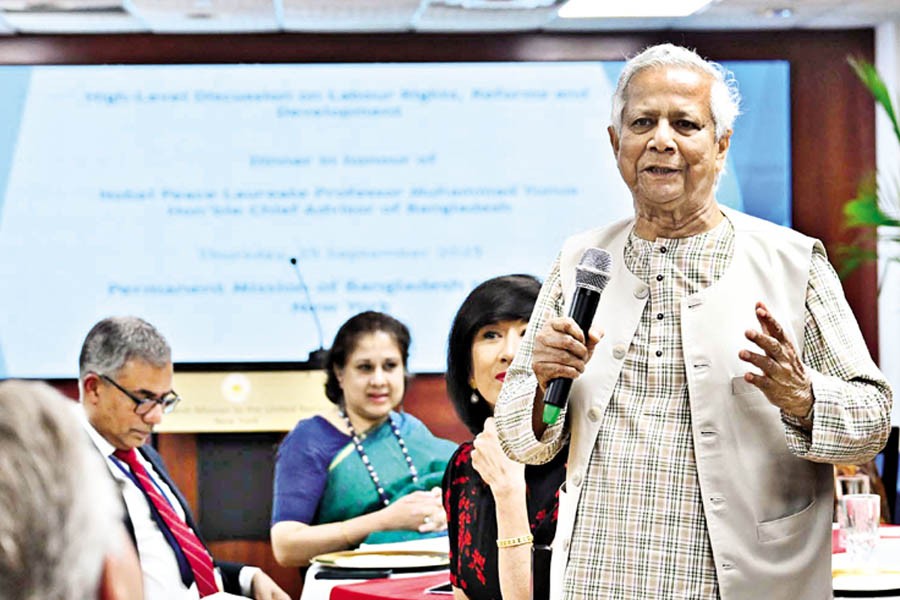
 Chief Adviser Prof Muhammad Yunus reaffirms his interim government's stress on labour reforms and mentions other baits for wooing large-scale foreign direct investment into Bangladesh.
He was addressing a high-level dinner hosted at the Bangladesh Permanent Mission to the United Nations on Thursday. Diplomats, UN officials, and senior political figures from Bangladesh attended the function for a focused dialogue on labour laws, worker rights and ongoing reform efforts in the country, a spokesman for the CA Office said Friday.
Dr Yunus reaffirmed the interim government's commitment to implementing key reforms-aligned with International Labour Organisation (ILO) conventions-before the upcoming national elections in February.
Leaders from three major political parties of Bangladesh, who are members of the CA entourage to New York, participated in the event and shared their views particularly on the economic front, with special focus on the export industry-readymade garments.
In his remarks during discussions, moderated by Lutfey Siddiqi, Special Envoy to the Chief Adviser, the head of interim government included comments from the Director-General of the ILO and senior representatives from various UN agencies.
Participants commented on the broader implications of labour reform for Bangladesh's economic future and international standing.
Before the formal address by the Chief Adviser, political leaders from the three major parties were invited to share informal remarks. Each emphasized the importance of the garment industry and expressed support for continued labour-sector reform.
Mirza Fakhrul Islam Alamgir, Secretary-General of the Bangladesh Nationalist Party (BNP), described the garment industry as a cornerstone of Bangladesh's economy, as it stands out for long the country's main export-earners.
"Any future government must prioritize its growth and sustainability," he said, acknowledging the Interim Government's efforts to advance labour reforms and ILO commitments.
Syed Abdullah Mohammad Taher, Nayeb-e-Amir of Jamaat-e-Islami, highlighted that many in his party bring direct experience from the apparel industry.
This, he states, gives them "valuable insights into how the sector can become more globally competitive". He extends support to the Interim Government's reform agenda and a desire to build on these reforms if elected.
Humayun Kabir, Foreign Affairs Adviser to BNP's acting chairman, Tarique Rahman, echoed BNP's appreciation for the current labour initiatives. "Such efforts should not only be continued but further expanded under any incoming administration," he said.
A common theme among all three speakers was an urgent need for Bangladesh to secure fairer pricing for its garment exports. "It should not be the buyer who always dictates the terms," said one speaker-a sentiment that drew consensus across party lines.
Dr Tasnim Jara, a senior leader of the National Citizens Party (NCP), offered a personal reflection, recalling the Rana Plaza tragedy as a defining moment in her political journey.
Then a medical student, she volunteered to treat the injured. "That incident shaped my politics," she told the meet, calling attention to the human cost of unsafe labour practices and the pressing need for reform.
In closing remarks, Chief Adviser Prof Yunus reaffirmed government's resolve to implement meaningful and lasting reforms on the cusp of transition from the post-uprising interregnum.
Meanwhile, during a meeting with the Chief Adviser on the sidelines of the United Nations General Assembly, Albanian President Bajram Begaj expressed strong interest in recruiting skilled and semi-skilled workers from Bangladesh to meet its expanding labour-market needs.
"We need workers for our country, and several Albanian companies have already submitted applications to hire from Bangladesh," President Begaj told Dr Yunus.
He emphasised that bilateral cooperation could be broadened further, particularly in sectors like tourism, highlighting Albania's southern coastline as a promising destination for Bangladeshi tourists.
Chief Adviser Yunus welcomed the initiative, noting that Bangladesh, with its dynamic and youthful workforce, is well-positioned to support Albania's economic growth. He also urged the Albanian government to ease visa procedures, pointing out that Bangladeshi citizens currently have to travel to New Delhi to apply for visas.
In response, President Begaj suggested that Albania is considering introduction of e-visas for Bangladeshi nationals. He also called for stronger institutional engagement, including high-level official visits, to advance cooperation.
Adviser Asif Nazrul, who oversees the Ministry of Expatriate Welfare, affirmed Bangladesh's capacity to provide a wide range of manpower-from doctors and nurses to factory and agricultural workers. He emphasized signing a memorandum of understanding to streamline the recruitment process.
President Begaj also announced that Albanian universities are ready to welcome Bangladeshi students under existing international enrolment schemes.
Senior Secretary for SDG Affairs Lamiya Morshed was also present at the meeting.
mirmostafiz@yahoo.com