
Draft whistleblower rules seek to silence market insiders
MOHAMMAD MUFAZZAL | Tuesday, 3 March 2026
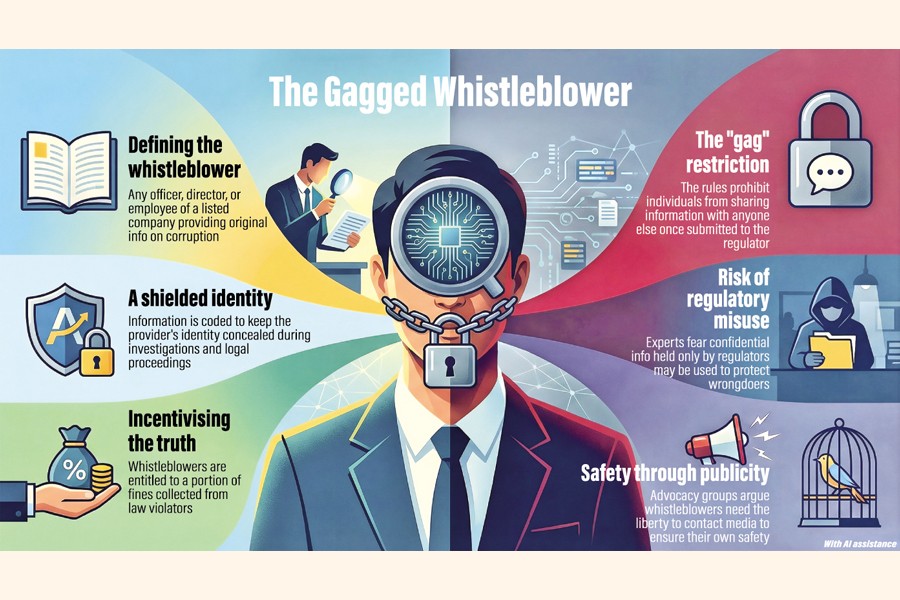
The proposed whistleblower rules prohibit individuals from sharing information with anyone after submitting it to the market regulator. Experts say this restriction undermines the very purpose the rules are intended to serve. They have questioned the regulator's motive, arguing that if confidential information remains available only to the securities regulator, it may become susceptible to misuse to protect wrongdoers.
A whistleblower can be an individual or a group that voluntarily provides the regulator with original information in writing regarding any corruption or law violations that have occurred, are ongoing, or are about to occur.
The proposed Bangladesh Securities and Exchange Commission (Capital Market Related Information Disclosure and Whistleblower Protection) Rules, 2026 define a whistleblower as any officer or employee of a market intermediary registered by the securities regulator, or of any listed company, issuer, registered fund or SVP (special purpose vehicle), as well as any member of the board of directors, board of trustees, auditor, or any person associated with them.
The Bangladesh Securities and Exchange Commission (BSEC) on Sunday uploaded the draft rules on its website and sought public opinions.
"The restriction is totally unacceptable," said Md. Ashequr Rahman, managing director of Midway Securities, adding that it could lead to misuse of information amid a lack of good governance within the regulatory body.
Dr Iftekharuzzaman, executive director of Transparency International Bangladesh (TIB), said the BSEC should protect the identity and safety of whistleblowers. Even if they make the information given to the regulator public, the regulator will remain responsible for ensuring their protection.
The BSEC cannot stop them from sharing the information, he added. Talking to the FE, some other market operators said the prevailing culture of impunity already poses challenges in bringing wrongdoers to justice. In such an environment, the restriction may put whistleblowers at further risk and could result in information being used as a weapon to extract benefits from law violators or market fraudsters.
"Whistleblowers should be at liberty to disseminate information to any other authority and the media for the sake of their own safety," said the chief executive officer of an asset management company, preferring anonymity.
When information becomes public, the market watchdog comes under pressure to act against wrongdoers, he added.
BSEC spokesperson Md. Abul Kalam said the regulator had sought opinions on the draft rules from stakeholders and experts.
"They can oppose any provision while expressing their views. The regulator will finalise the rules after taking the opinions into consideration."
The proposed rules are intended to encourage the reporting of insider information on corruption and misconduct. The first of their kind, the rules, once finalised, will help initiate regulatory investigations to improve market discipline.
Currently, the BSEC relies on media reports and financial statements of listed companies and market intermediaries for necessary intervention. Market insiders remain reluctant to provide information to the regulatory body in the absence of any legal mandate to protect them.
At least 59 countries have already enacted specific whistleblower protection laws, with comprehensive frameworks in the United States, Canada, Australia, Japan, India, South Korea, the UK, and across all European Union (EU) member states.
The draft rules also contain a provision to incentivise whistleblowers.
Handling of confidential information
Under the draft rules, insiders of listed companies and market intermediaries will be able to send information directly to the BSEC chairman.
The information will then be transferred to a designated officer. After examining its relevance and prima facie evidence, it will be sent back to the chairman.
The identity of the information provider will be recorded by the designated officer through coded references in a bid to keep it concealed.
Upon receipt of prima facie evidence, the chairman will issue an order to the department concerned to prepare terms of reference (ToR) for investigation following further crosschecks.
The BSEC's inquiry and investigation department will conduct a probe. Hearings will then be held based on the probe reports, and fines may be imposed.
Following regulatory action, the designated officer will place a proposal to incentivise the whistleblower with a portion of the fine realised.
However, the draft rules state that the identity of the information provider will in no way be disclosed during the investigation or in legal proceedings.
mufazzal.fe@gmail.com