
Drug makers show strong resilience in H1 FY26 despite adversities
BABUL BARMAN | Monday, 2 February 2026
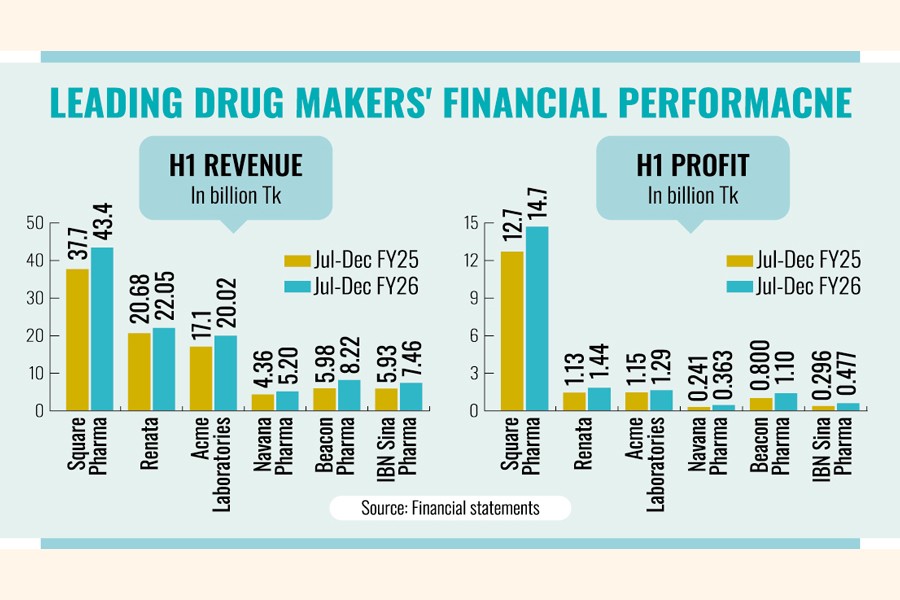
The leading drug manufacturers posted double-digit year-on-year profit growth in the first half (H1) of the current financial year, driven by higher sales and lower input costs amid a stable forex market.
The pharmaceutical companies remained on growth trajectory at a time when other businesses were struggling with high operating costs amid inflationary pressure.
"Sales of lifesaving drugs increased due to strong local demand, while leading companies successfully managed to keep operating costs lower," Salim Afzal Shawon, head of research at BRAC EPL Stockbrokerage, told The Financial Express over the phone.
The growing population, coupled with rising awareness of healthcare needs, has amplified demand for generic medicines in the local market, particularly for chronic diseases.
The aftermath of the Covid-19 pandemic has further accentuated the importance of healthcare, leading to heightened focus on medical preparedness and infrastructure, which in turn has positively impacted the pharmaceutical industry.
Macroeconomic indicators such as inflation and the forex market improved in July-December 2025 compared to the same period of the previous year, which also benefited top drug manufacturers, Shawon said.
Combined profits of seven major drug makers surged more than 18 per cent year-on-year to Tk 19.34 billion in July-December 2025, while drug sales rose 16 per cent year-on-year to Tk 106 billion during the period under review.
"Rising income levels and increased health awareness have led to higher spending on medicines," Shawon said. When people's living standards rise, they increase spending on medicines and lifestyle products.
Per capita healthcare expenditure in Bangladesh almost doubled to $61.9 over the last decade, according to the Bangladesh Bureau of Statistics.
"This resilience allows leading pharmaceutical companies to sustain high revenue and profit growth," addedShawon.
Besides, leading pharma companies' operating efficiency, strong financial positions, and lower finance costs helped them secure double-digit profit and sales growth.
Square Pharmaceuticals, the largest drug manufacturer in the country, posted a 16 per cent year-on-year profit growth in July-December of FY26, driven by higher sales.
This sustained growth momentum can be attributed to several factors, including increasing domestic demand for healthcare products, export earnings, and income from subsidiaries, said the company.
"The drug maker continues to grow in both sales and profit owing to strong consumer trust in its products," said Akramul Alam, head of research at Royal Capital.
The company's ability to produce high-quality generic medicines at relatively low costs has strengthened its competitiveness in the global market as well, Alam added.
Another well-known drug manufacturer, Renata also posted more than 25 per cent year-on-year earnings growth in the first half of the current financial year, primarily driven by strong growth in operating profit and a reduction in finance costs following a capital restructuring initiative.
"Lower raw material costs resulted from strong supplier negotiations and access to US dollar-denominated funding from the IFC, and reduced foreign exchange volatility amid a relatively stable exchange rate environment," said the company in its earnings note.
Renata reported a 7.3 per cent reduction in finance costs following the completion of its capital restructuring, including the full drawdown of low-cost IFC funding and full subscription of Tk 3.25 billion in preference shares.
Renata said revenue from pharmaceutical products, which account for 80.7 per cent of total revenue, grew by 10 per cent, while its animal health business remained flat year-on-year.
Navana Pharma posted a 50 per cent year-on-year profit growth in the first six months of FY26, supported by higher sales, improved profitability, and stronger operating cash flows.
Higher revenue generation, fueled by increased market demand and efficient production planning, played a key role in boosting profitability during the reporting period, said the company.
In addition, lower borrowing costs and prudent financial management helped ease pressure on expenses, further strengthening the bottom line, the company said.
Mir Ariful Islam, managing director of Sandhani Asset Management, said leading drug makers posted steady profit growth by successfully managing operating costs.
"People had to spend more to buy medicines as essential products.There was a time when people delayed treatment because they could not afford it. Now, most of them access treatment more quickly and take medicines, leading to higher sales and profitability," he added.
IBN Sina Pharma posted the highest increase in profit among drug makers, recording 61 per cent year-on-year growth backed by higher sales amid lower input costs.
The country's pharmaceutical industry, which meets 98 per cent of local demand, is one of Bangladesh's success stories, having recorded remarkable growth in recent years.
Pharmaceutical exports, however, saw slow growth of 3 per cent year-on-year to $118 million in July-December 2025, largely due to deferred orders after inventory meant for export was damaged in a fire at the Dhaka airport on October 19, 2025.
The devastating fire at the cargo village of Hazrat Shahjalal International Airport (HSIA) dealt a severe blow to the pharmaceutical industry, with an estimated economic impact of more than Tk 40 billion.
However, Alam said that with continued investment, regulatory compliance, and a growing skilled workforce, the local pharmaceutical sector is poised not only to sustain but also to accelerate export growth in the coming years.
The global pharmaceutical industry is expected to grow by 5.8 per cent over the next three years through 2028, while the local pharmaceutical sector is expected to grow by more than 15 per cent during the same period, according to Statista, a global data and business intelligence platform.
babulfexpress@gmail.com