
DSCC ramps up drives for clean, climate-resilient city: Administrator
Friday, 3 April 2026
The Dhaka South City Corporation (DSCC) has undertaken a series of initiatives to build a clean, climate-resilient and citizen-friendly city, its Administrator Bir Muktijoddha Md Abdus Salam said on Thursday, reports UNB.
Presenting a summary of activities carried out from February 25 to March 31 at a press conference at the DSCC auditorium, he said various development works, special drives and policy measures have been taken to improve urban services and infrastructure.
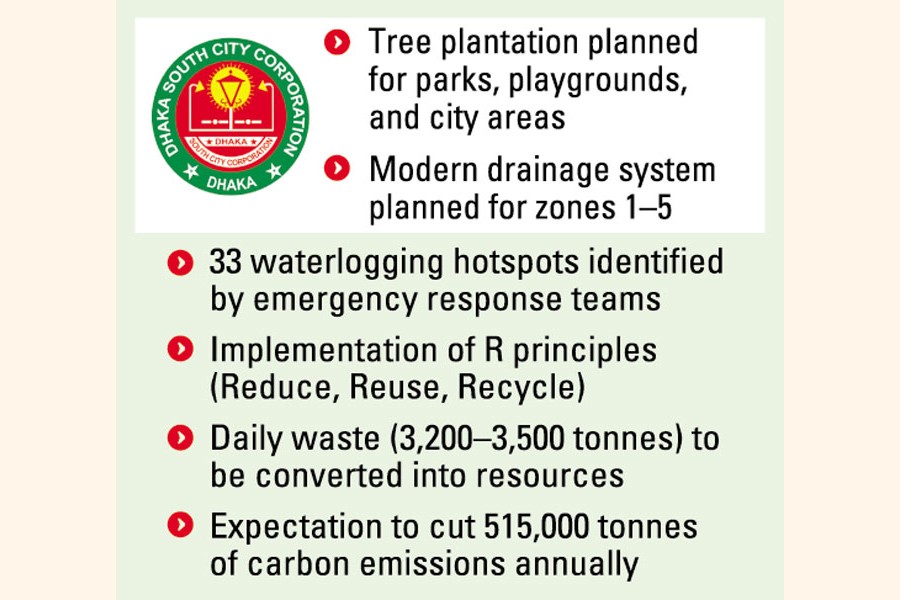
To promote environmental sustainability, steps have been taken to establish nurseries to support tree plantation at 20 parks and gardens, 13 playgrounds and 20 city squares, as well as in different areas, Salam said.
A consulting firm has appointed to develop a modern drainage system and address waterlogging problems in zones 1 to 5 of the city corporation, he added.
The DSCC has also reduced the registration fee for graveyards and cremation grounds from Tk 1,000 to Tk 500 to ease the burden on citizens, the administrator said, adding that the six-storey Siddique Bazar Community Centre has been inaugurated to facilitate social and family events for residents of Old Dhaka.
In the waste management sector, it has taken steps to modernise the system through coordination meetings with sanitation inspectors from all 75 wards and through the implementation of the 3R principles - Reduce, Reuse and Recycle, he said.
A master plan for the Dhaka Resource Circulation Park at the Matuail landfill has been devised and an agreement was signed with a Korean company to this effect.
According to the proposed master plan, landfill gas will be extracted from the old 100-acre landfill to collect around 15,000 tonnes of methane annually, which could generate about 81,000 megawatts of electricity, while an additional 28,000 megawatts may be generated through solar energy.
At a pilot Material Recovery Facility (MRF), around 300 tonnes of household waste will be processed every day to produce biogas, compost, biofuel, eco-bricks, Black Soldier Flies (BSF) and Solid Refused Fuel (SRF).
If implemented successfully, the project is expected to reduce about 515,000 tonnes of carbon emissions annually and convert the daily waste generated in DSCC - around 3,200 tonnes to 3,500 tonnes - into valuable resources, the administrator stressed.
To tackle waterlogging ahead of the monsoon season, the DSCC has launched a month-long special cleanliness drive beginning with the cleaning of the Segunbagicha box culvert.
He mentioned that they have identified 33 waterlogging hotspots and formed emergency response teams to address the situation, while six portable pumps have been kept ready to remove stagnant water during heavy rainfall.
Two new drainage outlets at New Market and Sowarighat have also been approved to improve water discharge capacity. Restoration work is ongoing in four canals -
Jirani, Shyampur, Kalunagar and Manda - to ensure proper water flow, Salam said.
Mentioning that a compost plant with a capacity of 20 tonnes has also been inaugurated at the Matuail landfill to produce organic fertiliser from biodegradable waste, he said initiatives were taken to install water hydrants at 40 points across the 181-acre landfill area along with pipelines and reservoirs to prevent frequent fires at the landfill site, while six new portable pumps have been procured for emergency firefighting.
About 40 per cent of the landfill waste has already been covered with soil to control methane emissions and reduce the risk of fire, the administrator said.
To reduce congestion around the Sayedabad Bus Terminal, the DSCC has decided to remove illegal ticket counters and roadside shops and ensure that buses use designated bays instead of using the terminal as a depot.
Measures are also being taken to establish an information desk and a breastfeeding room at the terminal to improve passenger services.
Meanwhile, to save energy, the DSCC has instructed a 30 per cent reduction in fuel allocation for official vehicles and 20 per cent for waste-carrying vehicles.
The city corporation has also introduced a "Public Hearing Day" every Saturday to allow citizens to directly submit complaints and suggestions.
Mosquito control activities have also been intensified across the DSCC areas through regular larviciding and adulticiding.