
DU's research programmes face stagnation amid poor funding, bureaucracy
It awarded fewer than 100 PhDs annually since 2014
ARMAN HOSSEN | Thursday, 19 June 2025
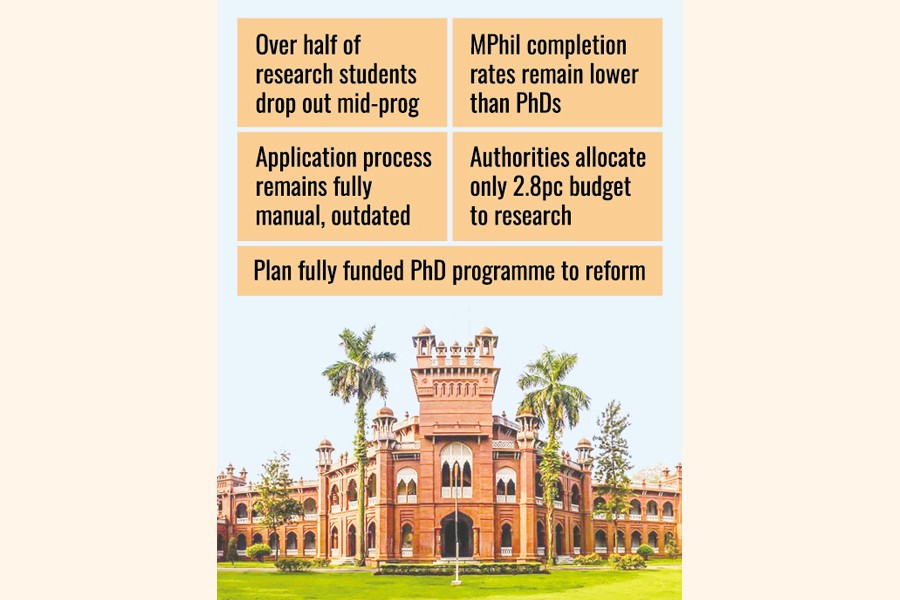
Dhaka University, the country's leading public university, has seen little progress in its MPhil and PhD programmes over the past decade, stalled by chronic underfunding, outdated procedures, and poor research support despite repeated promises of reform.
From 2014-15 to 2022-23 academic years, the university awarded fewer than 100 PhDs each year, except in 2023-24 when 105 students earned the degree.
MPhil completion rates have been even lower, ranging between just 51 and 88 students per year.
University officials estimate that over half of MPhil students and an even larger share of PhD candidates drop out before finishing, mainly due to financial hardship and bureaucratic red tape.
Although MPhil programmes are meant to be completed within two years and PhDs in three to five years, delays are routine.
One of the primary obstacles is funding. In the current fiscal year, DU allocated just 2.8 per cent of its total budget to research - a modest rise from 1.63 per cent in 2022-23.
Currently, only 50 MPhil students receive a Tk 10,000 monthly stipend, while 32 PhD students receive Tk 20,000 - figures widely seen as insufficient amid rising living costs.
To make matters worse, students who fail to complete their degrees must repay the stipend, further discouraging research enrolment.
The application process for MPhil and PhD programmes remains painfully outdated.
Prospective students must find a supervisor manually, print and submit paper forms, deposit Tk 1,000 in a bank, and pass through six layers of manual approval at the registrar building - a process made worse by the absence of digital systems.
Faculty members say the stagnation in research output is hurting DU's global standing and contributing to brain drain.
Many departments still lack basic research infrastructure, and students face challenges in publishing in reputable journals due to poor institutional support.
As a result, top candidates increasingly prefer foreign universities with better funding and facilities.
Pro-Vice Chancellor (Academic) of the university Prof Mamun Ahmed acknowledged that limited career opportunities discourage students from pursuing research.
However, he said the university plans to launch a fully funded PhD programme, which could help address the current challenges.
"Fewer students choose research because of the lack of viable career paths. We're planning a fully funded PhD programme, where the university will cover most or all of the costs. This could be a game changer," he added.
DU Vice-Chancellor Prof Niaz Ahmed Khan pointed to past political unrest as a key barrier to reforms but noted that several initiatives are now underway.
"We've formed a special committee to improve DU's ranking. Funding is being allocated for publication costs, new research projects are being launched, and research methodology courses are now mandatory across all departments," he said.
He added that the university is committed to maintaining research quality and is now focusing on increasing the number of research students.
"Political instability affected our ability to make progress, but we've already begun to implement improvements," he also said.
Tariq Manzoor, a professor in the Bangla Department, underscored the need for stronger institutional commitment.
"Without proper funding and student support, we can't expect students to feel motivated to pursue research. The university must respond to their socio-economic needs," he told The Financial Express.
armanhossen7971@gmail.com