
Earth-like planet discovered in Nasa Kepler telescope haul
Friday, 24 July 2015
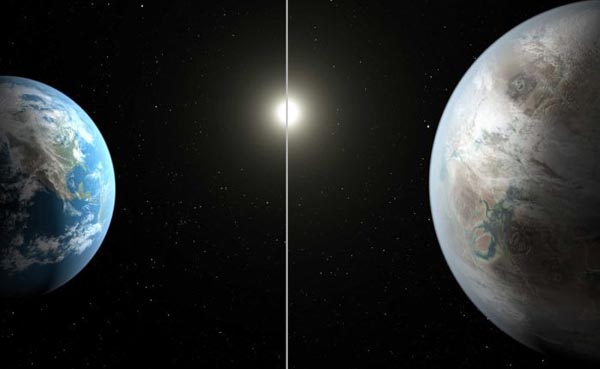
Astronomers hunting for another Earth have found what may be the closest match yet, a potentially rocky planet circling its star at the same distance as the Earth orbits the sun, NASA says. Not only is this planet squarely in the "Goldilocks zone" — where life could exist because it is neither too hot nor too cold, and so could support liquid water — its star looks like an older cousin of our sun, the US space agency said. That means the planet, which is 1,400 light years away, could offer a glimpse into the Earth's apocalyptic future, scientists said. Known as Kepler 452b, the planet was detected by the US space agency's Kepler Space Telescope, which has been hunting for other worlds like ours since 2009. "Kepler 452b is orbiting a close cousin of our sun but one that is 1.5 billion years older," NASA said in a statement. Its star is 4 per cent more massive than the sun and 10 per cent brighter. If the planet is rocky, and scientists believe that it has a better than even chance of being just that, then it could be in the midst of a fearful scenario, as the heat from its dying star evaporates Kepler 452b's lakes and oceans, according to AP.