
Economic big guys set sights on Ctg: SEZs for Japan, China, Singapore, India on cards
Our Chittagong Correspondent | Sunday, 30 November 2014
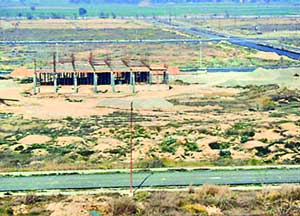
Industrial development of Chittagong is of national importance, as it implies not merely developing the regional industrial base but also building the nation's industrial backbone to the benefit of the whole of the country and the region surrounding the Bay of Bengal. A study by an international development agency underlined this prospect.
JICA (Japan International Cooperation Agency) in its 1995 draft final report on 'The Study of Industrial Development of Chittagong Region' concluded that Chittagong should be given priority consideration within the industrial development policy. This should be done in view of its primary function as the national gateway with international port facilities and its inherited trade and industrial functions, even though such intensive development efforts on a priority basis could create temporary regional disparities.
JICA said a Special Economic Zone (SEZ) may be defined as a special economic development area with a high-quality physical environment where machinery and raw materials can be imported, stored, processed, manufactured, and exported, with the benefits of a liberal regime, free of taxes, duties, and trade restrictions.
Such a zone will typically be managed by a dedicated Zone Company, and will usually have a range of special tax and other incentives to promote the economic development of an area by attracting domestic and foreign investment.
Dr. Khurshid Alam, operations director of Policy Research Institute (PRI), has said Bangladesh is enjoying a demographic dividend that potentially brings in a large working-age population as well as a large number of consumers if quality jobs can be created with the end result of increased incomes.
Both historical and cross-country evidences show that the prospects for rapid growth with extensive job creation require a high-performing and diversified manufacturing sector which will remain, for some time to come, the main driver of growth in countries like Bangladesh. The good news is that the share of manufacturing is increasing, rising from 17.9% in 2010 to 19.5% in 2013 and 22.3% in 2015. But it needs to be accelerated, he said.
Bangladesh Export Processing Zones Authority (BEPZA) runs eight EPZs in the country. But the EPZ (Export Processing Zone) model has its limitations in terms of creating spill-over to domestic economy. In 2010, the government felt the need of further broadening the horizon of export zones to optimize its benefits, particularly taking lessons from China and other successful East Asian countries. The Bangladesh Special Economic Zones Act 2010 was passed to this end.
But fund constraint for land acquisition is the major barrier to building special economic zones in various parts of the country. Paban Chowdhury, executive chairman of BEZA, recently said at a function in Dhaka that all measures have been taken to build special economic zones in the country but his office was having fund constraint for land acquisition.
SEZ for Japanese investors: As the Japanese investors are moving their plants from China to other countries, Bangladesh has decided to set up a dedicated economic zone for entrepreneurs of Japan, world's third-largest economic power.
As Japan, China, Singapore and India have expressed interest to invest in the SEZs dedicated for their respective entrepreneurs. Bangladesh Government has started setting up eight SEZs in different parts of the country, at least three in Chittagong.
The government has decided that Japanese investors will be given 8,000 acres of land in Mirsarai, the northernmost upazila (sub-district) of Chittagong district. Terming Japan as a 'tested friend and vital development partner' for the country's development, commerce minister Tofail Ahmed said Japanese investors could set up units of automobile, garments and fabrics, electronics and high-end consumer goods in the SEZ. The land for Japanese investors has already been acquired in Mirsarai.
The Japanese investors have been moving their investment from China to other countries since 2008, when Japan adopted the "China plus one" policy to reduce overdependence on Beijing. Since then, Bangladesh has turned into a lucrative destination for Japanese investors. About 180 Japanese companies already have operations in Bangladesh.
Japan has given Bangladesh US$ 1.18 billion in loans for the Matarbari coal-fired power plant in Cox'sBazar district and four other projects as the Asian economic giant seeks to deepen its ties with Bangladesh.
SEZ for Chinese investors: The Government of Bangladesh has planned to offer another economic zone for Chinese investors in Anwara, south of Chittagong Port. A proposal from China to set up a special economic zone in Anwara was made to the GoB and the government has responded positively. The zone will exclusively house the units originating from China.
The Chinese request came against the backdrop of Bangladesh's appeal to China for financing the construction of an immersed tunnel under the Karnaphuli River. The Bangladesh Bridges Authority (BBA) is reportedly looking into the Chinese proposal as the Prime Minister's Office (PMO) asked it to do so.
The Chinese Government wants at least 1,000 acres of land in Anwara on the south bank of the Karnaphuli River, near the Korean EPZ, to build the economic zone. But the BEZA said it has ready land in the Gohira area of the upazila. Gohira is several kilometres away from the Korean EPZ but just opposite to Chittagong Shah Amanat International Airport. The Chinese Government has offered to build the proposed immersed tunnel under the Karnaphuli that will connect Gohira on the south bank.
An export-processing zone (EPZ) has been set up at east Anwara by Korean shoe and readymade garment giant Youngone Corporation in an area of about 2500 acres of land apart from an exclusive industrial park already set up by local textile giant Saad Musa group in the area.
There are proposals for developing an industrial city at Anwara, construction of an immersed tunnel connecting the port city with Anwara. The place is of highest historical importance. Rich Buddhist archeological instances were discovered in 1927 and 61 metal-sculpture images of Buddha were found under the soil at Jheory village of Anwara.
The government has chalked out a master plan to expand Chittagong City to the south bank of the Karnaphuli River in Anwara area. It covers a vast area on the juncture of River Karnaphuli, River Shankha and the Bay of Bengal. Anwara has Bay in the west, Shankha on the eat and Karnaphuli on the north.
SEZ for Indian investors: Indian investors twice requested Bangladesh for granting them a special economic zone for setting up industries of their own. Bangladesh also has assured them of granting it. However, the government did not specify where the Indians will be accommodated with land.
The Indian businesses are interested to invest in the sectors such as renewable energy, gas exploration, information communication technology, capacity development of small and medium enterprises and other promising sectors.
Former Industries Minister Dilip Barua assured the Indian investors at a meeting with a visiting business delegation of the Confederation of Indian Industry (CII) in July 2012 that the Indian investors deserve priority allocation of SEZ for their extraordinary assistance during the liberation war of Bangladesh in 1971.The former minister did not specify where.
Meanwhile, a vast tract of char land has surfaced in the coastal unions of the Bay of Bengal under Banskhali upazila to the southwest of Chittagong district. Local chairmen of different coastal unions said the chars are being illegally grabbed by land-grabbers. The government can consider the char land for SEZ.
The coastal unions where the char lands have surfaced are Saral, Katharia, Baharchara, Chanua, Gandamara, Khankanabad and part of Premasia in the estuary of the River Shankha. The area of char land in the Saral union alone could be about 1,000 acres. They said that some portion of the surfaced char area has been brought under jhau plantation by the local forest department but a major portion lies barren. The huge land can be used for industrialization and tourism.
Local upazila administration officials said the government should immediately conduct a feasibility study on the char lands to make the best use of it otherwise the lands will be grabbed. They mentioned that a few years back India's Tata Industrial group took an initiative to set up industrial zone in the area.
SEZ for Singapore: The government is also ready to allocate a land in Mirsarai upazila for setting an exclusive economic zone for Singaporean investors.
Prime Minister Sheikh Hasina announced it when Singaporean Senior Minister of State for Foreign Affairs and Home Affairs Zulkifli Masagos met her at the PM's office in the middle of October last.
Earlier, Singapore had expressed its keen interest to invest in establishing an independent clean smart city as well as a power plant in Bangladesh. Zulfikli Masagos said the investors of his country are very much interested in setting up a smart city on the outskirts of Dhaka, particularly at Purbachal, which could also be in joint venture with Bangladesh.
If the government seriously contemplates offering SEZs to the entrepreneurs of those countries it should start the process without any further delay. A far-sighted strategic outlook and sound policies may help set up vibrant special economic zones in Chittagong.