
Economic growth slows, shrinks to 3.03pc in Q2
FHM HUMAYAN KABIR | Tuesday, 7 April 2026
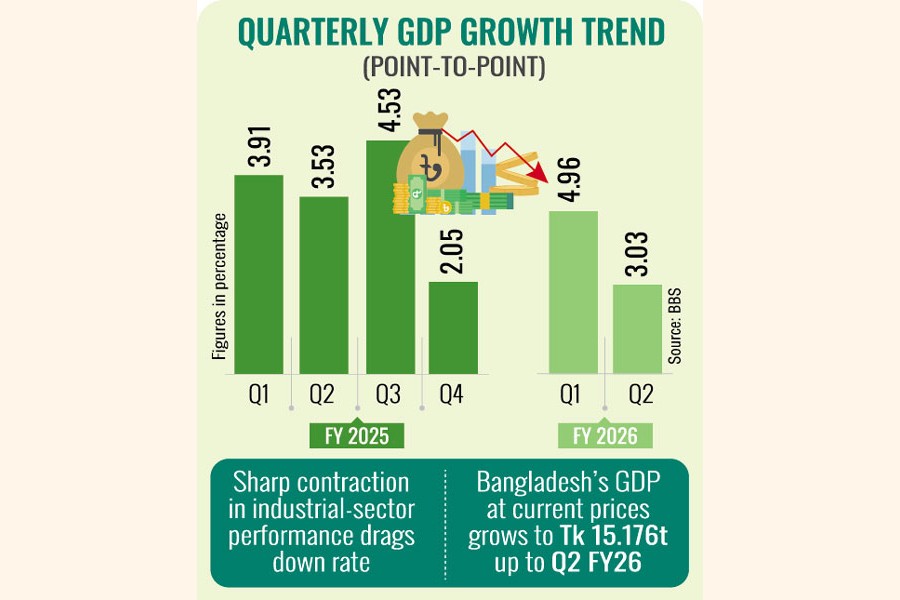
Bangladesh's economic growth significantly slows with the second-quarter GDP growth of this fiscal year declining to 3.03 per cent, official statistics show.
The growth in the October-December period of the fiscal year (FY) 2025-26 marks a decrease from the level of 3.53 per cent recorded during the same period in the previous fiscal year (FY2024-25), according to Bangladesh Bureau of Statistics (BBS) data published Monday.
The growth rate in the second quarter shows a notable decline compared to the revised 4.96-percent growth achieved in the first quarter (July-September) of the current fiscal year.
According to the latest summary from BBS, the slowdown is primarily driven by a sharp contraction in industrial-sector performance.
The BBS report highlights a stark contrast in performance across three major sectors of the economy with the industrial sector hit hard by slowdown.
The industrial sector saw a dramatic decline in growth, reaching to only 1.27 per cent in Q2 FY2025-26, the national statistical body shows.
This is a sharp drop from the 5.78-percent growth recorded in Q2 of the last year and a significant fall from the 6.82 per cent seen just one quarter prior (Q1 FY2025-26).
The industrial slowdown is largely attributed to weakened domestic demand, high inflation, and industrial unrest. Furthermore, global trade uncertainties and potential tariff increases have dampened the outlook for manufacturing and exports.
In contrast to the industrial slowdown, the agriculture sector demonstrated robust growth, rising to 3.68 per cent, to save the situation.
This is a substantial improvement over the 1.90-percent growth recorded in the same period last year and the 2.11 per cent in the preceding quarter.
The services sector grew at a steady rate of 4.45 per cent, slightly higher than the 3.48 per cent recorded in the Q2 last FY2024-25.
This performance remained relatively stable compared to the 4.51-percent growth seen in the first quarter of the current fiscal year.
The national statistical bureau regularly publishes quarterly GDP (QGDP) data since the first quarter of FY2023-24 to provide short-term economic analysis for policymaking and planning.
The current estimates for Q2 FY2025-26 are preliminary and were calculated using the production method based on the FY 2015-16 as the base year.
The reporting also notes that previous figures for Q1 FY2025-26 were revised following international manuals and updated benchmarking.
According to the latest BBS data, the size of Bangladesh's GDP at current prices reached Tk 15.176 trillion in the Q2 of the current fiscal, up from Tk 13.901 trillion in the same quarter last FY2025.
While the nominal value has increased, the inflation-adjusted (constant price) growth rate highlights "underlying structural challenges in the economy".
International financial institutions have been cautious regarding Bangladesh's economic recovery, frequently revising their forecasts for the FY2026 as new data emerge.
As of January 2026, the World Bank had projected a GDP growth of 4.6 per cent for FY2026.
This was a slight downward revision from its October 2025 forecast of 4.8 per cent.
The Bank cited rising household consumption and an easing of inflationary pressures as potential growth drivers, but warned that tight monetary policy and political uncertainty remain significant risks.
The International Monetary Fund (IMF) has provided one of the more optimistic yet frequently adjusted outlooks, projecting growth at 4.9 per cent for FY2026.
This represents a "mild recovery" from the estimated 3.8-percent growth in FY2025. However, the IMF has cautioned that banking sector vulnerabilities and the slow implementation of structural reforms could threaten this stability.
The Asian Development Bank (ADB) projects a 5.0-to 5.1-percent growth for FY2026.
The ADB notes that while the economy remains resilient, it is hampered by energy-security issues and high inflation, which is expected to average around 8.0 per cent for the year.
The Manila-based lender emphasizes that growth will depend heavily on the government's ability to improve the business environment and diversify exports beyond the garment sector.
The current actual performance of 3.03 per cent in Q2 suggests that achieving the annual targets of 4.6 per cent to 5.1 per cent set by international lenders will require a massive surge in economic activity in the second half of the fiscal year.
The Bangladesh government in its macroeconomic policy statement has set a target to achieve a 5.5-percent GDP growth for the current financial year. In the last FY2025, Bangladesh economy grew at 3.49-percent rate.