
Economists warn next govt of reform test
Fragile macro stability, weak institutions and low revenue base seen as key risks ahead of LDC graduation
FE REPORT | Tuesday, 10 February 2026
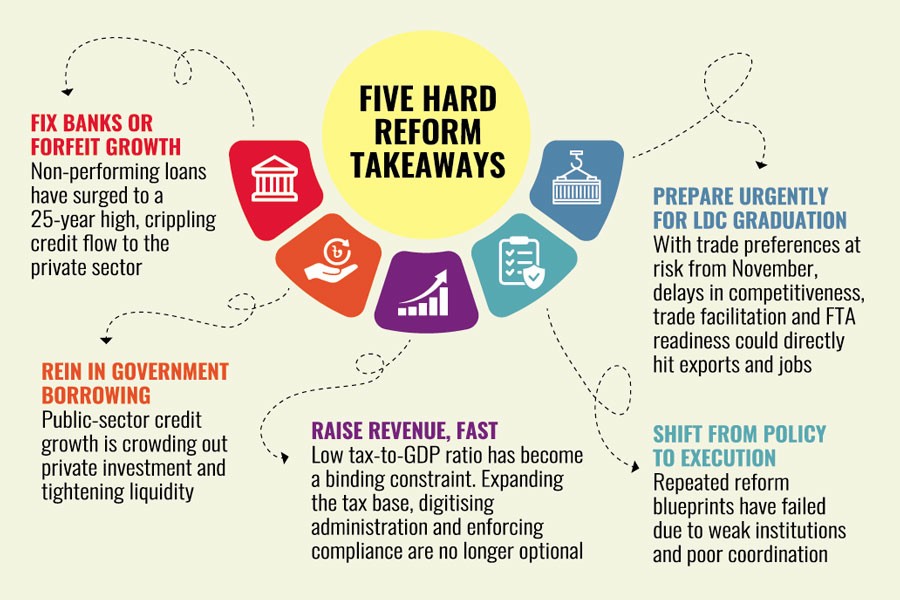
Bangladesh's next elected government will inherit an economy that is functioning but fragile, with mounting fiscal, financial and external pressures threatening growth, investment and social stability, economists and policy experts warned on Monday.
While the interim administration has helped avert immediate crisis, they cautioned that without decisive structural reforms the room for policy manoeuvre will remain limited.
At a high-level discussion in Dhaka, speakers urged the incoming government to move swiftly on banking governance, revenue mobilisation and institutional reforms to secure sustainable and inclusive growth, particularly as Bangladesh approaches graduation from the least developed country (LDC) category later this year.
The observations emerged at a discussion titled "Macroeconomic Insights: An Economic Reform Agenda for the Elected Government", organised by the Policy Research Institute of Bangladesh (PRI) at a city hotel.
Finance Adviser Dr Salehuddin Ahmed attended the event as chief guest, while PRI Chairman Dr Zaidi Sattar presided over the session. Former Bangladesh Institute of Development Studies (BIDS) director general Dr KAS Murshid and Australian Deputy High Commissioner in Dhaka Clinton Pobke were present as special guests.
Dr Fahmida Khatun, executive director of the Centre for Policy Dialogue (CPD), and Dr M Masrur Reaz, chairman and chief executive officer of Policy Exchange Bangladesh (PEB), offered their insights on the keynote paper presented by Dr Ashikur Rahman, principal economist of PRI.
Speaking at the event, Dr Salehuddin said the economy remains broadly stable despite significant challenges, emphasising that sustained reforms, stronger institutions and political commitment from the next government are essential for long-term growth.
He underscored institutional weaknesses and poor coordination among public agencies as major barriers to reform implementation, noting that while many recommendations are made, implementation remains the most difficult task.
"Without strong and accountable institutions, even well-designed policies fail to deliver expected outcomes," he said, stressing the need for political consensus to carry forward meaningful reforms.
Dr Salehuddin said the economy was on the verge of collapse before the interim government took office.
While the outgoing administration has managed to stabilise the situation, he cautioned that challenges remain deep-rooted and require consistent and carefully calibrated policy support.
He said the interim government has prioritised macroeconomic stabilisation, fiscal discipline, management of foreign exchange pressures and continuity of essential economic activities.
"We have tried to take balanced decisions so that the economy continues to function while also protecting vulnerable groups," he said.
Highlighting revenue mobilisation as a major concern, Dr Salehuddin said Bangladesh's tax-to-GDP ratio remains far below that of peer economies, severely constraining the government's ability to finance development and public services.
"It is extremely difficult to run a modern state with such a low level of revenue collection," he said, calling for comprehensive tax reforms, expansion of the tax base and improved compliance.
Dr Zaidi Sattar said modernising tariffs, expanding the tax base, digitising tax administration and aligning trade policies with global standards are essential for deeper integration into global markets and future free trade agreement (FTA) negotiations.
He expressed hope that the next elected government would take decisive steps to implement structural reforms, noting that democratic administrations are generally better positioned to carry out major policy changes.
Dr Sattar said recent economic shocks have slowed growth to around 4 per cent, which does not reflect Bangladesh's long-term potential.
Without reforms, growth could recover to 5.5-6 per cent once political stability returns, while timely and robust reforms could lift growth to 7-8 per cent, he added.
"We often overlook the macro-micro link in Bangladesh's development, and reforms have too often been driven by IMF conditionality rather than domestic ownership," said Dr KAS Murshid.
He argued that meaningful reform requires focusing on a few core areas and delivering visible success, rather than spreading reform efforts too thinly.
Dr Fahmida Khatun also underscored the need for comprehensive reforms, stronger institutions and greater emphasis on employment generation to sustain Bangladesh's development momentum.
She described political pledges to achieve a one-trillion-dollar economy by 2034 as highly ambitious, noting that this would require sustaining annual growth of around 9 per cent for nearly a decade.
She questioned whether Bangladesh currently has the institutional capacity, governance standards, skilled workforce and technological readiness needed to maintain such high growth rates.
Dr M Masrur Reaz said Bangladesh is undergoing a triple transition, deepening democracy, restoring governance across institutions and reconstructing the economy, which requires comprehensive, time-bound and integrated reforms.
Strengthening exchange rate management, revenue mobilisation and economic governance is essential amid rising fiscal and external pressures, he said.
Presenting the keynote, Dr Ashikur Rahman said non-performing loans had climbed to a 25-year high of 35.7 per cent, amounting to roughly Tk 18.04 trillion by late 2025, while private-sector credit growth fell to a historic low of 6.1 per cent in December.
jahid.rn@gmail.com