
Economy's upturn persists
Broad-based growth across all key sectors signals sustained momentum
FE REPORT | Monday, 10 November 2025
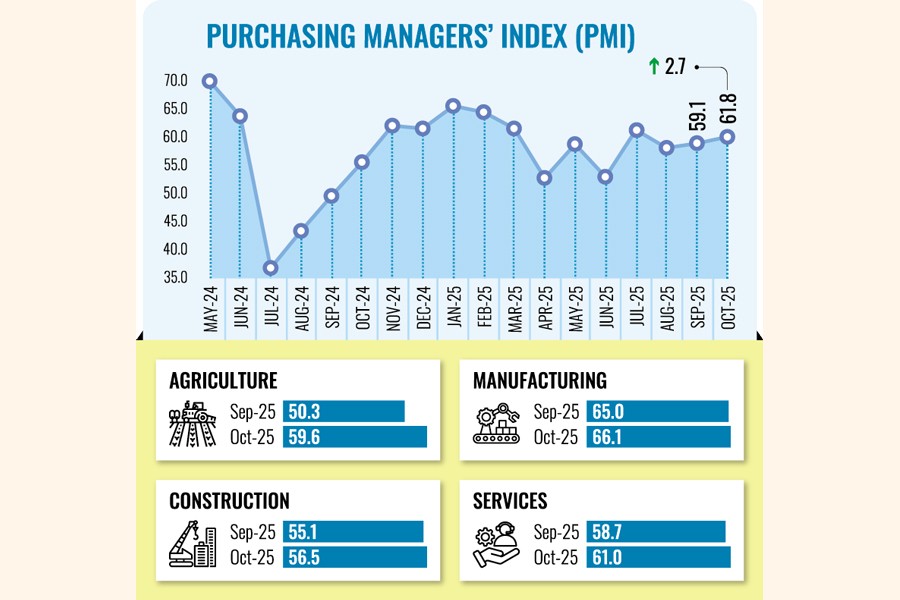
The Bangladesh economy gathered fresh momentum in October, with the Purchasing Managers' Index (PMI) rising by 2.7 points from the previous month to 61.8, indicating a faster pace of expansion across all major sectors.
The upturn was broad-based, led by robust growth in agriculture, manufacturing, construction, and services, marking the fourteenth consecutive month of overall expansion in the private sector.
The latest data, released on Sunday, underscores the economy's steady recovery despite persistent global uncertainty and domestic inflationary pressures.
Analysts say the upbeat October reading reflects renewed confidence and resilience as the economy moves into the year's final quarter, buoyed by improving exports, easing inflation, and stronger domestic demand.
Agriculture recorded its second consecutive month of growth, expanding at a faster rate amid favourable crop conditions and optimism for a strong harvest. New business and activity levels improved, while input costs accelerated and employment returned to growth.
Manufacturing, the backbone of the export-driven economy, maintained its strong run, marking fourteen consecutive months of growth with faster expansion in new orders, exports, factory output, and employment.
However, manufacturers reported a quicker depletion of backlogs, suggesting some easing of earlier supply constraints.
The construction sector also sustained its recovery momentum, expanding for the second month with stronger readings in new business, employment, and input costs.
Meanwhile, the services sector posted its thirteenth month of expansion, with improvements in both business activity and hiring. After two months of decline, service-sector backlogs returned to growth, indicating renewed demand.
Despite the broad-based upturn, the future business index showed slower expansion across all four sectors, reflecting caution among firms amid global economic uncertainty and domestic cost pressures.
"The latest PMI readings indicate that the overall Bangladesh economy continued to expand, primarily driven by favourable crop conditions and expectations of a good harvest in the agricultural sector," said Dr M. Masrur Reaz, chairman and CEO of Policy Exchange Bangladesh.
"Other sectors of the economy also posted faster expansion rates going into the final quarter of the year, with monthly growth in exports and inflation gradually waning."
The upbeat October data suggests Bangladesh is entering the year's final stretch with renewed economic vigour.
A combination of easing inflation, export resilience, and improving domestic demand could sustain the expansion, though analysts warn that slowing forward expectations merit close monitoring.
The PMI is a forward-looking economic indicator that helps gauge the direction of the economy. A reading above 50 indicates expansion, 50 denotes no change, and below 50 signals contraction.
First developed in the United States in 1948, the PMI is now used in over 50 countries for its accuracy in capturing real-time economic conditions.
It remains a vital tool for investors, businesses, and policymakers to anticipate shifts in growth and guide strategic decisions.
jasimharoon@yahoo.com