
Eight Qatar stadiums to host 64 WC matches
Friday, 18 November 2022
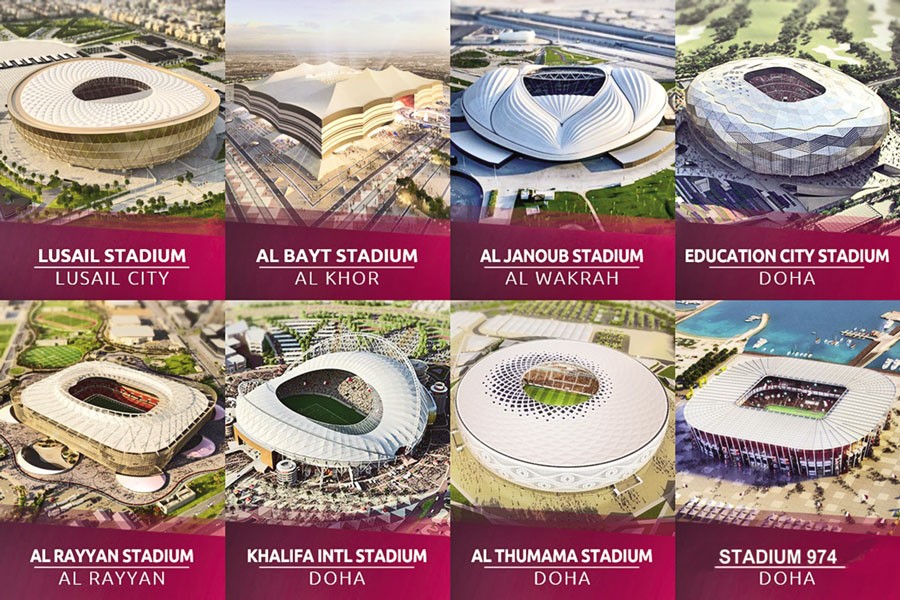
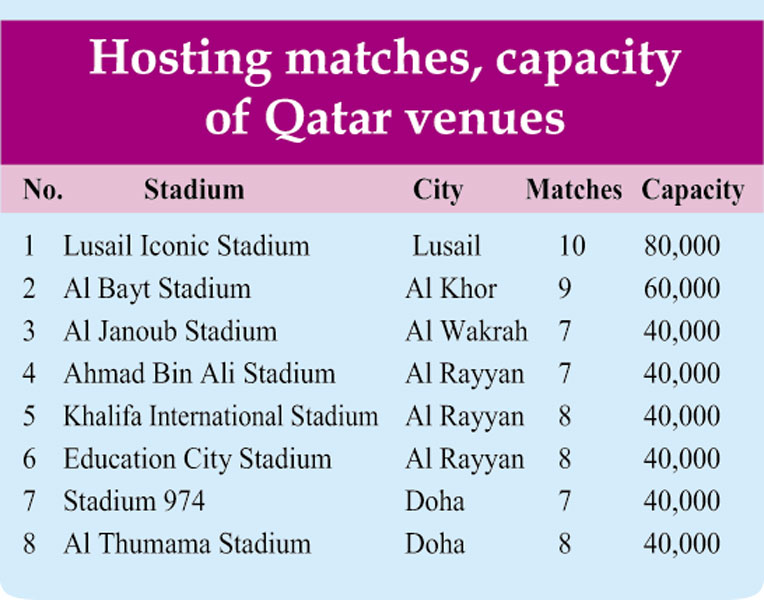 A total of eight stadiums spread across five different Qatar cities will host 32 teams for 64 matches during the FIFA World Cup 2022. The opening match kicks off at the Al Bayt Stadium in Al Khor on November 20, while the finalists will head to Doha a month later to play at the Lusail Stadium on December 18, report agencies.
While these stadiums are striking in design, the eight venues - the fewest since the 16-team 1978 World Cup in Argentina - are a logistical relief for fans attending arguably the most controversial World Cup ever.
That is because the eight stadiums are all within 21 miles of central Doha and will be linked by a metro and tram system, making it possible to watch more than one game in the same day.
However, some grounds are powered by solar farms and equipped with cooling systems to battle the heat, while others have outdoor air-conditioning.
The mercury can hit 50 degrees Celsius (122 Fahrenheit) during the Gulf state's blistering summers, which is why this year's World Cup was moved to the winter.
But even with maximum temperatures down to around 25 Celsius (77 Fahrenheit) for the tournament in November and December, cool air will still be pumped out onto the players and watching fans.
Stadium cooling is nothing new. The Superdome, home of the New Orleans Saints American football team, has 9 000 tonnes of air conditioning equipment.
Saud Abdulaziz Abdul Ghani, nicknamed "Dr Cool", a professor of engineering at Qatar University who also helped develop cooling for the Ford Mondeo car, has however developed a system that World Cup organisers say is 40 per cent more "sustainable" than existing techniques.
Let's have a look at the eight stadiums:
Lusail Iconic Stadium
The Lusail Stadium (officially "Lusail Iconic Stadium") will be the centrepiece of the Qatar World Cup. It is the biggest stadium available and features cooling systems to help combat the local climate, drawing power from a solar farm outside the city. This is where the World Cup final will be played, as well as a number of group fixtures, and one game from each of the knockout rounds before December 18.
It is situated 15 miles north of Doha and served by both the Metro and matchday buses from Doha. Lusail is very much still a city in development, with plans ultimately to develop an infrastructure that could support more than double the current 200,000 population.
Beyond the accommodation blocks that have housed many of those 10,000 people who have worked on the Lusail Stadium for the past six years - and whose faces form a mosaic outside the stadium - the immediate surrounds remained largely barren at the time of The Telegraph's site visit in June.
Construction began in 2017 and was finished in 2021, at an estimated cost of $767 million.
Al Bayt Stadium
At around 30 miles from the centre of Doha, Al Bayt Stadium represents the 'outpost' of football's most compact ever World Cup. It is also one of the biggest stadiums at a capacity of 60,000 and will host nine matches during the tournament, including England v USA in the group phase, a quarter-final and a semi-final. With its retractable roof and traditionally Arabic tented design, it is also one of the most eye-catching designs. Express shuttle buses will take fans to the stadium from both the centre of Doha and the Lusail Metro Station.
Education City Stadium
Opened on June 15, 2020, the Education City Stadium is billed as one of the world's most environmentally sustainable stadiums. It is surrounded by Qatar's educational institutes, which will continue to use the stadium after the tournament closes.
The stadium has already hosted matches in the Qatar Stars League and the World Club Cup, and Education City will host seven World Cup matches up until the quarter-finals. Its capacity will be reduced to around 25,000 after the tournament. Situated on the edge of Doha, the stadium can be accessed on the Metro line.
Stadium 974
Nestled just 5km from the airport and overlooking the seafront corniche, the ideal match venue for those fans who might be heading in and out of Doha on a matchday while staying elsewhere in the region.
The name comes from the 974 shipping containers that were used to construct the stadium and, with a 40,000 capacity, it will host matches up until the last 16. It will be dismantled after the tournament, making it the first temporary venue in World Cup history.
Khalifia International Stadium
Served by the Doha metro and just seven miles outside Doha city centre, the Khalifa International Stadium is the oldest of the eight stadiums after first being constructed in 1976. It has been renovated for the World Cup, and now has a 40,000 capacity, but has already previously hosted the Club World Cup and the World Athletics Championships. It will be the venue for England's first match of the tournament against Iran.
Ahmed Bin Ali Stadium
The Ahmed bin Ali Stadium in Al-Rayyan took its design from the desert landscape around the ground and Qatar. It features several sand dune-esque structures after a redesign for the World Cup following its initial build completion in 2003.
It was more than 40C when The Telegraph attended the final play-off match in June between Peru and Australia at this stadium which is situated within 600 metres of the metro station in Al Rayyan. But there will be no worries about the playing temperatures when England face Wales in their final group stage fixture inside the stadiums, thanks to air conditioning systems that were designed by Dr Saud Abdulaziz Abdul Ghani, a Sudanese graduate of mechanical thermal fluids from Nottingham University.
Al Thumama Stadium
Another of the more eye-catching architectural achievements, with its circular outline designed to reflect the gahfiya - the traditional woven cap worn by men and boys across the Arab world. This is another stadium within close proximity of Doha and the airport, and it previously staged matches in the 2021 Arab Cup. This stadium will host eight matches during the World Cup, including a quarter-finals
Al Janoub Stadium
The stadium's design, by the British-Iraqi architect Zaha Hadid, was inspired by the hulls of traditional pearl fishing boats, which are further reflected by the use of timber and traditional materials. The symmetrical roof, intended to look like sails, is the standout feature.
Al Janoub stadium is situated in the town of Al-Wakrah where the England team are based, around 30 minutes from the centre of Doha. After the tournament, it will later be reduced in size and become the home venue of the local Al Wakrah football team which currently plays in the Qatar Stars league.