
Elected zila parishad for better implementation of district budget
Syed Mahbubur Rashid | Saturday, 15 February 2014
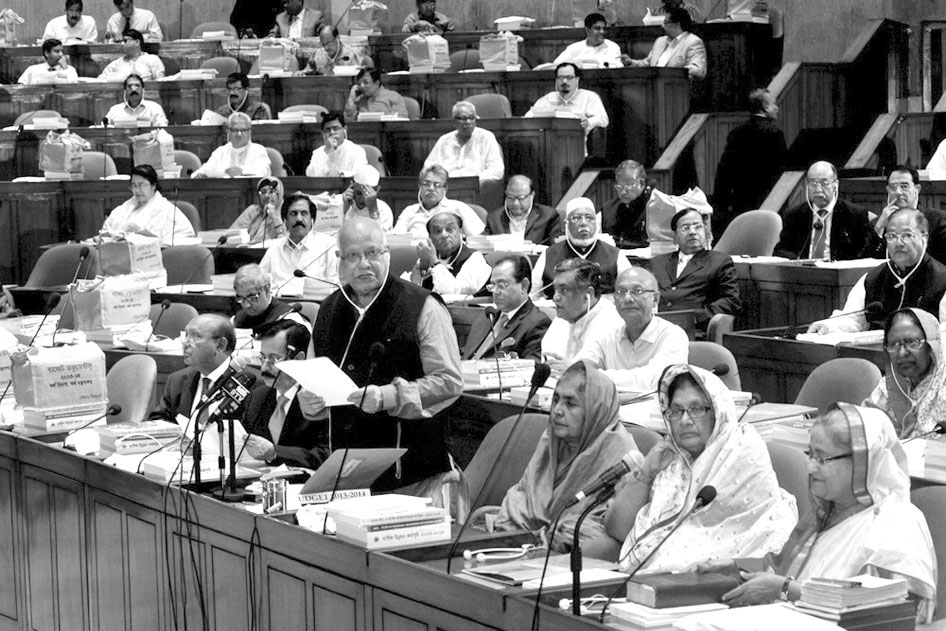
Finance Minister A M A Muhith is eager to introduce 'district budget'. In the valedictory budget session of the last parliament, he said "… this time we are presenting, on an experimental basis, a budget for the district of Tangail. In this budget, we are presenting the allocations for both the development and non-development spending for the field offices located in this district. However, this is not a district budget per se. In this document, we will find a reflection of what activities are being carried out with the budget allocations and how much is being spent in the district. The purpose of this document is to inform the public about the impact of the government programmes on a district and how the people of a district are benefited. I expect this will enhance transparency and accountability of government actions. I also hope that in future, the districts will gradually find place in the district budget. There is a precondition for this process to work and this is the presence of a strong district council."
A few days back he reiterated his stand when he was speaking to the media about decentralisation of power. Before we discuss this issue in detail, let us try to study the history of development of local government, particularly with reference to the District Council/Board.
The history of local government dates back to the nineteenth century. Under the British rule, Bengal Local Self-government Act of 1885 provided for a three-tier local government. They are the District Board for a district, excluding the municipal areas, Local Board for a sub-division, and Union Committee for a union. It may be mentioned that municipal committees were recognised under the Municipal Act, 1884. The Local Boards functioned for a few years and it was abolished in 1936, when these were found to be superfluous, and duplication of the function of the District Boards. The District Board consisted mainly of nominated members with the provision for some elected members. But until 1992, it was chaired by the district magistrate.
The District Board was a body corporate with independent fund and a body of officers and staff. It maintained its autonomous entity, but due to lack of necessary funds and the overbearing attitude of the government officers of the district administration, the scope of its function and activities could not be widened according to expectation. Still the District Board, as known at that time, limped under the leadership of an elected president until 1960. The size of franchise for election was limited. In 1958, when commander-in-chief of the Pakistan Army Ayub Khan usurped power and became President and Chief Martial Law Administrator of the country, the Deputy Commissioner, hitherto known as the district magistrate, was made chairman of the District Council as the word 'board' was replaced by 'council'. There was an elected vice-chairman, but only the members of the Union Council, otherwise known as basic democrats (BDs), had the power to vote and elect a vice-chairman and a few members for the District Council.
However, still during the rule of an autocratic general, there was a District Council, no matter how weak and powerless it might be. Unfortunately, four decades has elapsed since we achieved independence but the District Council in any form could not be revived. The affairs of the District Council are run by the peripatetic bureaucrats. The Deputy Commissioner is the administrator, which is worse than that in the British system. Recently, the last government appointed administrators for the District Council from the public, but this was done purely on party-line which was sure to impair the concept of neutral administration.
It may be mentioned that the Ayub regime introduced another tier of local government in the Thana known as the Thana Council. As expected from Ayub, it was also dominated by the bureaucrats. The sub-divisional officer (SDO) was the chairman and the Circle Officer was the vice-chairman of the council.
That the Thana should be the centre of all development activities was the concept of Akhtar Hameed Khan, the doyen of rural development activities in the then Pakistan. He was an ICS officer. He started the extensive rural development activities laying importance on cooperative societies, choosing Comilla Kotwali Thana as the model one. His idea was that all nation-building officers at the thana-level would sit under one roof so that the people could come to a single place and solve their problems. From this concept, the Thana development centres were set up at the Thana headquarters.
Some people ascribe the concept of upazila administration entirely to General Ershad, which is not the fact. First of all, he changed the name of the thana into upazila. However, Ershad can claim the credit of introducing the system of elected chairmen. This is no doubt a surprise from a man who illegally occupied the state power, and held a number of rigged elections.
Now, let us come to the main issue. In the very budget speech under reference, the Finance Minister recognised the importance of an elected District Council. He said, "There is a precondition for this process to work and this is the presence of a strong District Council. How can there be a strong District Council without the elected representatives of the people?" At a recent press interview, the Finance Minister said, "It is an established fact that if a development-oriented decision is taken at the local level, the work can be implemented easily and properly".
The finance minister has very eloquently stated the importance of an elected district council. The election of the zila parishsd (district council) should be held immediately after the upazila elections. The members of parliament (MPs) should work as the watchdog of both upazila and zila parishads. They should not be placed in any parishad either as an adviser or in any other capacity. Another point should be noted. Power should be with the parishad, be it of upazila or zila. This issue has been highlighted for the reason that on most occasions the question is raised about the power and functions of the chairman. It is a sheer nuisance. The chairmen of both the parishads are titular heads. It is the parishad, which is the repository of all powers of the people. The functions of both the elected members and the bureaucrats are to work in tandem for implementing the decisions of the board, be it for a zila or an upazila.
rezaulparvaz@live.com