
Electronic fresh flower auctioning at Dounan flourishes beyond borders
Local florists favour a clone to boost BD flower market
JASIM UDDIN HAROON, back from Kunming, Yunnan, China | Thursday, 27 July 2023
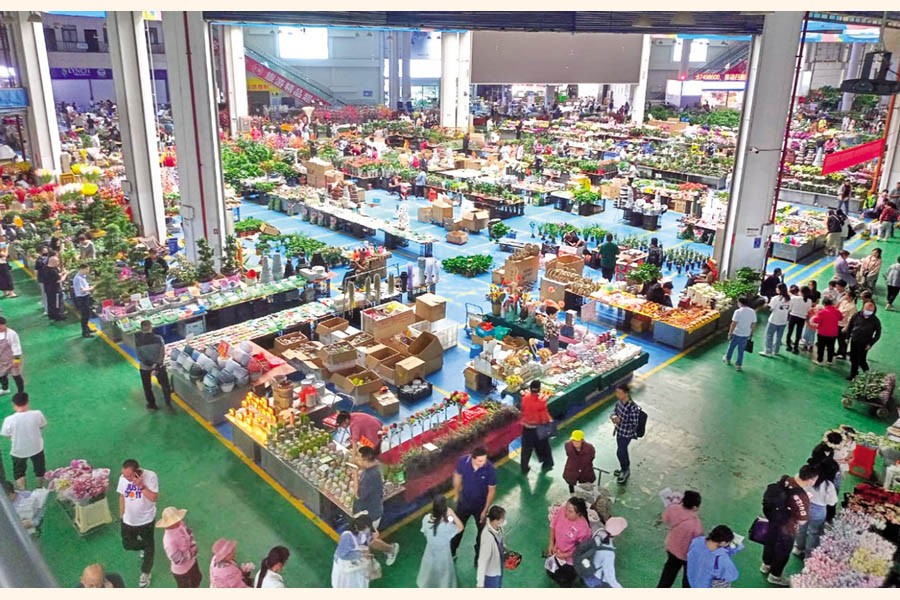
Transactions at Asia's largest flower market in Kunming, China, have witnessed a rapid growth, surging to double digits in recent times, thanks to the adoption of cutting-edge digital technology.
Known as Kunming International Flora Auction Trading Centre (KIFA), the market, situated in the Dounan area of Kunming, operates as an electronic marketplace.
In the 900-seat trading hall packed with flower agents, a transaction occurs every five seconds, on average, through electronic means, with approximately 30,000 visitors showing up each day.
Since its inception in 2015, online auctioning has facilitated real-time and prompt transactions. The latest addition, the remote auction, allows participation without physical presence, providing access to comprehensive coverage of auction transactions and flower finance.
Upon conclusion of the auction, the flowers are carefully packaged before being dispatched to various cities across China and neighboring economies involved in the Belt and Road Initiative (BRI), people familiar with the matter at the Dounan flower market told this correspondent.
The sales volume of fresh-cut flowers had risen significantly from 9.2 billion branches worth 7.436 billion RMB in 2019 to 11 billion branches in 2022, with a transaction volume surpassing 12.1 billion RMB (Chinese Yuan), according to the Dounan Flower Industry Comprehensive Service Centre.
"This rapid growth in transactions is due to adoption of cutting-edge digital techniques which ensure competitive prices both for growers and traders," Ms Zhang Xian, publicity officer of the KIFA, told the FE correspondent at its HQs in Dounan.
She revealed that over 30 million flower stems are sold daily, with transaction rates increasing by around 20 per cent from the pre-pandemic period.
She emphasized that this market is not a mere clone of the Amsterdam flower market; instead, it incorporates Chinese innovations and has a supply chain tailored to the needs of the BRI economies.
Bangladesh, which has been implementing a number of BRI projects, also imports flowers from the Kunming market, even though the scale of its flower industry is expanding.
Contacted, local florists and agro-business researchers said that Bangladesh could benefit from adopting similar tech-based trading in its traditional yet growing flower market to ensure fair prices for growers and a competitive environment for traders.
The existing pattern of Bangladesh's flower market involves selling produces through agents in Dhaka and other major cities, mostly on credit, causing delays in payment to growers, as the flower agents pay the growers after receiving money from retailers.
Moreover, there is a lack of logistics to preserve flowers. Nevertheless, the flower market, worth over Tk 15.0 billion, expands annually during wedding seasons, Valentine's Day, and Pahela Baishakh festivals.
However, the florists and experts identified some challenges to converting the traditional flower market into an electronic marketplace. The challenges include the lack of awareness among farmers, lower internet usage in rural areas, lack of refrigeration logistics, and issues with the supply chain.
Dr. Jahangir Alam, a professor and director at the Agribusiness Institute of Bangladesh Agricultural University (BAU) in Mymensingh, told the FE that farmers in Bangladesh need such tech-based trading to make the growing flower market transparent and efficient.
"There is no doubt that such trading will help make the market efficient".
The rise in flower consumption in Bangladesh is primarily due to increased disposable income resulting from the country's economic growth, he said.
Nearly 60 per cent of rural households own smartphones, he said quoting the latest ICT survey.
The government and authorities concerned can think of how to make a clone of KIFA in Bangladesh, he added.
Florists engaged in trading for a long time believe that introducing electronic auctioning is a feasible step, given that Bangladesh's tea auctions are now partially digitized.
President of Bangladesh Flower Society (BFS) Babul Prasad told the FE that electronic trading should be launched, as the flower market is growing rapidly at a rate of "more than 20 percent annually."
He pointed out the strong aspects of both supply and demand, mentioning that many flowers are imported to meet customer requirements, with major sources being Kunming and Amsterdam, the home of the world's largest flower market.
Mr. Prasad, representing a platform of over 100 leading florists in Bangladesh, said: "There is no price control as importers hike the flower prices on many grounds".
To break the 'existing cartel of some flower importers' and foster healthy competition, Mr. Prasad advocated for the establishment of a cutting-edge trading platform like KIFA, which would bring together all domestic and imported flowers under one umbrella.
Mr. Feroze Al Mamun, a senior planning official at the Ministry of Commerce (MoC), told the FE that this is high time to launch such an initiative, as the government is actively embracing digital technologies across the economy.
A government department under the Ministry of Agriculture (MoA) has already developed infrastructures in flower-growing areas and Dhaka to facilitate trade.
Nikhil Chandra Dey, an official at the Department of Marketing at MoA, revealed that his department implemented a project involving Tk 270 million to build infrastructure for the flower market. This included six buildings, including a main market in Gabtoli, which could also facilitate digitalisation.
He mentioned that there are five flower assembling centers located in different regions of the country -- two in Jessore and one each in Savar, Chuadanga and Jhenaidah.
These infrastructures could be instrumental in introducing electronic trading, he said, adding that there is a need for another project to assess the feasibility of such trading in Bangladesh.
Md Ismail Hossain, an enthusiastic chrysanthemum and tulip grower from Godkhali in Jessore, expressed his optimism about flower auctions, stating that it would enable real-time cash transactions instead of selling on credit.
He also noted the significant price difference between selling one chrysanthemum flower at Tk 2.0 compared to retailers in Agargaon or Shahbagh who sell the same flower at Tk 5.0.
He believes that the gap between the prices at retail and grower level would narrow with electronic trading.
According to the Department of Agricultural Extension or DAE, Bangladesh boasts more than twenty-five types of flowers with over one hundred varieties, and the major flower-growing districts include Jessore, Jhenaidah, Chuadanga, Savar, and Golapgram in Dhaka.
Sushanta Tarafder, a trainer at DAE in Jessore, highlighted the cultivation of exotic flowers like Lilium, tulip, and gladiolus in the region.
Godkhali in Jessore is popularly known as the "capital of flowers," as the local people mostly rely on flower cultivation for a living.
While the country produces enough flowers to meet domestic demand, the export activity remains sluggish.
Export Promotion Bureau (EPB) data analysis over the last seven fiscal years indicated that the export income from flowers ranged between $80,000 and $90,000.
According to Bangladesh Bureau of Statistics (BBS) data, the current flower production stands at 32,120 tonnes on 3,930 acres of land.
Rose dominates the domestic production, accounting for over two-thirds (67 per cent) of the total production, which amounts to nearly 22,000 tonnes.
jasimharoon@yahoo.com