
Ensuring chemical safety, health management at RMG units
Md. Harunur Rashid | Thursday, 4 December 2014
Long time ago Bangladesh had a fully agro-based economy. These days the economy also depends on industries. It is predicted that after two decades, the country's economy will become knowledge-based. The government has taken steps to ensure workers' health and safety in the ready-made garments (RMG) sector and some other industries.
At the beginning, the RMG sector had a few thousand workers. Presently, it has the strength of over four million workers. Every worker in the sector gets a minimum wage. Despite this, the issue of compliance with a lot of rules and laws related to health and safety of workers poses a challenge to the RMG sector. Productivity cannot be improved without health and safety measures in place. For sustaining the RMG sector and other industries, there are prerequisites to be monitored by the government bodies, national and international watchdogs, and the UN agencies.
In line with this, the International Labour Organisation (ILO) got itself engaged in the Bangladesh RMG sector. The UN organisation wants to see the health and safety standards of workers are maintained. Also Asian Development Bank (ADB) has taken steps to ensure safety and skill development for apparel workers in the country in collaboration with Bangladesh Knitwear Manufacturers and Exporters Association (BKMEA).
Most of the RMG factories and others use various chemical substances during production. The chemicals are used in fabrics and dyeing, for making the colours and their combination solid. Thousands of workers are exposed to these chemicals at the factories. Due to this, they become vulnerable to attacks of various chronic diseases.
Any chemical substance could turn out to be dangerous. These hazardous substances may be in the form of gases, solid masses, liquid, mist and dust. These substances are divided and sub-divided into classes depending on the risks they entail. Some substances combine different types of risk. GHS (Globally Harmonised System of Classification and Labeling of Chemicals) system classification defines physical, health, and environmental hazards. Contractors, visitors and neighbours can be exposed to them.
The dangerous substances include the toxic ones. They disrupt the normal functions of the human body and are dangerous for the environment. They are harmful because of their negative impact on human health in relatively small concentrations. Larger the quantity of substances, less are consequences. They explode at a certain temperature, through contact with other substances or in case of shock or friction, even without the effect of additional oxygen. They are highly flammable; ignite in the presence of a flame, a heat source or a spark. Extremely flammable substances ignite easily, even at sub-zero (°C) temperature. They produce additional oxygen upon coming into contact with other substances and cause anything flammable to burn fiercely. The chemicals are corrosive, attack living tissue on contact and may cause serious burns. They are harmful to materials, clothes, skin, eyes and lungs. The substances are irritating. They cause skin irritation and inflammation after repeated contact with the skin or mucous membranes. Being carcinogenic, they can cause cancer.
The employers are obligated to identify the chemicals and take measures to prevent exposures, as well as measuring and analysing the exposures. The substances can cause genetic mutations (mental and physical). They can affect the reproductive function of men and women. Pregnant and lactating women must avoid contact.
The contacting surface for the dangerous substances can include the skin, the eyes, and the mucous membranes of nose, throat or respiratory tract. At the workplace, inhalation is the most common way of absorption in the body. Dangerous substances enter the body through the pores (open wound or eczema). Absorption through the mouth is less frequent. Dangerous substances can be absorbed directly into the bloodstream via small wounds.
Let us see why chemicals are important to the factories. The term chemicals mean chemical elements and compounds, and mixtures thereof, whether natural or synthetic. Chemicals are essential to life and there are widespread uses. Chemicals are also a critical part of many industries. But they have potential adverse effects on the health of people and on the environment.
IMPACT OF CHEMICAL EXPOSURE: Chemicals can leave impact on every system of the human body. Exposure to certain chemicals causes serious occupational diseases. Notable among these is occupational cancer. The significant impact on an individual who has developed a disease as a result of chemical exposure may be incalculable. It ranges from inability to work to death. Physical hazard of chemicals at the workplace: It needs attention because the substances have significant potential for property damage in a certain facility. In the worst cases, they may impact on the surrounding communities and the general environment.
Chemicals have been proven to have a significant impact on the environment - from climate change to the destruction of wildlife species and the contamination of drinking water. Pollution crosses borders and prompts the need to have an effective national programme for the environment. There must be an international coordination strategy to promote a similar approach on the part of all countries.
Employers ought to maintain a record of hazardous chemicals used in the factories and have them cross-referenced to the appropriate chemical safety data sheets. This record shall be accessible to all workers concerned and their representatives.
Employers shall: (a) limit exposure to hazardous chemicals so as to protect the health of workers; (b) provide First Aid treatment; (c) make arrangements to deal with emergencies.
Hazardous chemicals which are no longer required and containers which have been emptied but which may contain residues of hazardous chemicals, shall be handled or disposed of in a manner which eliminates or minimises the risk to safety and health of workers, and to the environment, in accordance with national laws and practices.
Employers shall: (a) inform the workers of the hazards associated with exposure to chemicals used at the workplace; (b) instruct the workers on how to obtain and use the information provided on labels and chemical safety data sheets.
Workers concerned and their representatives shall have the right to (a) information about the identity of the chemicals used at work, the hazardous properties of such chemicals, precautionary measures, education and training; (b) the information contained in labels and markings; (c) chemical safety data sheets; (d) any other information required to be kept by the relevant Convention.
SUGGESTION: National laws and regulations on safety and health at workplaces should apply to 'homework' (work carried out by a person), taking into account its special characteristics, and shall establish conditions under which certain types of work and the use of certain substances may be prohibited in homework for reasons of safety and health.
For hazardous chemicals, chemical safety data sheets containing detailed essential information regarding their identity, suppliers, classification, hazards, safety precautions and emergency procedures should be provided to the employers.
Criteria for the preparation of chemical safety data sheets should be established by the competent authority, or by a body approved or recognised by the competent authority, in accordance with national or international standards.
The chemical or common name used to identify the chemical on the chemical safety data sheet should be the same as that used on the label.
The hierarchy of control (keeping exposure to a minimum or avoiding it altogether) should focus on Elimination: Remove the source; Substitution: product less toxic; Isolation: Isolating the potential victim; Engineering controls: Ventilating (opening windows, using extraction installations, using fans); Administrative controls: Job rotation, training, information, signals, collective protective equipment; PPE: Last resort --- supplementary
Chemical Incompatibility Matrix can be used for reducing the risks.
AFIRM Group (The world's 24 leading buyers) has always recommended to suppliers on following the Incompatibility Matrix. Because it is important for laboratory/industry personnel to conduct researches on the properties of the chemicals being used at the factories. Tools such as Material Safety Data Sheets (MSDSs) for guidance on chemical incompatibility should be used. It should also be ensured that the persons concerned read the containers' labels along with the storage guidelines.
The highest standards should be followed for the protection of the environment and human safety. The RMG sector and the other industrial units should take initiatives on Zero Discharge of Hazardous Chemicals (ZDHC).
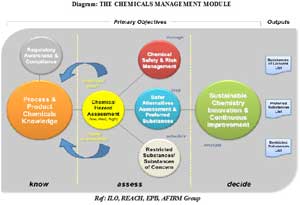
Finally, every industry should follow rules set in accordance with AFIRM Group chemical management module and REACH Registration, Evaluation, Authorisation and Restriction of Chemicals — Annex 17.
The writer is Assistant Secretary (Labour & Compliance), BKMEA.
harun.bkmea@gmail.com