
Ensuring total safety in RMG factories
Md Shahabuddin Rajon | Wednesday, 14 January 2015
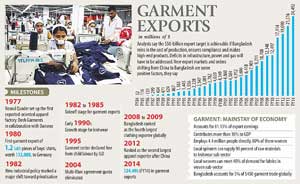
The readymade garment (RMG) sector has proved to be a boon for Bangladesh. It is the mainstay of the country's economy, facilitating sustained 6.0 per cent plus gross domestic product (GDP) growth over the years. It has provided millions of jobs within the industry and among those connected with backward linkages. Bangladesh already has a strong foothold in the world's apparel market and we hope this will enable us to grow in the coming years. Our vision is to increase global market share of Bangladesh's RMG industry from the current 5.0 per cent to 8.0 per cent by 2021. This requires increase in our exports to about US$ 50 billion. Many may consider this to be over-optimistic but for Bangladesh's RMG industry, this is an achievable goal. That the industry has come of age is demonstrated by the manner in which it has handled the tragic industrial accidents. Despite all the adverse publicity, RMG exports' growth during the last fiscal year (FY) 2013-2014 was 13.8 per cent.
On the occasion of the Dhaka Apparel Summit 2014, the president of the Bangladesh Garment Manufacturers and Exporters Association (BGMEA) told a press conference on December 06 that the country would reach US$ 50 billion RMG export when it will celebrate the 50th anniversary of its independence in 2021. He hoped that the RMG industry's global market share would rise from the current 5.0 per cent to 8.0 per cent by 2021 to fetch US$ 50 billion earnings.
So what is to be done to realise the dream of exporting garments worth US$ 50 billion? Time has come for rethinking and there is no alternative but to ensure 'Total Safety' (a new concept) in apparel industry. 'Total safety' means the way of ensuring workers' safety through combined initiatives of ergonomics, chemical safety management, globally harmonised system (GHS), hazard identification and risk assessment (HIRA), restricted substance list (RSL), occupational safety and health (OSH), real time risk assessment (RTRA) and fire safety with matrix model theory. Only market diversification and duty-free market access would not draw global buyers' attention to the sector. Global buyers have said time and again that they would not import clothes stained with blood of workers.
In most cases, our factory owners are tackling workers' safety and compliance issues and taking corrective measures on buyers' pressure. Most of the workers know their rights and the ILO declared child labour-free RMG units in 1995. At the same time, Accord fire safety and building integrity and Alliance for Bangladesh workers' safety have said, in the field of safety, Bangladesh's RMG has improved a lot. But there is a long way to go in case of ensuring workers' total safety.
The McKinsey summer report 2014 found that Bangladesh, remaining at the top of the list of apparel-sourcing markets, is expected to grow in importance in the next few years. As per the forecast in 2011, Bangladesh is on the radar-screen of all European and US apparel buyers and likely to attain triple growth (US$ 45 billion) by 2020. A forecast of the US Fashion Industry Association (USFIA) in June 2014 titled the 'Benchmarking Study' shows that apparel retailing companies are not leaving Bangladesh and are committed to compliance there and elsewhere. Among the respondents of the survey, 76.9 per cent currently source from Bangladesh. Despite the recent tragedies, the country is still regarded as a popular as a source. With Bangladesh now being on the watch-list, international buyers and consumers would like to see effective steps in place to help avert a new tragedy. Just because of a few non-compliant operators, the whole sector is getting a bad name and as such, is running the risk of losing markets.
Under such circumstances, restoring the image of the country's RMG sector is now an urgent national task. The government, the apparel owners, the workers' representatives and all others need to urgently put in their joint efforts to facilitate sustained development of the industry.
If we take into consideration the global giant's report, then what should be done immediately? It is high time for us to ensure 'total safety' (a new concept) in every RMG unit and all workers' safety that will regain the global image. Its ultimate impact definitely will be on the RMG industry.
The following are the core areas of safety measures that will have to be ensured to fulfil the dream within Vision 2021:
Ergonomics: Ergonomics is the science that focuses on how equipment, environment, etc. can be adapted to optimise work efficiency. (Minimising long-term work-related health effects and adapting the tasks to individual characteristics of the employee). A constant interaction exists between man and work. Man influences machines or material during his work. However, he is also influenced by environmental and human factors.
Various factors (work pressure, the ratio between the task and the capacities of the worker, atmosphere, organisation, infrastructure, surrounding noise, etc) can cause loss of concentration, depression, fatigue, nervousness and errors. It is a good idea for employers to minimise such undesirable factors to ensure teams' efficient work in the interests of company productivity.
Chemical management: A proper chemical management system can increase transparency of the manufacturing process, provide a safe working environment for staff and benefit the ecological environment. In the study, 18 of 20 factories were assessed in the following areas: chemical policy, staff training, chemical handling, safety policy and management of documents.
Most factories have stated their chemical management system guidelines. However, in practice, the implementation of such policy was less reliable and it varied from supplier to supplier.
In most cases, chemical information provided to factories by chemical suppliers lacks appropriate details to make informed decisions regarding chemical components. It was sometimes unclear whether a restricted substance is present in a formulation of trace amounts or if it is a minor ingredient, it is not listed as part of the formulation due to intellectual property concerns.
Training will provide a consistent platform for supply chain partners, tailored to all who have a role in handling chemicals, not just managers or those overseeing activities. Providing these resources through a common industry platform should reduce duplication of efforts, promote common efforts and reduce burden on apparel workers.
Globally harmonised system: The GHS is an acronym for the Globally Harmonised System of classification and labeling of chemicals. The GHS is a system for standardising and harmonising the classification and labeling of chemicals. It is a logical and comprehensive approach to:
l Define health, physical and environmental hazards of chemicals;
l Create classification processes that use available data on chemicals for comparison with the defined hazard criteria; and
l Communicate hazard information, as well as protective measures, on labels and Safety Data Sheets (SDS).
Occupational health and safety: in Bangladesh, the RMG industries need to implement occupational health and safety regulations to deal with workers' safety issues and conduct business in line with national and international policies and regulations. OHSAS 18001/ISO 45001 sets out the minimum requirements for a good occupational health and safety management system - helping organisations to control their hazards and risks, while boosting their performance. It assists apparel industries with their planning and policy formation, while ensuring compliance with the latest health and safety requirements and legislation.
Occupational safety: Occupational health should aim at promotion and maintenance of the highest degree of physical, mental and social well-being of workers in all occupations; prevention of hazards among workers caused by their working conditions; protection of workers in their employment from risks resulting from factors adverse to health; placing and maintenance of the workers in an occupational environment adapted to their physiological and psychological capabilities; and adaptation of work to man and of each man to his job. Management can reduce work interruptions, improve employee morale, and increase productivity. The incidence of work accidents and occupational illness will also decrease. The macroeconomic benefits of this are beyond any dispute.
Real time risk assessment: Operational employees at the workplace must check whether all the risks have been mapped and the necessary measures taken in respect of the actual conditions at the work places. This is often done with a check list.
The fire safety guidelines should be developed for workers' safety. Assessment of fire safety of a RMG factory building should be done through matrix model theory and with a two-step process by a team of engineers and architects:
Preliminary assessment: Preliminary assessment of an existing RMG factory building should be done through collection of field data on two groups of separate but inter-related parameters of the concerned building.
The detailed safety assessment is a systematic approach to evaluate potential hazards and to recommend suggestions for improvement, which will identify deterioration of building elements/equipment and built-in facilities for fire prevention and fighting, areas of risks or vulnerability, hazards and possibility of accidents.
Product diversification: Most of our RMG exports is concentrated in five basic products (77 per cent of the total export). We want to enter the market for some higher-end products like suits/blazers, lingerie, jackets, swimwear, sportswear, uniform, raincoat, fishing wear, etc. For this, we require technological upgrading and expertise. We trust our RMG industry will adapt and redefine itself. We encourage Foreign Direct Investment (FDI) from our technologically advanced partners for product diversification in the high-end non-traditional items.
Skill-based training and need-based education: If we want to reach Vision 2021, certainly we have to concentrate on productivity improvement. It is one of the most important indicators that must be developed strategically because our competitors are much more concerned and better than our productivity. The key to productivity improvement is need-based education and skill training. Concerted efforts need to be taken by the government for skill-based training and need-based education.
Market access: There are a number of non-tariff barriers to trade with member-states of the South Asian Association for Regional Cooperation (SAARC) and other Asian countries which include lack of land connectivity, transit problems, complex visa system, etc. A regional infrastructure strategy is essential for tapping economic and commercial opportunities among the Asian countries.
The writer is Assistant Secretary (Fire and Safety) and ILO accredited OSH trainer, BKMEA.
rajonbkmea@gmail.com